
Every farming game promises a slower life. Stardew Valley is the one that delivered it so completely that it became a problem for the entire genre: after 2016, every cozy game gets measured against a $14.99 pixel farm that one man built alone in about five years, coding, drawing, composing and sound-designing the whole thing himself. It has sold 50 million copies. This is the second entry in my indie analysis series, and it is the case study for how far design restraint can go.
What Stardew Valley is
Stardew Valley is a farm life simulation and country-life RPG by Eric “ConcernedApe” Barone. It launched on Windows on February 26, 2016, and has since arrived on effectively everything: consoles that same December, Switch in October 2017, mobile in 2018 and 2019, and even the Switch 2 in December 2025. It costs $14.99, and every update it has ever received has been free.
The setup is a quiet act of rebellion. Your character works a desk job at the Joja Corporation, a soulless retail giant, until they open a sealed envelope left by their grandfather: the deed to his old farm outside Pelican Town, in Stardew Valley. The farm is a ruin of weeds, rocks and fallen trees. The job of the game is whatever you decide it is: restore the farm, grow rich, marry into the town, descend into the mines, or some braid of all of it, at whatever pace you like.
Barone started the project as a fan-made modern alternative to the later Harvest Moon games, under the name Sprout Valley, put it through Steam Greenlight in 2012, and spent roughly five years building it. Publisher Chucklefish handled the original launch, and Barone has since taken back publishing on every platform himself.


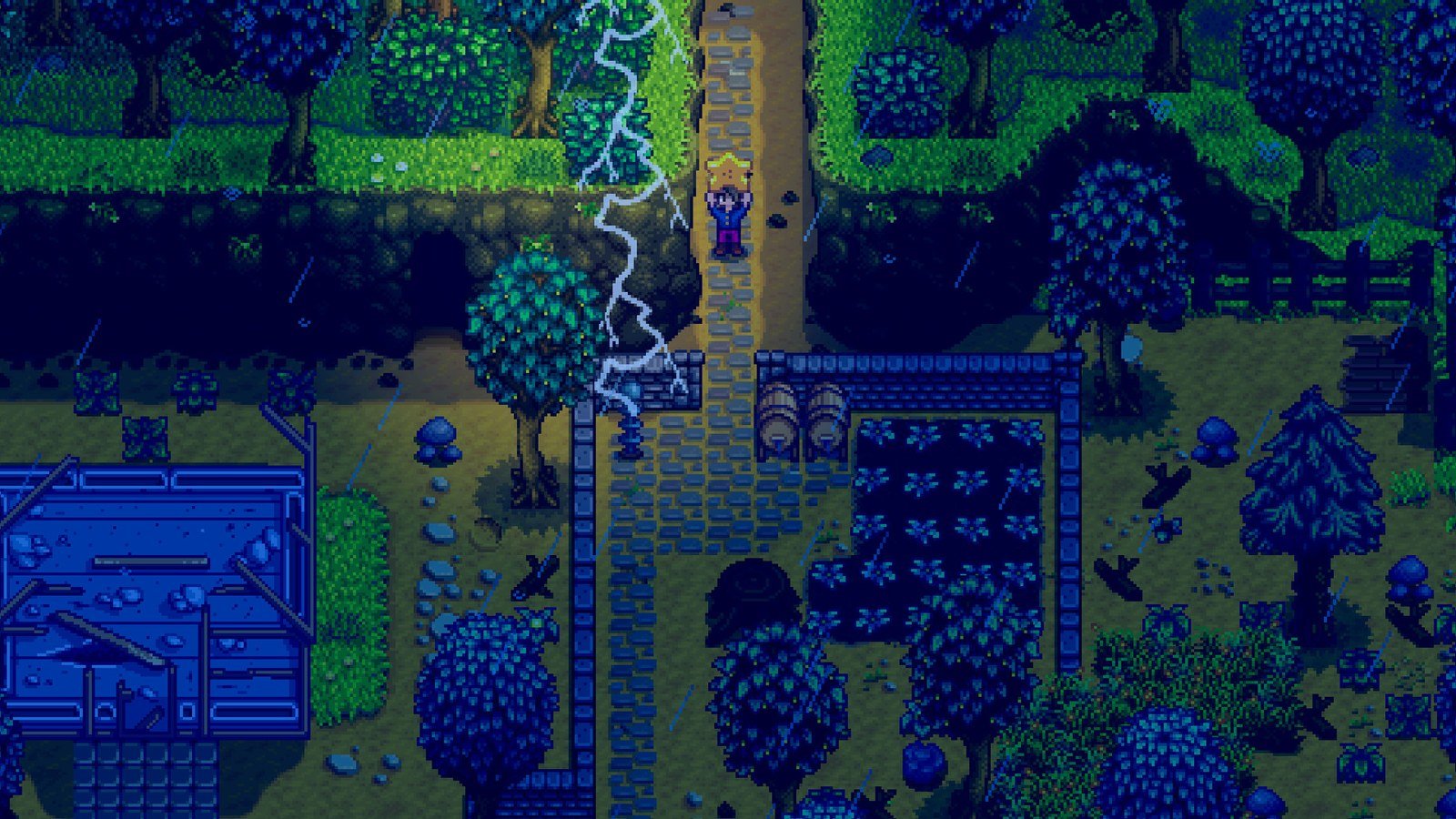
The loop: one more day, forever
The game’s heartbeat is the day. You wake with a full energy bar; watering, chopping, hoeing, fishing and fighting all spend it; food restores it and can add buffs. Sleep ends the day, tallies the shipping bin, and deals out a new morning. Time is organized into four seasons of 28 days, and crops are season-locked: plant blueberries in summer, water them daily, and harvest before the season turns or lose them.
What makes the loop hold for hundreds of hours is that there is no clock behind the clock. The Harvest Moon games Barone grew up on typically ended after about two in-game years, and he has said he kept Stardew Valley open-ended on purpose, specifically so players would not feel rushed. There is an evaluation of your farm in year three, and then the game simply continues. Deadlines exist inside days, never across years. The pressure is real but it is always the pressure you scheduled yourself.
Five skills and a farm that is secretly a build
Under the calm surface, Stardew Valley is a systems game. Five skills (Farming, Mining, Combat, Fishing and Foraging) level up through use, unlocking recipes and, at set levels, a choice between two professions that nudges your whole economy in a direction. Crops feed crafting, crafting feeds automation: sprinklers end the watering chore, furnaces turn mined ore into bars, and more than a hundred cooking and crafting recipes give every resource somewhere to go.
The mines are the second game hiding inside the first: a cave system of descending floors holding ore, gems and monsters, where you swap between pickaxe and weapon and the deeper floors pay out rarer materials. Fishing runs its own parallel economy, with seasonal fish tied to specific waters, bait, tackle and crab pots.
Two design decisions show Barone thinking like an analyst’s favorite kind of designer, one who argues with his own systems. Cooking, by his own account, was made deliberately unprofitable as an income source: food exists to give buffs that power the other activities, not to be a money printer. And there is no butchering farm animals, a mechanic he excluded on purpose, pushing the design toward naming and keeping animals instead of processing them. The cozy tone is not an accident of the art style. It is enforced by the math.
The fork at the center of town
Early on, the game presents its one big structural choice. The town’s Community Center sits ruined, and restoring it room by room means completing bundles: collections of crops, fish, forage and artisan goods gathered across seasons. The alternative is to buy a JojaMart membership and pay cash for the same town developments one by one, at which point the Community Center is converted into a Joja warehouse.
Same progression, two opposite philosophies, delivered as mechanics instead of dialogue. The bundle route pays in gathering, patience and community; the Joja route pays in the exact corporate currency the protagonist fled in the opening scene. It is the game’s whole theme compressed into a menu choice, and it quietly shapes a first year of play either way: chase the specific items the bundles demand, or optimize income and buy your way out.
Eight farms, eight different games
Before the first seed goes in the ground, Stardew Valley asks its most underrated design question: which farm? At save creation you pick one of eight maps, and the choice is permanent. The Standard farm offers the most raw planting space. Riverland bends the layout toward fishing. Forest feeds foraging and respawns hardwood. Hill-top embeds a small quarry. Wilderness turns the farm itself into combat ground at night. Four Corners splits the land into quadrants built for multiplayer. The Beach farm offers fishing and forage but its sandy soil refuses sprinklers, which rewrites the automation game entirely. Meadowlands, added in the 1.6 update, front-loads animal husbandry with a coop and two chickens from day one.
Most farming games treat the farm as a blank rectangle. Here the map is a build decision, a set of bonuses and handicaps chosen before you have any tools, and it is a big part of why no two long-running farms look alike.
A town of schedules
Pelican Town holds more than 30 characters, each with a daily schedule, a birthday the game expects you to learn, and a friendship track advanced through gifts and conversation. Twelve of them can be courted and married regardless of the player’s gender; a spouse moves into the farmhouse and pitches in with chores like watering and feeding animals, and the couple can have children.
The design trick is that the town runs whether you watch it or not. People walk their routes, the saloon fills on Friday nights, and festivals punctuate the calendar. The social layer is not a separate mode bolted onto the farming; it competes for the same hours and the same energy bar, which is what makes a day feel like a day.
1.5, 1.6 and the updates that never cost a cent
A decade of support is the other half of the story. Update 1.5, in December 2020, added Ginger Island, a full late-game region with its own year-round farm, the Volcano Dungeon and a new unlock currency in Golden Walnuts. Update 1.6, in March 2024, added the Meadowlands farm, a three-day Desert Festival, two fishing festivals, a summer “green rain” weather event, a Mastery Cave for maxed-out skills, and raised multiplayer from four players to eight (co-op had arrived back in 2018). Both updates were free, on a game that costs $14.99.
The market noticed. Barone’s official figures put the game at 41 million copies by December 2024, 26 million of them on PC and 7.9 million on Switch, and at 50 million by February 2026. When 1.6 launched, the Steam concurrent player count peaked at 236,614, an all-time record for a game then eight years old. Critics were there early: 89 on Metacritic for PC and a 90 Top Critic Average on OpenCritic.
My take
The analytical lesson of Stardew Valley is that “cozy” is a discipline, not a mood. Every system that could have added pressure was audited: no ending deadline, no butcher’s knife, no paid expansions, no monetized convenience. What remains is a game whose only real opponent is a single day, and whose rewards compound slowly enough that progress feels earned rather than granted.
It also redefined what one developer can be. Barone wrote the code, drew the art, composed the music and later took back his own publishing, then spent a decade updating the game for free while it sold 50 million copies. Studios with hundreds of people now pitch “Stardew-like” as a genre label. The genre is one man’s five-year project that refused to hurry its players, and then refused to hurry itself.
Sources
- Steam store page and Steam API, Stardew Valley (ConcernedApe): price, features, multiplayer count
- Wikipedia, Stardew Valley: release dates, development history, update contents, sales milestones
- ConcernedApe, official press page (December 2024): 41 million copies, platform split
- Official Stardew Valley Wiki: farm maps, skills, Community Center and Joja routes
- SteamDB: 1.6 launch concurrent player record
- Metacritic and OpenCritic: review scores cited in the panel above
The Checkpoint Poll
Leave a Reply