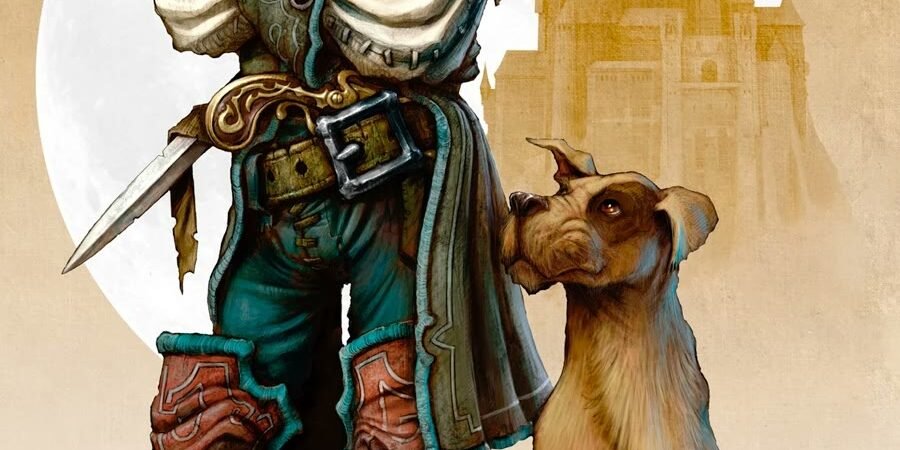
Most RPGs want to test you. Fable II wanted to move in with you. It gave me a dog, a mortgage portfolio and a halo, roughly in that order, and eighteen years later I still have not played anything that felt quite like it.
By Ruan Martini, Daily Checkpoint, November 1, 2026
There is a moment early in Fable II that tells you everything about the game. You are a street kid in Bowerstone, dirt poor, collecting a few gold coins with your sister Rose to buy a magic box that grants wishes. The wish goes wrong in the way wishes do. Rose dies. And within the hour the game hands you the single best companion in the history of the medium: a dog. No cutscene where a grizzled mentor explains your destiny. No chosen one ceremony. A dog finds you, decides you are his person, and from that second until the credits, that dog is the emotional operating system of the entire game. I have played RPGs with thousand page lore bibles that did not make me feel a fraction of what that dog made me feel by digging up a rubber ball.
With the new Fable dated for February 23, 2027, I went back to Albion in my head, and I realized Fable II is the game I measure cozy RPGs against. Not hardest. Not biggest. Warmest. So here is my love letter and my receipt book, all in one: what Lionhead promised in 2008, what actually shipped, the systems that made this game a second home, and where it stands now that its series is finally waking back up.
2008, Lionhead, and the Art of the Promise
Some context, because you cannot understand Fable II without understanding Peter Molyneux. Lionhead’s founder was famous for promising the moon in interviews: worlds that would grow with you, trees planted from acorns, rival heroes competing for your quests. The first Fable, in 2004, shipped as a good, short, charming game carrying the weight of a hundred promises it never made in its own marketing meetings. Gamers of a certain age still joke about the acorn.
Fable II, which launched on Xbox 360 in October 2008, was the redemption tour. The pitch this time was smaller and more human: a living Albion set 500 years after the first game, a hero who starts with nothing, a dog who loves you unconditionally, and a world where your choices show up on your face. And here is the thing that still surprises people: most of it shipped. The dog shipped. The economy shipped. The morality you could see in the mirror shipped. Reviewers noticed: Fable II sits at an 89 on Metacritic, it won the BAFTA for Action and Adventure, and it went on to sell more than 3.5 million copies, the biggest success the series ever had. Lionhead, for one shining autumn, had actually done it.
It also helps to remember what October 2008 looked like, because Fable II did not stroll into an empty field. That autumn was a war: Gears of War 2, Fallout 3 landing one week after Fable II, Dead Space, Mirror’s Edge, a new Call of Duty. The games industry was deep in its gritty era, all brown filters and space marines and serious men doing serious violence. Into that walked a game where you could win a crowd over by dancing, where the most important character had four legs, and where half the progression system was real estate. It should have been crushed. Instead it reviewed at the top of the pack and outsold almost everything around it that was not wearing power armor. Albion was the warm room in a cold year, and millions of us moved in.
The story it tells is simple in the way fairy tales are simple. Lord Lucien, the man who murdered your sister, is rebuilding an ancient tower called the Spire to remake the world. A blind seer named Theresa, who players of the first Fable will remember, sends you to gather three heroes: Hammer, a mountain of a monk with the strength; Garth, a mage with the will; and Reaver, a pirate king with the skill and absolutely no morals whatsoever, the funniest man in Albion and a strong argument that the series was always a comedy wearing an RPG costume. It is a revenge story, a family story and, by the end, a story about what you would trade to get one person back. Or one dog. We are getting to the dog.
The Dog Deserved His Own Section, So He Gets One
Your dog is not a pet system bolted onto an RPG. He is the interface. He sniffs out dig spots and buried treasure, so exploration becomes following an excited animal instead of sweeping a map with your eyes. He growls when enemies are near. He finishes off wounded bandits, which sounds dark until you remember the bandits started it. He learns tricks. He gets hurt in fights, limping until you heal him, and the first time it happens you stop caring about the quest entirely, which is the most honest piece of game design I have ever seen: the game understood exactly what you would protect, and it was not the kingdom.
And then the ending makes you pay for loving him. Spoiler warning for a game from 2008, and if you have waited eighteen years that is on you. At the Spire, the game offers you one of three rewards. Sacrifice: the thousands of workers who died building the tower come back to life, and you are a legend nobody in your house will ever thank you for. Wealth: a mountain of gold, more money than the economy section below could ever spend. Or Love: your murdered family comes back. And your dog comes back, because Lucien shot him too, because Lucien understood game design as well as Lionhead did. The internet has argued about this choice for eighteen years. The statistics of the heart are not complicated: almost everybody picks the dog. Fable II’s final boss was not Lucien. It was a multiple choice question about a dog, and it has a near perfect win rate against the human soul.
I Became Albion’s Landlord, and the Rent Paid for Everything
Now the system nobody puts on the box art and everybody remembers: in Fable II, you can buy almost everything. Every house in Albion has a price. Every shop, every stall, every tavern. Buy a house and you can live in it, decorate it, or rent it out. Buy a shop and the money it earns drips into your pocket at regular intervals, and the game keeps counting while you are out questing, so you come back from saving the world to find your tenants have funded your new sword. Buy enough of Bowerstone and the economy starts bending around you: set your prices and rents low and the town loves you and the shops flourish; jack them up and you get rich on a population that increasingly looks at you the way people look at weather.
I will confess my own playthrough honestly: somewhere around the middle of the story, saving Albion quietly became a side quest. The main quest was property. I had a system. Jobs first, blacksmithing and bartending in little rhythm mini games that paid insultingly small gold per shift, then flipping cheap houses in the gypsy camp and Bower Lake, then the Bowerstone shops, then the big houses in Old Town, and finally, the crown: Castle Fairfax itself, the villain’s own castle, on the market for a cool one million gold after the main story, complete with a throne room and a bed that grants you bonuses for sleeping in it like the royalty you now legally are. I defended Albion from an ancient evil mostly so the real estate market would stay stable. Lucien wanted to remake the world. I wanted to own the world at a fair monthly yield. We were not so different, he and I. I was just better at it, and my tenants had a dog to play with.
The houses were not just income either. Furniture mattered: fill your home with a decent bed and quality pieces and sleeping there handed you real bonuses, so even my interior decorating had a stat sheet. Trophies from your kills could go on the walls. A spouse could move in and have opinions about the neighborhood, the budget and you. It was a life simulator wearing an RPG as a coat, years before every second game started bolting on a homestead. And if a friend wanted to see your empire, drop in co-op let them walk your Albion beside you as a hired henchman, tour the properties, and watch you collect rent like a feudal landlord with a sword. My Albion tours were not optional content for my friends. Attendance was taken.
No other RPG has let me do this since. Games give you a house. Fable II gave you a housing market, a reputation attached to it, and the freedom to be a beloved landlord saint or a rent gouging demon, and it tracked which one you were becoming in your actual face.
Good and Evil, Done in Small Change
That is the other thing Fable II understood: morality is mostly small. The game tracks two dials, good versus evil and purity versus corruption, and corruption is the genius one, because you do not earn it by kicking puppies in a cutscene. You earn it in the economy of everyday life. Eat meat pies instead of tofu, corruption. Charge your tenants above the fair rate, corruption. Set your shop prices to gouge the poor, corruption. Meanwhile purity is celery, fair rent, and gifts. Your body keeps the score: a pure, good hero stands straight with a halo and a dog of matching virtue; a corrupt, evil one grows horns, gains weight, attracts flies and watches villagers cross the street. Children point. Spouses file for divorce, and yes, you can get married, have kids, and absolutely ruin it all, the game tracks that too.
The expression system deserves a sentence in the history books: at any moment, for any reason, you could fart in a crowded market, dance, pose, laugh, or play sock puppet theatre for a child, and the world reacted with a little opinion meter over every head. It sounds stupid because it is stupid, joyfully, deliberately stupid, and it made Albion feel like a place where people had feelings about you between the battles. Modern games simulate crowd panic. Fable II simulated crowd embarrassment. I know which one I have thought about more in eighteen years.
Combat That Respected My Time
Here is the part that would get me yelled at in a modern comments section, so let me say it carefully and then say it louder: Fable II is easy, and the easy is the point. Combat runs on three buttons, one for your sword, one for your gun, one for your magic, and it flows between them without menus or stamina bars or a build guide open on a second screen. You cannot truly die. Get knocked out and you lose some floating experience orbs and wake up with a new scar, which the game counts as character development. There are no failure screens, no corpse runs, no boss who asks you to memorize nine phases after a work shift. The game wanted to know if you were having a nice evening, not whether you had suffered enough to deserve one.
I love a hard game when hard is the art. This site is not anti challenge. But Fable II is my standing proof that a game can be generous with the player’s time and still be unforgettable, because what you remember eighteen years later is never the fight you retried eleven times. It is the dog, the house, the horns you grew by accident through aggressive pie consumption. Playground Games has said the new Fable will not demand a hundred hours, in line with the original trilogy, and every time I read that quote I think of this game and nod like a man whose landlord just lowered his rent. If you want the full rundown of what the reboot is promising, it is in my Fable 2027 release piece, and the rest of the 2027 pile up lives in our Coming Soon coverage.
The Receipts, and the Long Sleep
The numbers, for the record: released October 2008, Xbox 360 only, an 89 on Metacritic, a BAFTA on the shelf, more than 3.5 million copies sold, two expansions (Knothole Island and See the Future) that added new lands, new quests and, crucially, a way to bring the dog back for the people who chose wrong at the Spire. Fable III followed in 2010 and pushed the landlord fantasy all the way to the throne, with a mixed reception I will defend on another day. Then the series went quiet. Lionhead closed its doors in 2016, and Fable slept for a decade, kept alive by players like me telling younger gamers about the dog.
Today the game is easy to revisit: Fable II runs on modern Xbox hardware through backward compatibility, with a frame rate boost on Series X|S that smooths the old Albion wobble, and it sits in the Game Pass catalog for subscribers. It looks like a 2008 game, because it is one, and I find I do not care at all. The charm was never in the polygon count. It was in a town that knew my name, charged me nothing for the privilege, and paid me rent.
One Last Walk Before February
So here is my plan, and my recommendation, and they are the same thing: replay Fable II before February 23, 2027. Not for homework. For calibration. The reboot will be bigger, prettier and funnier in 4K, but its soul will be judged against a 2008 game where the most powerful system was kindness with a cash register attached. If Playground’s Fable makes me feel even half of what I felt buying my first terrible little house in Bowerstone Old Town while a dog I would die for dug up treasure in the yard, then the great escape from GTA 6 will have been worth every day of the wait.
Tell me I am not the only one: did you pick the dog at the Spire? Be honest, this is a safe space, and the other two options are sitting right there in gaming history being wrong forever. And if you are replaying it too, I want your landlord report. Which town did you own first?
Sources
Fable II release, reception and sales: Metacritic score of 89; BAFTA Games Award for Action and Adventure, 2009; lifetime sales of more than 3.5 million copies as stated by Peter Molyneux in 2010. Story, companion heroes, the Spire ending choices, the property and economy systems, the morality and expression systems and the Knothole Island and See the Future expansions per Lionhead’s Fable II and its official materials. Lionhead Studios closure, 2016, per Microsoft. Backward compatibility and FPS Boost availability per Xbox. New Fable date and details per Xbox and Playground Games, covered in the Daily Checkpoint Fable 2027 release article.