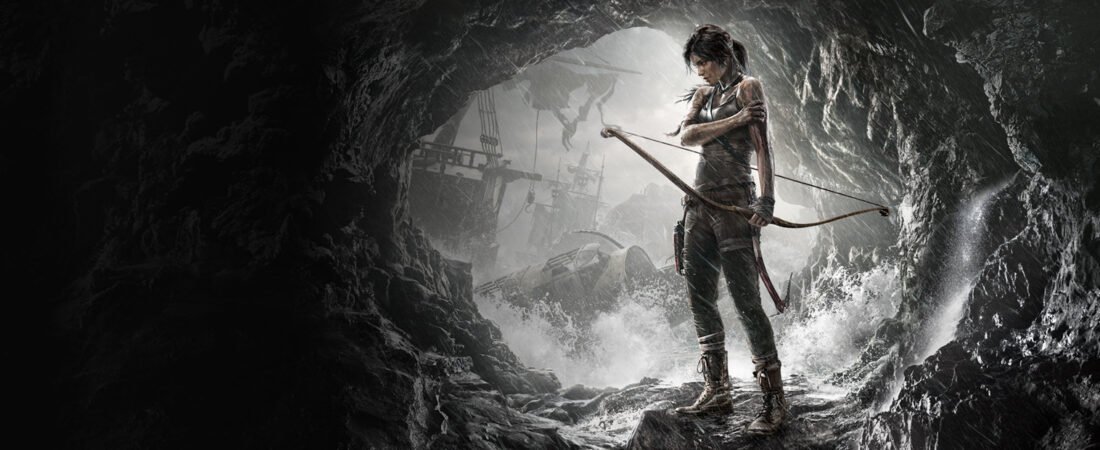
Everybody remembers the Lara who never blinked. This is the story of the one who was terrified, bleeding and seasick, and somehow carried a dying franchise back to the top of the charts on her back.
By Ruan Martini, Daily Checkpoint
I want you to picture my copy of Tomb Raider the way I still see it. Not the icon on a launcher. The game I actually played, the one where Lara Croft spends the first hour crying, shivering, impaled on a spike and apologizing to a deer. In 2013 that felt like vandalism. Lara was supposed to be the most confident character in games, a woman who backflipped over dinosaurs in a swimsuit and never once checked if the door was trapped. Crystal Dynamics took that icon, made her twenty one years old, put her on a boat she had no business being on, and sank the boat.
It is one of my favorite games of its generation, and I will tell you exactly why, because with Lara coming back in February in Tomb Raider: Legacy of Atlantis, this is the other origin story, the modern one, and it is the perfect thing to replay before she goes home to 1996.
First, Remember How Dead This Series Was
People forget the stakes, so let me dig them up. The original Tomb Raider run ended in embarrassment with The Angel of Darkness in 2003, a game so troubled it got its own developer, Core Design, taken off the series. Crystal Dynamics revived Lara with the Legend trilogy, and Legend in 2006 was genuinely good, but each sequel sold a little less than the one before, and by the end of the decade the most famous woman in gaming was a nostalgia act. The industry had moved on. Nathan Drake was eating her lunch in the exact genre she invented, and he was doing it with better jokes.
So Square Enix and Crystal Dynamics made the bravest call available to them: burn the icon down and start before the beginning. Not a sequel. Not a remaster. A first expedition, with a Lara who had never killed anyone, never raided anything, and did not want to be there. Writer Rhianna Pratchett built her as a person first and a legend eventually. Camilla Luddington gave her a voice that cracked when it needed to. The marketing tagline was three words long and it was a promise: a survivor is born.
The Island Does Not Care About You
The setup is lean and perfect. Lara, fresh out of university, joins the expedition ship Endurance hunting the lost kingdom of Yamatai, somewhere in the Dragon’s Triangle off Japan. Her mentor figure is Conrad Roth, an old friend of her father’s. Her best friend Sam is aboard as the documentary filmmaker. Then the storm hits, the ship splits in half on the rocks, and the game spends its next twelve or so hours teaching you what survival actually costs.
Yamatai is ruled by a dead queen, Himiko, whose rage supposedly drives the storms that trap every ship and plane that wanders in, and it is patrolled by the Solarii, a cult of castaways led by Father Mathias, a man who has been shipwrecked so long he turned the island into a religion. It is a great pulp setup, but what sold it in 2013 was the texture. The island is a junkyard of history: Portuguese wrecks, Second World War bunkers, a thousand years of people who arrived and never left. Every area tells you the same thing in a different century’s handwriting. Nobody gets out.
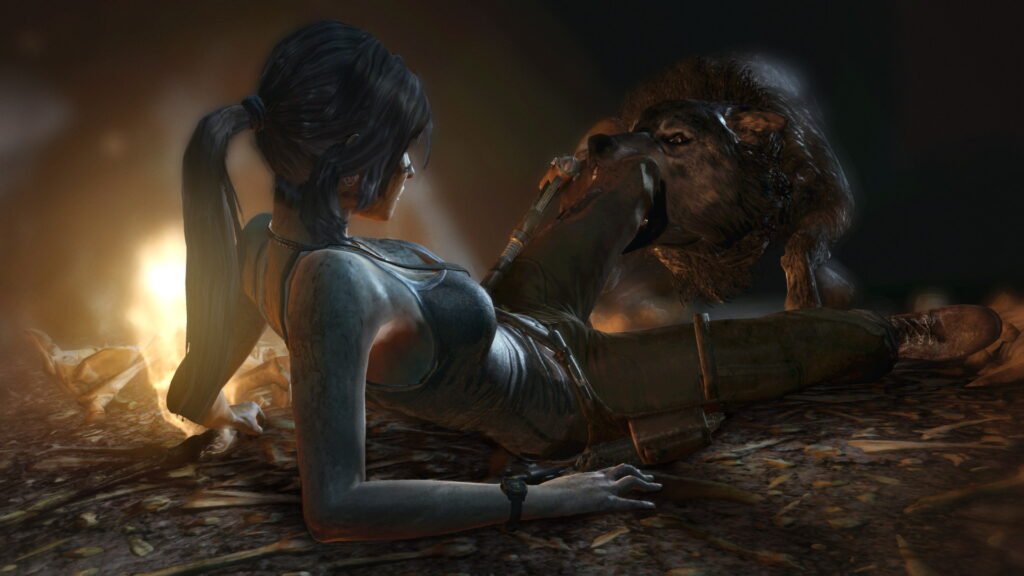
And then there is the first hour, which I will defend as one of the best opening hours in the medium. Lara wakes up hanging upside down in a cave of bones. She escapes by setting her own prison on fire and falling onto a metal spike, and the game makes you pull it out. Minutes later comes the first kill, a desperate, ugly, close up struggle that leaves her shaking over the body saying she is sorry. Compare that to the old Lara, who treated human life like a coin slot. This game wanted every death, hers and theirs, to weigh something. The famous deer hunt right after, where she whispers an apology before her first shot, is the thesis of the whole reboot in one scene: the bow is not a toy, eating is not free, and the island is going to charge her for everything.
The Bow Changed Everything
Underneath the cinema, 2013 quietly rebuilt how a Tomb Raider plays, and most of the series still runs on this blueprint.
The makeshift bow became Lara’s signature weapon, silent, craftable, upgradeable, and it taught the game’s whole rhythm: hunt animals for the salvage economy, spend salvage on better gear, use better gear to reach places the story had locked behind fire arrows, rope arrows and a stronger climbing axe. Base camps stitched it together, fast travel, skill points, weapon parts, a quiet minute by the fire before the island resumed trying to kill you. The skill trees split into Survivor, Hunter and Brawler, which in practice meant you got to choose what kind of problem solver your Lara became. None of this was revolutionary on paper. In Lara’s hands, in 2013, it felt like the series had finally joined the modern era without selling the tomb raiding soul to do it.
One honesty corner, because a retrospective that only praises is just an advertisement wearing a fake beard: the game also shipped with a competitive multiplayer mode, built by Eidos Montreal, in which survivors and Solarii shot each other on small maps with the game’s traps and ziplines bolted on. It was not terrible. It was simply unnecessary, a 2013 checkbox from the era when every single player game was legally required to pretend it was a multiplayer platform. The servers are a ghost town now and history has quietly swept it under the rug, where it keeps the franchise’s few other experiments company. The campaign never needed it, and the campaign is what we are all still talking about.
Because the tombs were still there, and they were treated with respect. Scattered off the main path sat the optional challenge tombs, single room physics puzzles with names like Tomb of the Unworthy, each one ending with that wonderful little musical sting and the two best words in the game: tomb raided. They were short, clever and completely missable, which somehow made them feel more like real secrets than any checklist collectible has since. When people ask me what modern Tomb Raider got right first, I do not start with the graphics. I start with a hidden room, a counterweight puzzle and a treasure chest that only about half the players ever found.
Cinematic, Yes. Cruel, Never.
Here is the part of this game I have come to appreciate more with every passing year, and it is the part nobody put on the box. Tomb Raider 2013 is a blockbuster that respects your time, your hands and your blood pressure.
Context matters. This game arrived in the middle of the Souls era, when a loud part of the industry had decided that punishment was the same thing as quality, that a game earned your respect by wasting your evenings. Tomb Raider looked at that trend and politely declined. Its checkpoints are generous to a fault; die in a set piece and you are back inside seconds, before the frustration can even form. Its Survival Instinct vision lights up every climbable ledge, every rope anchor, every collectible glint, so the game never once asks you to pixel hunt your way through a tomb. Combat is tuned to be survived: cover is plentiful, the dodge roll is forgiving, the bow forgives your aim the way a good friend forgives your cooking. Quick time events ask for one clear button, pressed like you mean it, not a twelve input exam. The game is cinematic in the best sense of the word. It wants the scene to land. It wants you to reach the next camp, the next tomb, the next terrible thing the island does to this poor kid. It is a roller coaster, not a locked door, and it never confused the two.
I say this as somebody who loves plenty of hard games: there is a specific joy in a big adventure that simply flows, that trusts momentum and story more than it trusts your willingness to repeat a boss for two evenings. The series only leaned further into that philosophy from here, until by Shadow of the Tomb Raider in 2018 you could tune combat, traversal and puzzles as separate difficulties, which remains the smartest difficulty menu anybody has ever shipped. But the DNA of that kindness is already all over the 2013 game. It wanted everyone who started Lara’s story to finish it. Most of them did, and then they told their friends, which is how you get to what happened next.
The Sales Drama, or How to Be a Hit and a Flop in the Same Month
No retrospective of this game is honest without the funniest subplot in the whole story, because Tomb Raider 2013 managed to be a record breaking triumph and an official disappointment at the same time, and both things were documented in public.
The launch was enormous. More than a million copies in under forty eight hours. The biggest launch in the history of the franchise, number one in the UK, France and the United States, a record debut that more than doubled the opening of Tomb Raider Legend. Within a month it had sold 3.4 million copies at retail. And then, on March 26, 2013, Square Enix announced that the game had failed to reach its sales targets. Failed. With 3.4 million copies in a month and a franchise record in its pocket. The publisher was having a brutal financial year, its president stepped down, and Western games like Tomb Raider were named among the titles that had missed their internal numbers. The targets, it turned out, had been set somewhere in the stratosphere, and the atmosphere up there is apparently very thin on logic.
The long tail told the true story, the way it usually does. By the end of 2013 the game had turned profitable. In January 2014 the Definitive Edition brought it to PlayStation 4 and Xbox One with rebuilt visuals and every piece of extra content, and it went straight back to number one in the UK. In April 2015, Crystal Dynamics confirmed what the charts had been whispering: at 8.5 million copies, Tomb Raider 2013 was the best selling game in the entire history of the franchise, past every classic, past every sequel. By late 2017 the count had passed 11 million, and the game kept selling for years after that. The flop, ladies and gentlemen, outsold every Tomb Raider ever made. There is a lesson in there about expectations, and Square Enix’s old management learned it the expensive way so the rest of us could learn it free.
The Trilogy It Built, and the Lara It Left Us
A reboot earns its keep in the sequel column, and this one built a whole era. Rise of the Tomb Raider followed in 2015, Siberia, a secret city, the same bow and a bigger, colder sandbox, and it sold millions despite spending its first year as an Xbox timed exclusive. Shadow of the Tomb Raider closed the trilogy in 2018, taking Lara to the hidden city of Paititi in Peru and finishing the origin arc this game started: the frightened graduate of Yamatai, fully become the tomb raider. The 2018 film with Alicia Vikander built its Lara directly out of the 2013 game, down to the island, the bow and the climbing axe. Camilla Luddington’s Lara became the default Lara for an entire generation of players, the same way the 1996 original had defined her for mine.
And the game knew exactly what story it was telling, right down to its final shot. For twelve hours, the reboot refuses to give Lara her signature dual pistols. She gets the bow, the axe, the rifle, one battered handgun, everything except the pose on the 1996 box. Then, in the last playable moment on that beach, cornered by the final wave, she picks up a second pistol and stands in the stance a generation grew up with, and the game cuts to black. I have seen that scene described as fan service. It is not. It is a graduation ceremony. The whole game is the price of that pose, and the pose means ten times more because you watched her pay for it.
Notice the thread that runs from that shipwreck to next February. Crystal Dynamics has now opened Lara’s story twice, once in 1996 with the confident original and once in 2013 with the terrified reboot, and Legacy of Atlantis is them going back to weld the two together. Having replayed the 2013 game recently, I can tell you the weld has good metal to work with. The young Lara of Yamatai is the most human the character has ever been, and the game around her threads a needle most reboots miss completely: it honors what the icon was by showing you what she cost.
Why You Should Replay It Before February
Practical advice, friend to friend, because that is what this site is for. Tomb Raider 2013 is cheap everywhere, the Definitive Edition is the version to grab, and the whole adventure runs at a humane length, a focused weekend rather than a second job. It still looks handsome, it still plays smooth, and the opening hours hit just as hard as you remember. Play it before Atlantis lands and you will walk into February with both origin stories in your head, watching a studio remix its own two beginnings into one Lara. That is a genuinely rare thing to get to witness in this industry, and it costs about the price of a pizza.
And if you want the full board of what February is throwing at us, Metro, God of War, Persona, Fable and Lara in a three week knife fight, keep an eye on our Coming Soon coverage, because I intend to survive that month and document the casualties.
So tell me: are you team 1996, team 2013, or are you letting Atlantis settle the argument in February? I already know my answer. A survivor is born, indeed. She just needed a boat crash, a bow and a studio brave enough to let her be scared first.
Sources
Sales milestones and the 2013 expectations story: GameSpot’s reporting on the 4 million and 8.5 million announcements, Square Enix’s March 2013 statements via the fan and press record, and GamesIndustry.biz on the 11 million figure reported in 2017. Development and casting details: Crystal Dynamics and Square Enix materials, Rhianna Pratchett interviews. Release history and the Definitive Edition: publisher announcements and UK chart reporting from PlayStation Lifestyle and MCV. Game details verified against the Tomb Raider (2013) Steam store page.
The Checkpoint Poll
Leave a Reply