Some sequels add content. Origins subtracted something instead: it subtracted a year. The most important feature of the great Assassin’s Creed reboot is a gap in the calendar, and everything good about the modern series grew out of that empty space.
By Ruan Martini, Daily Checkpoint, November 1, 2026
I have a soft spot for Assassin’s Creed II that borders on a personality trait, so believe me when I say this with love: by 2015, this series was running on fumes. The games were still fun. The cities were still gorgeous. But somewhere between the third rooftop chase of the week and the fourteenth tailing mission of my life, the magic had become a routine, and routines do not sell like revelations do. Ubisoft could feel it too. What they did next is the reason we are still talking about this franchise in 2026: they stopped. No mainline game in 2016. Then, in October 2017, they came back with ancient Egypt, a grieving father named Bayek, and a game that quietly rebuilt Assassin’s Creed from the ground up.
First, Remember the Hole the Series Was In
The timeline matters, so let us lay it out honestly. From Assassin’s Creed II in 2009 onward, Ubisoft shipped a new mainline entry every single year, sometimes two. That machine produced genuine classics, and it also produced Assassin’s Creed Unity in 2014, a Paris so ambitious it launched half finished, with bugs so famous they became memes before memes were even the default language of gaming. Unity was eventually patched into a good game, but the damage was done. Assassin’s Creed Syndicate arrived in 2015, and Syndicate is honestly charming, all Victorian London and train heists, yet it posted the weakest sales of any mainline entry apart from the smaller Rogue spinoff. The audience was not angry. The audience was tired, which is worse. Angry people come back to yell at you. Tired people just quietly play something else.
Ubisoft’s answer sounds simple and was, at the time, almost unheard of for a series this size: the machine stops for a year. 2016 came and went with only the smaller Chronicles spinoffs. Behind the scenes, Ubisoft Montreal had actually been building the Egypt game for far longer than one extra year. Development ran roughly four years under director Ashraf Ismail, the man who had steered Black Flag, and the long runway shows in every system of the finished product. They were not making another annual sequel with a new coat of paint. They were making the series again.
Egypt Is Not a Backdrop Here. It Is the Main Character.
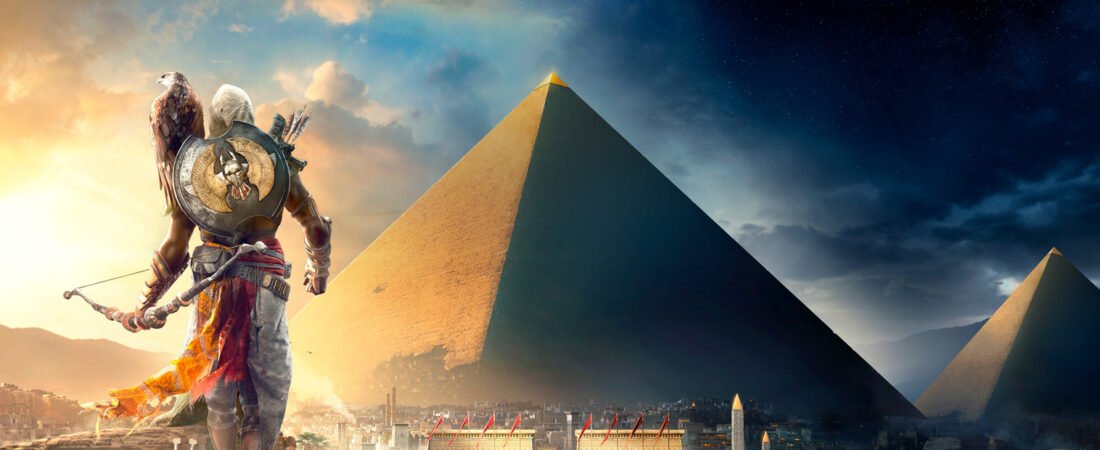
Players had been begging for ancient Egypt for years, the way you beg for something you are half convinced will never happen. Origins delivered Ptolemaic Egypt in the first century BC, the era of Cleopatra and Caesar, and it treated the setting with a respect that still catches me off guard. You can climb the Great Pyramid of Giza and slide down its face. You can sail the Nile, walk through Alexandria with its lighthouse standing over the harbor, hunt hippos in the river reeds, and cross deserts so empty that the heat haze becomes a gameplay feature. The map mixes dense cities, farmland, swamps, tombs and open sand into one continuous place, and it never feels like a theme park version of Egypt. It feels like a country that was already old when Rome was young.
Then Ubisoft did something no other blockbuster studio was doing: they turned the whole world into a classroom. In February 2018, a free mode called Discovery Tour: Ancient Egypt removed the combat and the story and replaced them with guided tours built with historians and Egyptologists, covering everything from pyramid construction to daily life and mummification. Teachers used it in actual classrooms. I have played hundreds of open world games, and I can count on one hand the ones that trusted their world enough to stand on its own without a single sword fight. Egypt carries that mode easily. That is how good the homework was.
The official key art: Bayek of Siwa, a shield on his back and ten thousand years of history in front of him. Image: Ubisoft.
Bayek, the Father the Series Needed
Everything above would have made Origins a strong comeback. Bayek made it a beloved one.
Bayek of Siwa is a Medjay, one of the last of an old order of protectors, and when we meet him he is a man hollowed out by grief. His young son Khemu was killed in an attack connected to a masked conspiracy, and the game that follows is a revenge story with a broken heart beating underneath it. His wife Aya serves as an agent of Cleopatra, and their marriage, loving, strained and slowly coming apart under the weight of what they have lost, is the emotional spine of the whole game. There is no cool detachment here. Bayek laughs with children in villages, loses his composure in tombs, and carries his sadness in his voice.
That voice belongs to Abubakar Salim, who was in his early twenties when he took the role and later admitted he was terrified the reboot would fail and he would be remembered as the man who killed Assassin’s Creed. Instead, his performance earned him a BAFTA nomination and put Bayek straight into the top tier of series protagonists, in the same conversations as Ezio Auditore. Ezio got three games. Bayek got one, and one was enough to make him immortal. There are side quests in Origins where Bayek simply helps ordinary people, a lost child, a farmer, a mad hermit, and those small mercies do more for the character than any cinematic. He is a protector first and an assassin second, which is exactly right, because the story is secretly about him inventing what an assassin is supposed to be.
That is the other masterstroke of the writing: Origins is a prequel to the entire franchise. Bayek and Aya, hunting the conspiracy that took their son, end up founding the Hidden Ones, the order that centuries later becomes the Assassin Brotherhood of Altair and Ezio. The creed, the hidden blade, the leap of faith mythology, all of it starts here, with two grieving parents deciding that nobody else should have to feel what they felt. When the logo finally forms at the end, it does not feel like branding. It feels like a gravestone and a birth certificate at the same time.
The Day the Creed Learned New Tricks
For all the heart, Origins was also a mechanical earthquake, and some old fans still have not forgiven it. Let us be precise about what changed.
The old counter based combat, where you stood in a circle of polite enemies waiting their turn to die, was thrown out completely. Origins uses hitbox based combat with light and heavy attacks, dodges, parries and shields that actually matter, and fights can genuinely kill you if you wander into a camp above your level. Gear now has levels and rarity tiers. There is a proper skill tree, split between hunter, warrior and seer paths. Your eagle Senu replaces the old floating eagle vision with a scout you physically fly over camps and ruins, and half the pleasure of the game is that bird’s eye planning before a strike. Origins was even the first game in the series to offer difficulty settings, a small feature that says a lot about the new philosophy: the world would be bigger and harder, so the player got more control over the terms.
Was everything an improvement? Honestly, no. The level gating could wall off main story missions until you had done enough side content, and that padding habit would grow into the series’ most argued about trait in later games. But in 2017, the dominant feeling was not resentment. It was relief. The series felt dangerous and new again, and the RPG elements arrived in a measured dose that still left room for stealth, parkour and the hidden blade to matter.
The Receipts
Comeback stories are cheap, so let us grade this one with the numbers Ubisoft itself reported. In its first ten days, Origins sold double what Syndicate had sold in the same window on a comparable basis, with a much bigger share of those sales happening digitally, 35 percent against Syndicate’s 15 percent. CEO Yves Guillemot, a man not usually given to understatement, declared on the earnings call that the series was, in his words, officially back. Reviews landed where a relieved fanbase hoped they would: generally favorable across the board, with an 85 aggregate on OpenCritic and Metacritic scores in the low to mid 80s depending on platform, praising the world, the reinvention and Salim’s performance.
The long game matters more than the launch, and there Origins kept winning. By March 2020, Ubisoft reported that Origins had passed ten million copies sold, a figure it shares with its successor Odyssey, and a number nobody was predicting for this series in the Syndicate autumn of 2015. Its story expansions held up their end too: The Hidden Ones took an older, sadder Bayek to the Sinai, and The Curse of the Pharaohs sent him to Thebes to fight undead kings in the afterlife, because even the respectful reboot knew how to have fun.
Where It Stands Now
Time has been kind to Origins in a way it is not kind to most annual sequels. Ubisoft kept tending it: in June 2022, years after launch, PS5 and Xbox Series players got a 60 frames per second update, and the game at that speed is the version I tell people to play today. In fan rankings of the series, Origins has settled permanently into the top tier, usually staring across the table at Ezio’s games and Black Flag. The RPG formula it introduced carried Odyssey and Valhalla to enormous sales, which means Origins is not just a good game in the series. It is the foundation the entire modern era stands on, and its shadow is so long that when Ubisoft later marketed Mirage as a return to the classic style, they were really marketing a reaction to the world Origins created.
And still, the fans keep asking for the one thing Ubisoft will not give them. Salim has said the fear never fully left him, and players have spent years campaigning for a Bayek sequel, an Ezio style trilogy, an Aya game in Rome, anything. It has never come. Maybe that is fine. Ezio needed three games to become a legend. Bayek needed one game, one pyramid, and one impossible standard: that a story about revenge could end with two people choosing to protect strangers instead. Assassin’s Creed took a year off and came back with its soul. Publishers rarely learn the lesson sitting inside that sentence, which is that rest is a feature, not a delay. Origins is the proof, pressed in gold, that they should.
My take: I rank Origins as the most important game in this series after Assassin’s Creed II, and some days, when the light in the Alexandria harbor hits just right, I wonder if it is not quietly the best one. It respected Egypt, it respected the player’s intelligence, and it respected its own hero enough to let him be a father before he was a logo. If you play one RPG era Assassin’s Creed, play this one, play the Discovery Tour after, and then come back and tell me Bayek does not deserve a second game. I will wait. I have been waiting since 2017 anyway.
Sources
Release date, platforms and development history (Ubisoft Montreal, directed by Ashraf Ismail, roughly four years in development): Ubisoft and the game’s official store listings, October 27, 2017.
Launch performance (first ten days sales double Syndicate on a comparable basis, 35 percent digital share, and Yves Guillemot’s “officially back” remark): Ubisoft first half 2017 to 2018 earnings reporting, covered by GameSpot, November 8, 2017.
Lifetime sales milestone (Origins past ten million copies by March 2020, reported alongside Odyssey): Ubisoft fiscal year 2019 to 2020 results, May 2020.
Reception aggregates (85 on OpenCritic, Metacritic scores in the low to mid 80s by platform): OpenCritic and Metacritic game pages.
Abubakar Salim on his fear of failing the series, his BAFTA nomination for the Bayek performance, and continuing fan demand for a Bayek sequel: TheGamer interviews and reporting, 2024 and 2025.
Discovery Tour: Ancient Egypt (free educational mode with guided tours, February 2018) and the June 2022 update adding 60 frames per second on PS5 and Xbox Series consoles: Ubisoft official announcements.