Some games end. This one said goodbye, twice, in two different centuries, and then an animated short film came along and finished what was left of my heart. Fifteen years later, this is still the standard every series finale gets judged against in my house.
By Ruan Martini, Daily Checkpoint
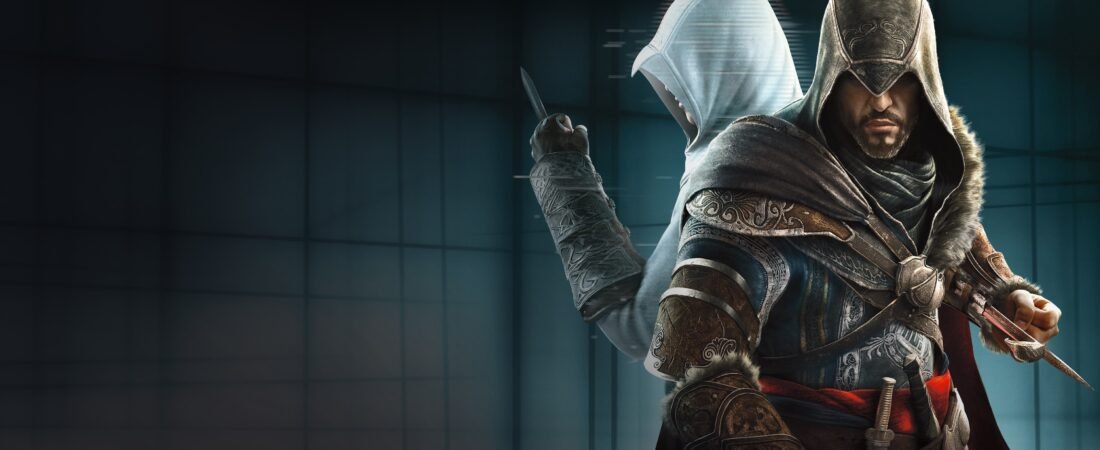
Ezio in front, Altair behind him, the two men who built this series sharing one piece of art for the first and last time. Image: Ubisoft.
Let me set the scene for November 2011, because context matters here. Ezio Auditore was not just a protagonist by then. He was the reason Assassin’s Creed survived its awkward first game and became a phenomenon. Assassin’s Creed II had turned a charming Florentine disaster of a young man into the most beloved character Ubisoft ever made, and Brotherhood had kept him around for an encore in Rome. So when Ubisoft announced Revelations, the pitch was genuinely terrifying in its ambition: one game would close Ezio’s story AND the story of Altair, the original assassin from 2007, AND move Desmond’s modern day plot toward its endgame. Three endings. One disc. If they fumbled it, they fumbled the whole legacy.
They did not fumble the goodbye. They fumbled some other things, and we will get to those, because this is still a receipts site. But the goodbye? The goodbye is perfect. Revelations launched on November 15, 2011, it reviewed at a solid 80 on Metacritic, and Ubisoft reported close to 7 million copies shipped by February 2012, the seventh best selling game of 2011 on the whole planet. Respectable numbers. Forgettable numbers, even. Nobody remembers the numbers. Everybody remembers an old man in a library, talking to a ghost.
The Promise: Two Funerals and a Locked Door
The setup is the cleanest in the whole series. Ezio, now in his early fifties, gray in the beard and slower in the temper, travels to Masyaf, the old Assassin fortress from the first game, hunting for the library of Altair Ibn La’Ahad. Altair sealed that library behind a door that needs five keys, and the keys have scattered to Constantinople. So Ezio goes to the crossroads of the world in 1511, where the Ottoman Empire is tearing itself apart over a succession fight, where the Byzantine Templars are digging in the shadows, and where a bookseller named Sofia Sartor is about to become the most important person in Ezio’s life for reasons that have nothing to do with keys.
Meanwhile, in the modern day, Desmond is in a coma, trapped inside the Animus itself after the brutal ending of Brotherhood, rebuilding his shattered mind on a strange digital island with only the voice of Subject 16 for company. Every layer of this game is a man trapped somewhere, trying to get out by understanding the men who came before him. The structure sounds complicated written down. In play, it feels like a set of nesting dolls, and every doll is sadder than the last.
Altair, the Co-Star Nobody Expected to Cry Over
Nobody saw this one coming, me included. Altair was the least loved protagonist in the series. The original game’s Altair was a stiff, arrogant master assassin with a voice acting performance that launched a thousand forum arguments. Revelations performs a small miracle with him: every key Ezio finds carries one of Altair’s memories, and we play that man’s entire life in fragments. We see him young and brilliant and insufferable. We see him lose his wife and his youngest son to the order’s own politics. We see him exiled, we see him return as an old man and take his brotherhood back in one of the coldest scenes the series ever shot. And we see him at the very end, an ancient man in Masyaf, sealing the library, sitting down in a chair in the dark with the Apple of Eden in his lap, and simply stopping. The lights go out one torch at a time. It is one of the bravest death scenes in games, because nothing happens in it. That is the point. Nothing happens, forever, until Ezio walks in 300 years later.
When Ezio finally opens that library, he finds Altair still sitting there. And Ezio, this man who has spent three games talking to everyone, sits down and talks to Desmond, a man he cannot see, across five centuries, because a vision showed him he was only ever a messenger. He takes off his weapons. He leaves the hidden blade on the floor of the library. He walks out unarmed, into a life. I have played this ending maybe six times across fifteen years and three console generations. It works every single time. This is the game that taught me a video game character could retire, that an ending could be a man choosing to be done, and I have been chasing that feeling in every finale since.
Constantinople, the Hookblade, and a Box of Bombs
The city deserves its paragraph. Constantinople in 1511 is the most atmospheric city of the Ezio era: the Galata Tower, the markets, the call to prayer rolling over the rooftops, ferries crossing the Golden Horn. It is denser and moodier than Rome, and Ubisoft gave Ezio a new toy built for it, the hookblade. You could hook and run up a wall, catch a zipline and sail over a street, or hook a man and throw him as you passed. Half the fun of Revelations is just commuting. Add bomb crafting, a whole workbench economy of shells, powders and effects, because nothing says “master assassin in his fifties” like a man who has started making his own grenades as a hobby.
Ezio also gets a family here, and the game slows down enough to let him have it. Yusuf Tazim, the leader of the Ottoman Assassins, is the warmest supporting character in the old series, all jokes and loyalty, and his death lands like a brick precisely because the game let you like him first. And then there is Sofia. A Venetian bookseller running her shop in Galata, sharp, funny, unimpressed by Ezio’s mysterious act because she has books to sell. The romance is written like two adults in their forties and fifties who have both seen some things, which in video game years is basically a species of science fiction. She is not a prize at the end of a quest. She is the reason the ending means anything.
The Receipts: Where Revelations Trips
Now the honesty, because nostalgia without receipts is just marketing. Revelations has real bloat, and everyone knew it in 2011. The Den Defense mode, a tower defense mini game where you defend your assassin dens from Templar attacks, is the most famously unwanted addition in the series. It interrupts the good game to make you play a worse one, and to this day I meet players whose entire review of Revelations is “great, except the tower defense.” There is also a fair criticism that the Ezio formula was running thin by the third game in three years: the recruitment system, the dens, the economy, all good systems, all familiar. The Metacritic 80, the lowest of the Ezio trilogy, tells that story in one number. Critics liked it. They just did not love it the way they had loved the previous two.
The modern day story also ends on a cliffhanger note that this game cannot resolve, because it was written as a bridge to Assassin’s Creed III. And sales wise, close to 7 million shipped in the first quarter was a strong result that still sat below the series peak that was coming a year later. If you were only reading the spreadsheet in 2012, Revelations looked like the beginning of a plateau. Reasonable people thought the magic was fading.
They were reading the wrong document. Because Ubisoft had one more Ezio story to tell, and it was not in the game at all.
Embers, or How a Short Film Broke the Internet Before That Was a Thing
Assassin’s Creed: Embers is an animated short film, made by UbiWorkShop and released alongside Revelations in 2011. Twenty minutes. That is all it needed. Embers finds Ezio years later, retired in Tuscany, married to Sofia, two kids, a vineyard, a bad heart. A young Chinese assassin named Shao Jun arrives asking for help rebuilding her order, and Ezio, who swore he was done, teaches her the only lessons he has left. Then he travels to Florence with his family, sits down on a bench in the same square where his father and brothers were hanged in 1476, watches his wife and daughter in the crowd, writes his last letter, and dies. Quietly. In public. In peace.
The letter is the thing. Ezio’s final words to Sofia, the famous “when I was a young man” passage, are the best writing Ubisoft has ever published, and I will not reprint the whole of it here because you should hear it in his voice, Roger Craig Smith delivering it like a man saying the truest thing he knows. What I will say is this: Embers turned a game character’s death into something that felt like losing a person you had grown up alongside. Fans cried in 2011. Fans cry now. There are reaction videos of grown adults sobbing at a twenty minute cartoon about a fictional Florentine. The game set up the goodbye, and Embers signed it.
Practical receipts, because I know some of you are about to go looking: Revelations shipped with the original 2007 Assassin’s Creed included on the disc in early PS3 copies, which made that version a strange little two for one museum piece. The Lost Archive DLC in 2012 filled in Subject 16’s story and is the piece of this era most people have never played. And the whole Ezio saga, II, Brotherhood and Revelations, was remastered together as The Ezio Collection in 2016 for PS4 and Xbox One, and reached the Switch in 2022, so there is no hardware excuse left. If you have only ever played the RPG era games, this trilogy is the foundation they are all standing on.
The Third Game in Three Years, and You Could Feel the Clock
One more piece of context, because it explains both the flaws and the miracle. Revelations was the third Ezio game in three years, built by Ubisoft Montreal with an army of support studios, while the company was also deep into building Assassin’s Creed III for the following year. This was the peak of the annual sequel machine, and Revelations wears the schedule on its sleeve. The multiplayer came back from Brotherhood and was genuinely fun again, that strange, tense cat and mouse mode where you walked calmly through a crowd trying to look like an NPC while hunting a player doing the same, but it was an evolution, not a leap. The single player took its risks in the writing room instead of the design document, because the writing room was where there was still time to be brave.
And that is why the game fascinates me as an industry story. Given a brutal schedule and a formula everyone agreed was tiring, the team chose to spend its courage on endings: the hardest, least marketable thing a blockbuster can attempt. No focus group asks for a beloved hero to die old, tired and happy. They did it twice in one package, game and film, and the audience they were supposedly exhausting responded by carrying those scenes for fifteen years. There is a lesson in there that the modern series, for all its size, keeps relearning the expensive way.
Where It Stands Now
Here is my honest verdict, fifteen years on. As a game, Revelations is the third best of the Ezio trilogy. The systems were aging, the tower defense was a mistake, and Constantinople, gorgeous as it is, never quite gets the breathing room Rome had. As a story, and specifically as an ending, it is the best the series has ever produced, and it is not particularly close. Ubisoft has spent a decade and a half and billions of dollars trying to make players feel about other assassins what we felt about Ezio and Altair, and the honest truth is that nobody has matched the day those two old men shared a library.
Revelations is the game I point at when people ask why stories matter in a series about climbing towers and stabbing cardinals. Because the climbing fades. The towers get rebuilt in every sequel. But a character who earns his rest, and takes it, and writes his wife a letter about it? That stays. Rest well, Mentore. You too, Altair. The library is quiet now, and we still visit.
Your turn, and I want the real answer, not the respectable one: did Embers make you cry? And be honest about the Den Defense too. Did anybody on Earth actually enjoy that mode, or have we all just agreed to pretend it was a fever dream?
Sources
Assassin’s Creed Revelations release date of November 15, 2011, Ubisoft Montreal as lead developer, and the Metacritic score of 80, per Metacritic and Ubisoft. Ubisoft’s Q3 2011-12 financial report (February 15, 2012) for close to 7 million sell-in units and the game’s position as the seventh best seller of calendar 2011, as reported by GameSpot and Engadget. Story details, the Masyaf keys, Yusuf Tazim, Sofia Sartor, the hookblade, bomb crafting, Den Defense and the Desmond and Subject 16 plotline per the game itself and Ubisoft’s official materials. The Lost Archive DLC (2012) and early PS3 copies including the original Assassin’s Creed on disc, per Ubisoft. Assassin’s Creed: Embers (2011), produced by UbiWorkShop and released alongside Revelations, per Ubisoft. The Ezio Collection remaster (2016, PS4 and Xbox One; 2022, Nintendo Switch), per Ubisoft.
The Checkpoint Poll
Leave a Reply