Every family has one member they argue about at dinner. In this series, it is the enormous one from 2012 that sold more than almost all the others, broke company records, debuted the best naval combat of its generation, and still cannot get through a fan ranking without starting a fight. I love this game. I also completely understand the people who do not. Both positions are correct, and that is what makes it fascinating.
By Ruan Martini, Daily Checkpoint
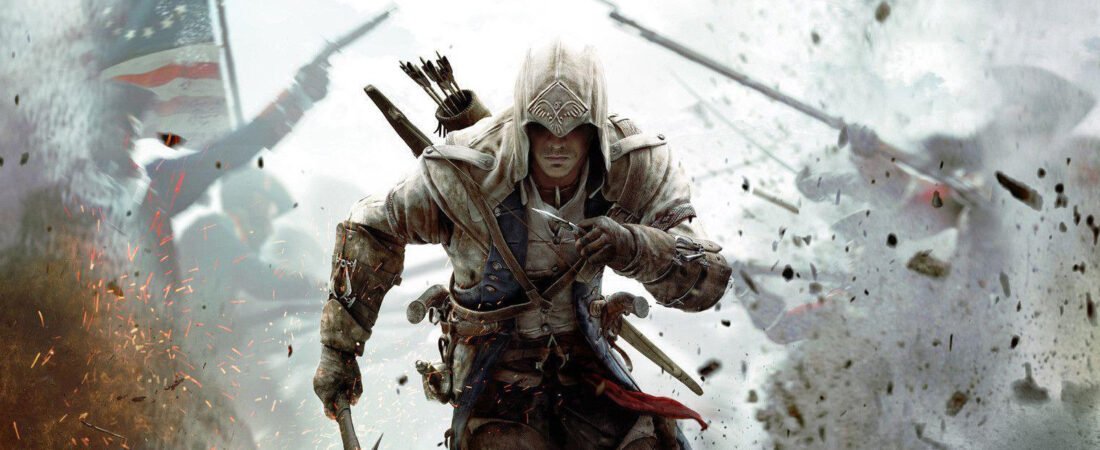
Connor over a fallen redcoat, the shot that sold the Revolution. The game underneath it was stranger, slower and braver than the poster. Image: Ubisoft.
Let me start with the receipts, because Assassin’s Creed III discourse usually skips them. Released on October 30, 2012, after roughly three years of development, it was the biggest production Ubisoft had ever mounted: a new engine, a new continent, a new protagonist, naval warfare, a frontier wilderness, seasons, hunting, a homestead to build, and the end of Desmond’s five game story arc, all in one box. Ubisoft announced before launch that it was the most pre-ordered game in the company’s history. By December 2012 it had sold 7 million copies and become the fastest selling game Ubisoft had ever released. By February 2013, Ubisoft reported more than 12 million units shipped and sold digitally, a jump of almost 70 percent over Revelations. Critics put it at an 84 on Metacritic on Xbox 360. This was not a flop that fans rescued later. This was a juggernaut that half its own audience has been apologizing for ever since.
So why does it need defending at all? Because Assassin’s Creed III is two games sharing a disc, and which one you met first decided your opinion forever.
Game One: The Slowest Blockbuster Ever Made
The famous problem, and it is famous for a reason: Assassin’s Creed III takes its sweet time. You do not start as Connor, the Mohawk assassin on the box. You start as Haytham Kenway, a smooth, lethal English gentleman arriving in Boston in 1754, and you play as him for the first three sequences. Hours of game. There is an opera assassination, a sea voyage, a frontier manhunt, an entire apprenticeship arc, and it is all genuinely good material, because Haytham is fantastic, charismatic and cold and funny in the exact ways Ezio trained us to love. Then the game pulls its big twist: Haytham is a Templar. Not just a Templar, the Grand Master of the Colonial Rite, and the father of the actual protagonist.
I will defend that twist with my last breath. It is one of the great rug pulls in the medium: the game makes you love a man, then reveals you have been building the villain, and every scene you enjoyed curdles in hindsight. But I cannot defend the pacing that follows. Because then you become Connor, Ratonhnhaké:ton, as a child. Then a teenager. Then a trainee under the bitter, limping Achilles Davenport. The Revolution is happening out there, the Boston Massacre, the Tea Party, Paul Revere’s ride, and you are doing chores and learning systems in the snow. Adult Connor finally pulls on the robes and picks up the tomahawk somewhere around the sixth sequence, five or six hours in depending on how much hunting you got distracted by. Modern games get review bombed for a twenty minute tutorial. This one, the biggest game of 2012, ran a feature length prologue before letting you be the man on the cover.
And Connor himself split the room. After three games of Ezio’s charm offensive, Connor is stoic, literal, angry and wounded, a young man watching his people’s world get dismantled by both sides of a war that keeps promising him things. Noah Watts plays him with real gravity, and the writing gives him a tragedy with teeth: his father is the enemy, his mentor is dying, his village keeps asking what all this fighting is actually buying them. But next to Haytham, who gets all the best lines and the opera coat, Connor read to a lot of players as dull. I think history has been kinder to him than 2012 was. He is not a failed Ezio. He is a deliberate answer to Ezio: what the war for the continent looked like to the people who were already standing on it.
Game Two: The Revolution, the Frontier and the Sea
Now the other game, the one that made me forgive everything above. When Assassin’s Creed III opens up, it is staggering. The Frontier is a wilderness the size of the previous games’ cities, with climbable trees, weather that rolls in, snow that slows your horse and swallows your footprints, and a hunting system that made skinning a deer feel like a trade instead of a loot animation. The Davenport Homestead quietly becomes the warmest hub in the series: recruit settlers, a woodcutter, a blacksmith, a pair of hopeless romantic farmers, and watch a community assemble itself mission by mission. Boston and New York are dense with the Revolution’s greatest hits, and the set pieces, Bunker Hill especially, sell the chaos of musket warfare better than most shooters of the era.
And then there is the sea. The naval missions, built with Ubisoft Singapore, send Connor out as captain of the Aquila in full broadside warfare: chain shot and grape shot, rogue waves, forts to bombard, storms that turn the whole screen white. They were side content. Optional missions in an assassin game. And they were so good, so instantly, obviously the best new idea the series had produced in years, that Ubisoft built the entire next game around them. Black Flag exists because Assassin’s Creed III hid a pirate masterpiece in its own side quest menu. When people ask me what this game contributed, I do not start with Connor or the Revolution. I start with the fact that the best pirate game of the decade hatched inside this one, unannounced.
The Craft Got Meaner, Too
Credit where it is due on the systems side, because this game quietly modernized the toolbox. Combat was rebuilt around being outnumbered: Connor fights with the tomahawk and hidden blade together, counters two men at once, grabs a soldier as a human shield when a firing line levels its muskets, and keeps his momentum through running assassinations instead of stopping to pose after every kill. The rope dart lets you string a guard up from a tree branch, which is horrifying and was immediately everyone’s favorite screenshot. Free running finally left the rooftops and learned the wilderness: branches, fallen logs, rock faces, a whole grammar of tree running that the series used for years afterward. Even the little things landed. Connor pets every dog and cat he passes. The animation team put that in on purpose, and fourteen years of players have noticed.
And I have to mention Lorne Balfe’s score, because it does half the emotional work the script will not slow down for. The main theme takes the series’ musical identity and runs it through fiddles, drums and something close to a heartbeat, and the Frontier exploration music is still, note for note, some of the most beautiful wandering music in the franchise. Play this game with headphones, in the snow, at dusk, hunting in silence. Whatever you think of the pacing, that hour is perfect and nobody can take it from the game.
The Ending, the Bugs, and the Year of the Ending Wars
Now the two things that stained the launch, and neither one is small. First, the technical state: Assassin’s Creed III arrived buggy, with glitches, broken animations and mission quirks widely reported and a hefty day one patch waiting at the door. For the most pre-ordered game in company history, it was a rough first impression, and it confirmed a reputation for launch jank that Ubisoft spent years trying to outrun.
Second, the ending. Not Connor’s ending, which is bleak and earned and ends with him watching the new nation sell his people’s land out from under the revolution he just won for it. Desmond’s ending. Five games of modern day buildup, the 2012 solar flare, the First Civilization, all of it cashes out in a short sequence where Desmond touches a pedestal, dies saving the world, and accidentally frees Juno, the digital ghost who becomes the series’ next problem. That is more or less the whole scene. Players who had carried this story since 2007 felt short changed, and they said so, loudly, in a year when Mass Effect 3 had already turned ending discourse into a blood sport. Two of the biggest story franchises in games face planted their finales within months of each other in 2012. It was a cursed year for third acts, and Assassin’s Creed III has worn that reputation ever since, even though most of its own campaign ending, the Kenway family tragedy, is honestly some of the strongest writing in the series.
The post launch story has one more odd chapter: The Tyranny of King Washington, an alternate history DLC where George Washington goes mad with an Apple of Eden and builds himself a pyramid in New York. It is exactly as unhinged as it sounds, and I mean that as praise. The main game was so solemn that the DLC team apparently decided to set the history book on fire, and the series could use more of that energy.
Where It Stands Now
Ubisoft gave the game a second launch with Assassin’s Creed III Remastered in March 2019, bundled with the Odyssey season pass and including the Liberation remaster, and even that managed to be divisive: the new lighting won some players and lost others, and the argument simply moved to a prettier battlefield. The argument is the point, I think. Unity has the redemption arc, Black Flag has the consensus crown, Ezio has the love. Assassin’s Creed III has the debate, permanently, and a game people are still debating fourteen years later is not a failure by any honest measure.
My verdict, for the record: this is the most ambitious game in the series, and ambition this size does not ship clean. The prologue is too long, the hero is an acquired taste, the modern day ending fumbled the bag, and I would still rather replay this flawed, furious, overstuffed thing than half the polished games that followed it, because it was trying to be about something: fathers and sons, revolutions eating their own promises, and the people standing on the land before the flags arrived. Connor deserved a sequel. The sea got one instead. Make of that what you will.
Your turn, and this game always delivers in the comments: where do you land? Team Connor, misunderstood and noble? Team Haytham, the father who stole the game? Or do you hold the respectable position that the naval missions were the whole point and everything else was packaging? I have held all three opinions, sometimes in the same week, so no judgment from me.
Sources
Assassin’s Creed III release date of October 30, 2012, Ubisoft Montreal as lead developer with support studios including Ubisoft Singapore on the naval missions, and the Metacritic score of 84 (Xbox 360), per Ubisoft and Metacritic. Most pre-ordered game in Ubisoft history and 7 million copies sold as the fastest selling game in company history, per Ubisoft announcements of October and December 2012, as reported by Eurogamer. More than 12 million units shipped and sold digitally, an almost 70 percent increase over Revelations, per Ubisoft’s Q3 2012-13 financial report (February 7, 2013), as reported by Engadget and VGChartz. Story, setting, the Haytham Kenway twist, the Davenport Homestead, naval missions, the Desmond and Juno finale and The Tyranny of King Washington DLC per the game itself and Ubisoft’s official materials. Assassin’s Creed III Remastered (March 2019), including Liberation Remastered and its bundling with the Assassin’s Creed Odyssey season pass, per Ubisoft.
The Checkpoint Poll
Leave a Reply