Origins took a year off and came back wise. Odyssey looked at that wisdom, nodded politely, and then built a game roughly the size of a European country. This is the story of the Assassin’s Creed that tried to give you everything, all of Greece, all at once, forever.
By Ruan Martini, Daily Checkpoint, November 1, 2026
Let me tell you how I measure a game’s size. Not in gigabytes, not in square kilometers. I measure it in Sundays. Assassin’s Creed Odyssey ate my Sundays for the better part of a season, and every time I thought I had seen the whole map, the game politely unfolded another island, another war, another goat with a bounty on my head. A year after Origins rebooted the series with restraint, Ubisoft Quebec took the new formula and turned every dial to maximum: bigger world, deeper RPG systems, choices, romances, naval battles, mythical monsters. The result is the most generous and most excessive game in the franchise, and I mean both of those words as compliments and as warnings.
Pick Your Spartan
Odyssey is set in 431 BC, at the start of the Peloponnesian War, nearly four centuries before Bayek was born. For the first time in the series, you choose your protagonist: Kassandra or Alexios, siblings, Spartan mercenaries, grandchildren of King Leonidas himself. Whoever you pick plays the hero, carrying Leonidas’s broken spear, which conveniently turns out to be a piece of ancient technology that grants superhuman abilities. The one you do not pick becomes the story’s haunted enforcer, and the sibling drama drives the whole plot.
A quick word of housekeeping, because this confused half the internet in 2018: Kassandra is the canon hero. Ubisoft’s own creative team confirmed it, the official novelization tells her story, and later games treat her as the one who lived it. Play Alexios if you want, he is a perfectly entertaining chaos gremlin, but the performance that history settled on belongs to Melissanthi Mahut as Kassandra: funny, warm, ferocious, and somehow able to make a mercenary who headbutts people for money feel like the most human person in the ancient world. She argues with Socrates. She flirts with half of Greece and out fights the other half. She Spartan kicks soldiers off cliffs with a joy that should be illegal in at least nine city states.
Also worth saying out loud, because old fans still twitch about it: there is no hidden blade in this game, and neither hero is an Assassin, because the Brotherhood will not exist for another four centuries. Odyssey is a story about the world that eventually needs assassins. Some players called that a betrayal of the brand. I call it the boldest premise the series ever had, and I respect the nerve it took to ship a game with Assassin’s Creed on the box and no assassins in it.
Greece, All of It, Including the Water
Let us talk about the map, because the map is the headline, the review, and the intervention all in one. Odyssey’s Greece was reported at around 230 square kilometers including the Aegean Sea, the biggest world the series had ever built and, by the fan measurements people kept running for years afterward, a map that stayed at or near the top of the franchise size charts long after newer games arrived. Numbers like that stop meaning anything after a while, so let me translate: you can sail from one end of this game to the other, fight a naval battle, sink two pirate ships, stop to raid a fort, get distracted by a singing crew, climb a statue of Zeus the size of a building, and still not be halfway to your quest marker.
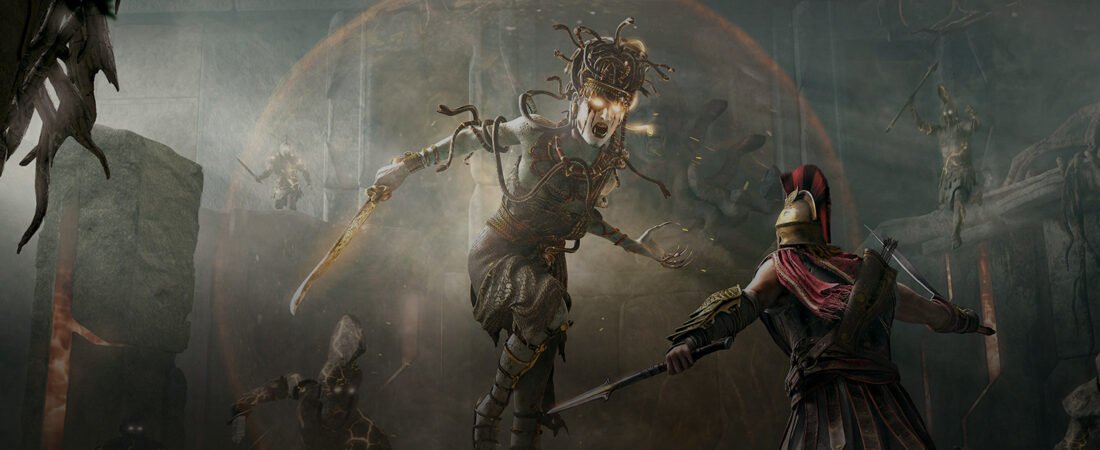
The sailing matters. Your ship, the Adrestia, turns the whole Aegean into a highway, and naval combat returns from the Black Flag playbook, with ramming, javelins, fire arrows and boarding actions. Athens gleams with marble and philosophy, Sparta is all dust and discipline, and in between there are dozens of islands, each with its own ruler, problems and extremely punchable tyrants. Historical figures wander through the story like it is the most casual thing in the world: Socrates will trap you in a logic argument for ten minutes, Herodotus takes notes, Hippocrates needs your help, Pericles does politics at you. And when the game wants to remind you that Greek myth is load bearing in this culture, it sends you into a labyrinth after the Minotaur, or to an island where Medusa turns careless heroes into garden ornaments. The Cyclops and the Sphinx are out there too. This is a history game that keeps a straight face while letting you suplex mythology, and the confidence of that tonal mix is half its charm.
The Full RPG Turn, No Half Measures
Origins dipped a toe into RPG systems. Odyssey cannonballed in. For the first time in the series, you pick dialogue responses, make story decisions, and live with multiple endings built around whether your broken family can be put back together. Romance options exist, and they range from sweet to gloriously unserious. A conquest system lets you weaken a region, then fight in huge pitched battles of 150 soldiers a side for Athens or Sparta, switching the map’s colors as you go. A mercenary system tracks your bad behavior with a bounty ladder, so if you steal and murder your way across Greece, increasingly terrifying bounty hunters will hunt you across islands to collect. It is the series’ wanted system grown up into a cast of recurring rivals, and some of them, plus one extremely aggressive goat incident the community will never let go, became legends.
The abilities are where the game stops pretending to be grounded and starts having the time of its life. You can Spartan kick a bear off a mountain. You can turn invisible, rain arrows, bull rush through a shield wall, and heal mid fight like a demigod, because, spoilers from the first hour, the spear is quietly making you one. Purists said it stopped feeling like Assassin’s Creed. They were not wrong about the feeling. They were just wrong about whether that was a problem, at least for me. Odyssey is a power fantasy set in a history book, and the history book is good enough to hold the fantasy up.
The Grind Debate, Honestly
Now the part every Odyssey retrospective is contractually obligated to fight about. The game is long. The main story alone can take forty to fifty hours, and full completion happily sails past a hundred. Wrapped around that length was a level curve that, especially in the later acts, could demand side content before the story would let you proceed at a fair fight. Then there was the store. Odyssey sold optional time saver packs, including a permanent experience booster, and critics and players reasonably asked the ugliest question in modern game design: was the grind tuned to sell the shortcut? Ubisoft’s position was that the boosters were optional for players short on time, and it is true that the game can be finished without spending an extra cent, because millions of us did exactly that. It is also true that the question itself damaged trust, and that later games inherited the suspicion. My honest ruling, eight years on: the side content in Greece is mostly charming enough that the scenic route rarely felt like a punishment, but the booster never should have existed, and the series is still paying interest on that decision in every comment section on Earth.
The Receipts
However the internet argues about it, the market delivered its verdict fast. Odyssey launched on October 5, 2018, and Ubisoft announced within days that it had delivered the franchise’s best launch week performance of that console generation, beating Origins, Unity and Syndicate on a comparable basis, with digital sales accounting for 45 percent of the total, up from Origins’ already healthy 35 percent. In the United States it was the third best selling game of October 2018, behind only Call of Duty: Black Ops 4 and Red Dead Redemption 2, which is like losing a footrace to two hurricanes. Critics backed it up: generally favorable reviews everywhere, with Metacritic scores of 83 on PS4, 86 on PC and 87 on Xbox One.
And the tail was enormous. By March 2020, Odyssey had sold more than ten million copies, matching Origins and cementing the RPG era as the series’ commercial peak form. Ubisoft supported it like a platform: the Legacy of the First Blade episodes finally tied its story to the hidden blade’s origin, The Fate of Atlantis trilogy went full science fiction mythology, a Story Creator Mode let players build and share their own quests, and the Discovery Tour returned, this time sailing through Greek history in September 2019. The game was so central to the era that Google chose it as the public test for its Project Stream cloud gaming experiment in late 2018, meaning the first time a mass audience ever streamed a blockbuster game in a browser, they streamed this one.
Where It Stands Now
Odyssey has aged into the series’ great divider, and weirdly, into its comfort game. Ubisoft kept polishing it: an August 2021 update unlocked 60 frames per second on PS5 and Xbox Series consoles, which is how it deserves to be played now. Then, in December 2021, Kassandra herself walked back on stage in a free crossover story inside Assassin’s Creed Valhalla, canon confirming what the fans had already decided. When people argue for the RPG era, Odyssey is their Exhibit A: the biggest, warmest, funniest game of the three. When people argue against it, Odyssey is also their Exhibit A: too long, too loose, too far from the creed. Both camps are describing the same game accurately, which tells you everything about its personality.
My take: Odyssey is my summer game. Not my favorite Assassin’s Creed, that chair has an Italian sitting in it forever, but the one I would hand to somebody who wants a world to live in for a month. It is too big, yes. The grind has a guilty chapter, yes. And then the sun comes up over the Aegean, your crew starts singing, Kassandra starts arguing with a philosopher, and I forgive it everything, every single time. If you go, go as Kassandra, kick at least one important person off a cliff, and do not rush. Greece has waited twenty five centuries. It can wait for you to finish that side quest.
Sources
Release date, developer (Ubisoft Quebec) and platforms: Ubisoft and the game’s official store listings, October 5, 2018.
Metacritic scores by platform (83 PS4, 86 PC, 87 Xbox One) and the game’s critical reception summary: Metacritic and Wikipedia’s reception records for Assassin’s Creed Odyssey.
Launch performance (best launch week of the franchise for that console generation, 45 percent digital share): Ubisoft announcement of October 2018, covered by GamesIndustry.biz, Eurogamer and PCGamesN, October 10 to 11, 2018. Third best selling game in the United States in October 2018: NPD Group reporting via Wikipedia’s sales records.
Lifetime sales milestone (more than ten million copies by March 2020): Ubisoft fiscal reporting, May 2020, reported in coverage of both Origins and Odyssey milestones.
Map size reporting (around 230 square kilometers including the sea, and later fan size comparisons with Valhalla and Origins): Ubisoft developer interviews and subsequent community measurement coverage.
Kassandra as the canon protagonist: statements by the game’s creative team and the official novelization, summarized in series coverage; her return in the Valhalla crossover story “A Fated Encounter”: Ubisoft, December 2021.
Post launch details (Legacy of the First Blade, The Fate of Atlantis, Story Creator Mode, Discovery Tour: Ancient Greece in September 2019, the August 2021 update enabling 60 frames per second on PS5 and Xbox Series consoles, and Odyssey as the Project Stream test title): Ubisoft announcements and Google Project Stream coverage, 2018 to 2021.