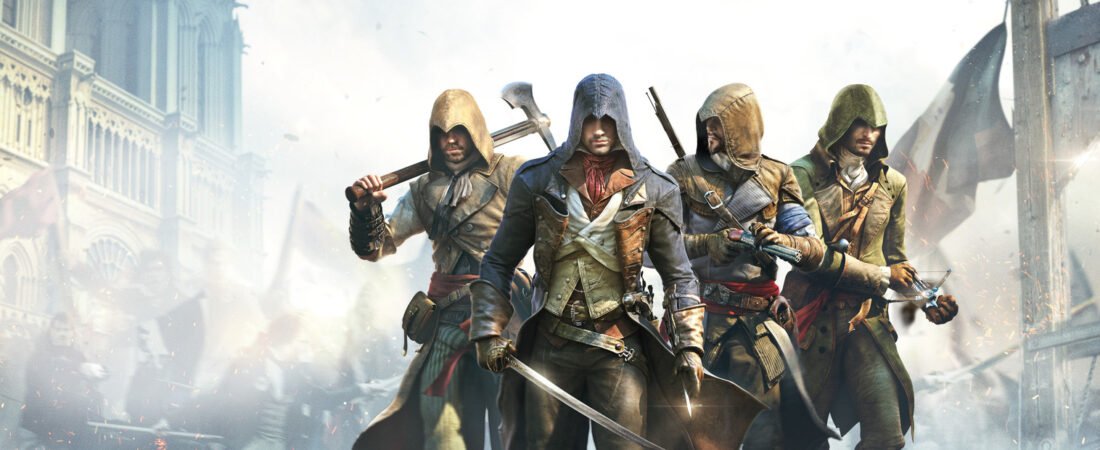
Unity is the strangest kind of failure. The city at the center of it is still one of the best things Ubisoft has ever built, the movement still feels modern, and the ambition was real. Then you remember launch week, when the frame rate fell into the Seine and half the internet met an Assassin whose face had clocked out early.
By Ruan Martini, Daily Checkpoint
Image: Ubisoft
Ubisoft Montreal released Assassin’s Creed Unity in North America on November 11, 2014, for PlayStation 4, Xbox One and Windows. It was the first mainline entry built only for that console generation. Assassin’s Creed Rogue handled the older PlayStation 3 and Xbox 360 audience on the same day, which already tells you something about the machine Ubisoft had become. One franchise, two giant games, two hardware generations, one calendar with no mercy.
Unity was supposed to prove that the new consoles changed everything. In some ways, it did. Paris was denser, taller, richer and more alive than any city the series had built before. The problem is that a proof of concept still has to work when a paying customer puts the disc in. Unity worked just often enough to show you the masterpiece hiding inside it, then broke character at the worst possible moment.
This is not a story about a lazy game. It is almost the opposite. Unity is what happens when talented people try to rebuild the engine, the city, the crowd system, the parkour, the combat, the stealth and the multiplayer all at once, while the release date stands behind them holding a guillotine.
The Promise Was Basically a New Series
The pitch was enormous. Ubisoft talked about a full scale Paris rather than the compressed historical theme parks of earlier games. Major landmarks could be entered without a loading screen. Contemporary preview reporting put roughly a quarter to a third of the other buildings in that same seamless category. You could pass through a window, cross a crowded room, leave by another window and continue across the roofs as if the city were one connected machine.
Notre Dame was the showpiece. It was not a pretty cardboard cathedral placed there for screenshots. You could climb it, enter it, cross it and use it as part of the geography. Around it, Paris had districts with different wealth, politics and moods, plus the catacombs and sewers underneath. The city was the game in a way that later giant maps sometimes forgot to be.
Then came the crowds. Ubisoft promoted scenes with as many as 5,000 AI driven characters, a ridiculous jump from the roughly 100 to 200 people earlier games put in a busy area. These crowds argued, fled, fought, gathered around executions and reacted to Arno. The French Revolution was not meant to be a backdrop. It was meant to be weather, always moving around you and sometimes swallowing you whole.
The systems changed too. Parkour gained dedicated movement up and down, so descending a building became a controlled route instead of a prayer and a hay cart. A proper stealth mode and cover system arrived. Gear and skills let you shape Arno toward combat, stealth or navigation. The best assassination missions used a black box structure, giving you a target, a place full of opportunities and more freedom to create your own ugly solution.
Four player co op sounded like the Brotherhood fantasy finally made real. You and three friends could take narrative missions and heists as different Assassins, each bringing customized gear and skills. On paper, Unity was not just the next annual sequel. It was a new foundation for the whole series.
Arno Had a Good Story Buried Under All That Ambition
Arno Dorian is not Ezio, and I am not going to insult either of us by pretending otherwise. He begins as a charming troublemaker, grows up loving Élise de la Serre, and gets pulled into the Brotherhood after the murder of Élise’s father, François, the Templar Grand Master who raised him. Arno joins the Assassins looking for redemption as much as justice. Élise joins the Templars and wants revenge with fewer meetings and more stabbing.
That relationship is the best part of the writing. Arno and Élise grew up together, love each other, and still end up serving organizations that have turned murder into office policy. The Revolution gives their private disaster the perfect public mirror. Everybody in Paris claims to be building freedom while finding new people to execute before lunch.
The weakness is that Unity keeps rushing past its own people to show you another system. Arno can feel like a handsome tour guide for features. Big revolutionary figures enter, deliver history and leave. The modern day story is thin enough to qualify as a rumor. When the game slows down and lets Arno and Élise argue about what their lives became, it works. When it remembers there are seventeen icons blinking on the map, it loses the thread.
Still, I like Arno more than the launch reputation suggests. He is not a legendary mentor by the end. He is a gifted idiot who loved the wrong person, trusted the wrong rooms and spent the whole game learning that revenge is a terrible project manager. There is a real character in there. Unity just kept interrupting him with technology.
Paris Delivered Before the Rest of the Game Did
Let us give the city its full credit. Unity’s Paris remains the most beautiful urban space in Assassin’s Creed. Not the biggest, not the most varied, but the most convincing as a single place. The light through smoke, the gold inside churches, the mud and blood in the streets, the rooftops packed so tightly that the whole city becomes one continuous route. It feels built by people who understood that a great Assassin’s Creed city needs density more than empty acreage.
The movement supports it. A good Unity run has a rhythm no later game fully copied. You rise over a market, slide down a facade, pass through an open window, cross a room full of nobles and come out above a patrol without the game stopping to admire itself. When the controls cooperate, Arno looks less like a video game character following paths and more like a trained thief reading architecture at speed.
The stealth can be excellent too. Guards are dangerous, open combat is less forgiving than in the older power fantasy entries, and the Phantom Blade gives you a quiet ranged option that fits the fantasy. The black box missions are the clearest glimpse of where the series could have gone. More of that and less map confetti, please.
So no, Unity was not empty ambition. Paris, the interiors, the crowds and the core traversal were genuine advances. That is why the launch hurt so much. Nobody mocks a bad little game for twelve years. We remember Unity because the great game was visible the whole time, trapped inside the one that shipped.
Then the Revolution Ate the Frame Rate
Ubisoft delayed Unity from October 28 to November 11, 2014, saying the extra two weeks would help refine the details. Friends, the details had brought friends.
The console versions targeted 900p and 30 frames per second on both PlayStation 4 and Xbox One. Ubisoft producer Vincent Pontbriand said the shared specification would help avoid debates, which is one of history’s funniest sentences because it started a debate before the game even launched. The real problem was not the number on the box. It was that Unity often failed to hold the performance it had already lowered its ambitions to reach.
Digital Foundry found crowded PS4 scenes dropping to around 20 frames per second for sustained stretches. Xbox One ran roughly five frames ahead in that same test, while rooftop movement on both systems swung through the 25 to 30 range. Add texture pop in, delayed geometry, characters sliding into place, crashes, broken co op connections, matchmaking trouble, erratic hair and animation, Arno falling through the world or politely walking on air, and the new generation miracle started looking like a stress test sold at full price.
PC players had their own bonfire. Heavy performance demands and bugs made the platform’s launch especially rough. That is also where the famous image came from: characters with missing faces, leaving eyes, teeth and hair floating in a cutscene like a Halloween prank nobody approved.
Here is the receipt that often gets lost. Ubisoft later said the missing face problem occurred only on PCs with one of two specific graphics cards and was resolved by the day one patch. It was not the universal experience, and it may have been one of the least widespread major bugs. Context does not save Ubisoft, though. A company does not get to complain that the most shareable bug became the symbol when the rest of the launch gave people so little reason to be charitable. The faces were funny. The frame rate was not.
Reviews landed where you would expect for a beautiful technical emergency. Metacritic settled at 70 on PlayStation 4, 70 on PC and 72 on Xbox One. Critics praised the environment, customization and several mission ideas. They also hit the controls, balance, technical failures and the sense that half the new systems were fighting each other. Unity was not savaged because Paris was bad. It was punished because Paris deserved a functioning game around it.
Ubisoft Had to Apologize Like It Meant It
To Ubisoft’s credit, the response went further than the usual statement about listening to feedback while quietly moving to the next product. The team ran live updates, named known issues and started pushing major patches at speed.
On November 26, Yannis Mallat, CEO of Ubisoft Montreal and Toronto, apologized directly. He acknowledged that bugs and unexpected technical issues had diminished the quality of the game. Patch 3 arrived with more than 300 fixes. That is not a patch note. That is a cry for help formatted as a changelog.
The commercial apology was bigger. Ubisoft stopped selling the season pass. The Dead Kings expansion, released in January 2015, became free for every Unity owner. People who had already bought the season pass or Gold Edition could choose one free game from The Crew, Far Cry 4, Watch Dogs, Assassin’s Creed IV: Black Flag, Rayman Legends and Just Dance 2015. Companies do not give away that much product because a launch had a few cosmetic hiccups. They do it when trust has caught fire.
Patch 5, released in February 2015, fixed another problem that perfectly explains the era. Some blue and gold chests and related rewards had been tied to the companion app or the Assassin’s Creed Initiates service. Imagine buying a single player game, finding a chest in Paris, and being told to go do homework on another screen before Arno can open it. Patch 5 made that content available to all players and fixed rewards that had been relocking. It was the right move, and it should never have required a patch.
The patched Unity became a much better product. It also became a lesson the industry keeps pretending is new. You can repair code after launch. You cannot patch the first week out of people’s memory.
The Sales Receipt Makes the Whole Thing Weirder
Unity did not flop in the simple way internet memory sometimes suggests. By December 31, 2014, Unity and Rogue had shipped a combined 10 million units. Read that sentence carefully, because the number belongs to both games together and shipped does not mean sold through to 10 million players. It still shows the size of the franchise machine. For comparison, Black Flag had reached 10 million shipped by the same point in its cycle on its own, so the combined figure was not exactly a victory lap either.
The long story is even stranger. In its full year results for the period ending March 31, 2020, Ubisoft listed Unity among eleven games from that console generation that had sold more than 10 million units. Discounts, bundles and years of quiet rehabilitation did a lot of work there, and the free PC giveaway arrived in 2019. None of that erases the milestone. The game with the disastrous launch eventually crossed a line many polished games never reach.
That is the Unity paradox. Commercially, it endured. Reputationally, it changed what players expected from Ubisoft and what Ubisoft had to prove next. The bill did not arrive only in Unity’s own reviews. It arrived one year later, when a better game launched and too many people decided to wait. I wrote that story in our Assassin’s Creed Syndicate retrospective, and you cannot understand one game without the other.
Notre Dame Gave Unity a Second Life
On April 15, 2019, fire tore through Notre Dame. Suddenly Unity was back in the news for a reason that had nothing to do with bugs. Its digital cathedral became a place people wanted to visit while the real one was wounded.
Ubisoft donated €500,000 toward restoration and made the PC version free from April 17 to April 25. That mattered. The internet then added a myth, because the internet cannot let a good story walk past without putting a cape on it. No, Unity did not provide the scientific blueprint used to rebuild Notre Dame. Ubisoft itself said it was not involved in the reconstruction and described its version as an artistic vision, not a scientific reconstruction. The in game cathedral even uses the famous spire that the building did not have during the period shown. Artistic license is not a laser scan.
What Unity offered was emotional, not architectural. It let people stand inside a loving interpretation of a landmark at a moment when the real doors were closed. That is not a small thing. Games preserve feelings about places even when they rearrange the furniture. Unity’s Paris became a public memory box, and for one week the game once mocked for missing faces was being downloaded because its most famous building had too many details for people to let go.
Paris at 60 Frames Changes the Verdict, Not the History
The redemption arc got one more chapter on March 5, 2026, when Ubisoft released Patch 1.6 for current consoles. The official notes list 4K at 60 frames per second on PlayStation 5, PlayStation 5 Pro and Xbox Series X, with 1080p at 60 frames per second on Xbox Series S. Twelve years after launch, the console version finally moves the way the trailers promised.
Does that make Unity a secret masterpiece? No. Let us not overcorrect and become the opposite kind of unserious. The story still rushes, some combat encounters still feel spongy, the co op belongs to another internet era, and the map still throws side content at you like a waiter dropping menus from a balcony. Time and patches fixed the disaster more than they revealed perfection.
But the patched game is absolutely worth playing, especially if you skipped it in 2014. The city is the star and it has not been dethroned. The parkour remains a high point for the series. The stealth focused missions show a version of Assassin’s Creed that valued place, planning and density before the RPG era chose scale and statistics. Play it as a dense urban stealth game, not as a checklist with a revolution attached, and Unity makes sense.
My final verdict is simple. Unity was not the worst Assassin’s Creed. It was the most damaging one, because it taught players that even the best looking promise might arrive unfinished. Paris survived that lesson. Ubisoft’s reputation took much longer to climb down from the roof.
More retrospectives and new releases are in our Games coverage.
Sources
Ubisoft and Steam store materials for Assassin’s Creed Unity: November 11, 2014 North American release for PlayStation 4, Xbox One and Windows, Arno Dorian, Revolutionary Paris, full scale city, building interiors, crowds of up to 5,000 characters, parkour, stealth, customization and four player co op.
PCWorld, E3 2014 Unity preview reporting: crowds approaching 5,000 in the largest scenes, all major landmarks enterable and approximately a quarter to a third of other buildings enterable without loading screens.
Digital Foundry performance analysis, reported by Eurogamer and VG247 in November 2014: 900p output on both consoles, PS4 performance around 20 frames per second in a crowded square, Xbox One roughly five frames ahead there, and rooftop performance fluctuating between 25 and 30 frames per second.
Polygon and Game Informer, November 19, 2014, reporting Ubisoft’s live update on the missing face bug: the issue was tied to PCs with one of two specific graphics cards and was resolved by the day one patch.
Metacritic records for Assassin’s Creed Unity: 70 on PlayStation 4, 70 on PC and 72 on Xbox One, with contemporary reviews praising Paris and customization while criticizing technical problems, controls and balance.
Ubisoft apology coverage from November 26, 2014: Yannis Mallat’s apology, Patch 3 with more than 300 fixes, the season pass removed from sale, Dead Kings made free for all owners and one free game offered to season pass and Gold Edition owners from a list of six titles.
Ubisoft Patch 5 notes, February 2015: stability fixes, gear rewards no longer relocking, and Initiates and companion app exclusive content made accessible to all players.
Ubisoft financial reporting covered by GamesIndustry.biz and GameSpot in February 2015: Assassin’s Creed Unity and Assassin’s Creed Rogue shipped a combined 10 million units by December 31, 2014.
Ubisoft full year 2019 to 2020 results, May 14, 2020: Assassin’s Creed Unity was listed among eleven Ubisoft games from the console generation that had sold more than 10 million units by March 31, 2020.
Ubisoft statement and coverage from April 2019: a €500,000 donation toward Notre Dame restoration and the PC version of Unity made free from April 17 to April 25, 2019. Ubisoft described the game version as an artistic vision rather than a scientific reconstruction and said it was not involved in the reconstruction.
Ubisoft, Assassin’s Creed Unity Patch 1.6 notes, March 5, 2026: 4K at 60 frames per second on PlayStation 5, PlayStation 5 Pro and Xbox Series X, and 1080p at 60 frames per second on Xbox Series S.
Leave a Reply