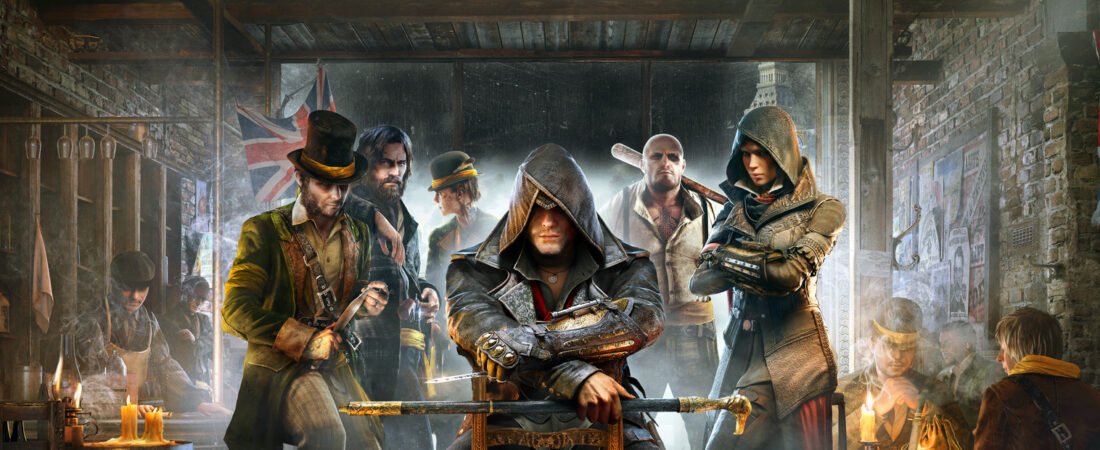
Syndicate had the worst job in the series. It had to be a great Assassin’s Creed, prove Ubisoft could ship a working one, and apologize for Unity without ever printing the word sorry on the box. It did most of that, charmed the critics, and still got treated like the sequel nobody ordered.
By Ruan Martini, Daily Checkpoint
Image: Ubisoft
Ubisoft Quebec released Assassin’s Creed Syndicate on October 23, 2015, for PlayStation 4 and Xbox One. Windows followed on November 19. One year earlier, Assassin’s Creed Unity had launched with a gorgeous Paris and enough technical problems to become a news story. Syndicate arrived with Victorian London, two playable twins, a rope launcher and a development team that had clearly been told one thing before every meeting: whatever happens, do not become a meme.
That pressure could have produced a timid game. In some ways, it did. Syndicate is less ambitious than Unity, less interested in rebuilding every system and much happier being a polished version of the Creed people already liked. But polish is not a dirty word. After 2014, polish was the whole ballgame.
Syndicate is the old formula with its shirt tucked in. It moves faster, jokes more, wastes less of your time outside the game and understands that a city takeover fantasy should feel like progress instead of a second job. It is also the point where the classic series quietly reached its natural end. Origins would reinvent Assassin’s Creed two years later. Syndicate was the last confident lap of the old machine, and a lot of us only noticed after the machine was gone.
London Was Built for Trouble
The setting is London in 1868, near the height of the Industrial Revolution. The city is split into seven boroughs, from wealthy Westminster to Whitechapel, Lambeth, Southwark and the Thames itself. Factories eat children and produce fortunes. Trains cut through the smoke. Carriages clog streets that were never designed for modern traffic. The rich are building an empire while standing on the people carrying the bricks.
It is a perfect Assassin’s Creed playground because the conflict is visible everywhere. Crawford Starrick, the Templar Grand Master, does not merely influence London from a shadowy chair. His network reaches into industry, transport, finance, medicine and organized crime. His gang, the Blighters, holds the streets. To hurt Starrick, you do not just stab a list of men in expensive coats. You dismantle the systems paying them.
That gives the open world a cleaner purpose than the usual icon soup. Gang strongholds, bounty hunts, cargo hijacks, child liberation missions, train robberies and Templar hunts all feed the same fantasy: take the borough back. Your gang, the Rooks, visibly replaces the Blighters. Your train headquarters rolls through the city like a stolen office with better weapons. Even the side content understands the assignment, at least until repetition starts tapping you on the shoulder and asking whether you would like to free one more identical street.
London itself has a different energy from Unity’s Paris. Paris was a cathedral of detail, too beautiful to touch without worrying about fingerprints. London feels used. Pubs, markets, stations, docks, factories and alleys all look like somebody works there and hates the hours. It may be less technically spectacular, but it is warmer and easier to inhabit. I can admire Paris. I can hang out in London.
Jacob Starts the Fight. Evie Brings the Brain.
Jacob and Evie Frye are the reason Syndicate still has defenders who talk about it like a favorite pub that closed too early.
Jacob is a brawler, a showoff and a human fire alarm. His plan for liberating London is beautifully simple: form a gang, punch the other gang until London improves. He specializes in close combat, loves an audience and treats caution as a rumor started by cowards. Left alone, he would liberate the city by Tuesday and accidentally hand it to a worse idiot by Friday.
Evie is the professional. She plans, studies the Pieces of Eden, favors stealth and has the revolutionary idea that maybe you should know what a target does before rearranging his organs. She also became the first woman to lead a mainline Assassin’s Creed game, sharing the top billing with Jacob rather than appearing as a novelty mission. Aveline de Grandpré had already led Liberation, a side entry, which makes Evie’s role the mainline breakthrough rather than the first time the series trusted a woman at all.
The smart choice is that neither twin is simply the correct one. Jacob’s direct war against Starrick creates chaos and sometimes makes the enemy’s job easier. Evie’s obsession with the artifact hunt can pull her away from the people bleeding in the street. Their arguments feel like sibling arguments first and Assassin doctrine second. He calls her rigid. She calls him reckless. They are both keeping receipts.
You can switch between them outside missions assigned to one twin, and their skill trees reward their specialties. Jacob leans into multi kills and gang leadership. Evie becomes a ghost with better one liners. The system is not radical, but it gives the campaign two temperatures. When Jacob has spent twenty minutes turning a street into a cartoon accident, dropping into Evie’s quieter infiltration missions feels like changing records, not repeating the same song louder.
The supporting cast helps. Henry Green gives the twins a local conscience. Alexander Graham Bell becomes their cheerful gadget dealer. Charles Dickens and Charles Darwin wander in with side stories, and Inspector Frederick Abberline supplies the Victorian police energy. Even Starrick gets a memorable piano moment that makes him more than a mustache with a bank account. Syndicate remembers that history is more fun when famous people are allowed to be characters instead of museum labels with quests attached.
There is also a surprise trip to 1916, where Jacob’s granddaughter Lydia hunts a Sage during the First World War. It is brief, strange and one of the game’s best detours. More Syndicate games could have used that structure. One city, one family, several eras, no need to inflate the map until it needs its own postal service.
The Rope Launcher Is Cheating, and I Forgive It
Let us discuss the grappling hook, officially the rope launcher, because it changed the feel of the series more than any new weapon in Syndicate.
London is wider and more industrial than the dense rooftop maze of Paris. Streets are broader, buildings stand farther apart, and plain climbing would have slowed the game to a historical walking tour. The rope launcher lets you fire up a facade in seconds or create a zipline between buildings. It turns rooftops into highways and makes crossing the Thames feel like an action scene instead of a transportation problem.
Yes, it reduces the tactile pleasure of climbing. Unity asked you to read every ledge and window. Syndicate sometimes lets you press the magic button and skip the architecture. Destructoid’s review made that criticism at launch, saying the tool made traversal easier while taking some pleasure out of climbing. Fair. But the trade gave Syndicate speed and confidence. The game is about momentum, territory and dropping into trouble before the trouble has finished its tea. The rope launcher serves that personality.
Carriages do the same on the ground. You can drive them, ram rival vehicles, fight from the roof and turn a dignified London street into a Victorian demolition derby. The handling is loose and the collisions can get silly, but the silliness fits Jacob’s half of the game. Trains add another layer. Your headquarters is always moving, gang members gather there, and missions on rails let the city pass like a smoky film strip.
Combat is faster than Unity and built around counters, combos and multi kills rather than fencing patience. The period weapons are a delight: cane sword for the gentleman assassin, kukri for speed, brass knuckles for when diplomacy has failed at close range, and a revolver for arguments across the room. It can become button heavy and repetitive, especially in large gang fights, but the animation sells the fantasy of a Victorian street brawler who also knows ballet and several felonies.
The Most Radical Feature Was What Ubisoft Removed
Syndicate had no multiplayer. No cooperative campaign. No companion app holding your chests hostage. In 2015, after years of every publisher trying to surround a game with extra doors, that restraint felt almost punk.
It was deliberate. Game director Scott Phillips later told Game Informer that the team knew it had to focus after Unity and deliver a polished, high quality product. Dropping co op and the companion app helped direct that effort toward the single player game. Ubisoft also said publicly that there would be no companion app because the team wanted all its effort on the core experience.
That is the correct lesson, and the game proves it. Syndicate is not free of bugs. It is not a technical miracle. Digital Foundry still found 900p presentation on both consoles and frame rate dips, especially during fast traversal and more heavily on Xbox One. Characters could disappear, bodies could behave strangely and our reviewer friends still found places to clip through the scenery. The difference is scale. Digital Foundry described the glitches as substantially reduced compared with Unity, and performance held much closer to the 30 frame target. PS4 generally had the advantage this time.
In normal human language: the game worked. You could buy it, play the story, enjoy London and finish without following a live apology blog. After Unity, that was revolutionary enough.
The focus shows in the campaign structure too. The assassination targets connect to Starrick’s empire. The borough liberation loop gives you a reason to do activities before the finale. The Jack the Ripper expansion, set twenty years later and built around Evie, adds a darker epilogue that understands which twin should carry a horror story. Syndicate is not bloated by Assassin’s Creed standards. It knows its city, its pair of leads and its central joke: the Assassins win London by becoming the best organized gang in it.
Critics Got It. The Calendar Did Not
Reviews were much kinder than Unity’s. Metacritic settled at 76 on PlayStation 4, 78 on Xbox One and 74 on PC. GameSpot and Game Informer both gave it 9 out of 10. IGN scored it 8.2, praising the city and lighter story. Polygon gave it 8.5. GameSpot called it a triumphant return to form, which may be the exact sentence Ubisoft Quebec wanted carved into a plaque and placed above the office coffee machine.
The criticism was consistent and fair. Combat wore out its tricks. Vehicle sections divided reviewers. Side activities repeated. The ending did not land as strongly as the build up. PC Gamer gave the PC version 66, arguing that the characters and main missions were better than the repetitive side content surrounding them. Syndicate was a good game with old habits, not a reinvention disguised as one.
It was also nominated for Best Action and Adventure at The Game Awards 2015. That nomination matters because 2015 was not an empty field. Batman: Arkham Knight, Metal Gear Solid V, Ori and the Blind Forest and Rise of the Tomb Raider were in the same category. Syndicate belonged in serious company again.
The long view got even warmer. In April 2020, Game Informer ranked Syndicate as the second best game in the series up to that point. Second. Ahead of games with bigger launches, bigger maps and much bigger reputations. You do not have to agree with the ranking to understand what it says. Once the launch noise faded, the thing people remembered was how much fun the Fryes and London were.
Unity Sent the Bill to Syndicate
Now the sad part, with numbers and no perfume.
Syndicate opened at number one in the United Kingdom, but Chart-Track data made it the weakest UK launch for a major Assassin’s Creed entry, with only Rogue below it among the wider franchise releases counted at the time. Ubisoft did not hide behind the chart position. CFO Alain Martinez said first week sales were clearly impacted by what happened with Unity. CEO Yves Guillemot added that Syndicate was down against Unity in week one, then outperformed it in week two as positive word of mouth spread. He compared the curve to Black Flag, a slower starter that kept selling.
That is as clean a reputation receipt as this industry gives you. Players were not rejecting Evie. They were remembering Arno’s missing face and deciding that Ubisoft could prove it on somebody else’s money first.
Reported totals put Syndicate above 4.12 million units by February 2016 and around 5.5 million by November 2017. Those are respectable numbers for most games. They were not the numbers Assassin’s Creed expected after years of annual blockbusters, and they were far below the more than 10 million Unity eventually accumulated over a much longer period. Syndicate sold like a well liked game carrying a damaged brand, because that is exactly what it was.
Ubisoft then made the healthiest decision in the franchise’s modern history. In February 2016, it confirmed there would be no new Assassin’s Creed game that year and said the team was stepping back to reexamine the franchise. The statement explicitly connected the pause to lessons learned since Unity. It would be lazy to blame Syndicate alone. Annual fatigue, Unity’s launch and the need for a new direction all pushed in the same direction. Syndicate became the evidence that simply shipping a good sequel was no longer enough.
Origins arrived in 2017 with RPG systems, a new combat model and a different relationship to scale. It sold twice as many copies in its first ten days as Syndicate had over the same span, according to Ubisoft’s reporting at the time. The reboot worked. It also swept the old formula into history, which is why Syndicate now feels like a farewell tour nobody announced.
London at 60 Frames Is the Version It Deserved
On November 19, 2024, Ubisoft released a free current generation update for Syndicate. PlayStation 5, PlayStation 5 Pro and Xbox Series X run it at 4K and 60 frames per second. Xbox Series S runs at 1080p and 60 frames per second. The rope launcher at double the old frame rate is a beautiful thing. London finally moves with the confidence the Fryes always pretended to have.
That update is also the simplest argument for playing Syndicate now. The classic structure is intact: one city, clear targets, a gang to build, two leads with actual chemistry and no hundred hour RPG swamp waiting behind the tutorial. It is substantial without being endless. You can finish the story, liberate the boroughs, chase the better side stories and leave before London starts repeating itself in a fake accent.
Is it the best Assassin’s Creed? I will leave that bar fight to people who enjoy being wrong in public. It is not as beautiful as Unity, not as revolutionary as II and not as grand as Black Flag. It is warmer than all three in its best moments. The Frye twins bicker like people who have shared a house, a profession and several bad decisions. London responds to your work. The game keeps its promises modest enough to keep most of them.
Syndicate did not fail because it was forgettable. It was forgotten because it arrived carrying an apology it never got to say, one year after the series had spent its trust. Time has been kinder to it than launch week was. Good. Evie earned the last word, and Jacob would want me to add that he earned it louder.
More retrospectives and new releases are in our Games coverage.
Sources
Ubisoft and Steam store materials for Assassin’s Creed Syndicate: October 23, 2015 release for PlayStation 4 and Xbox One, November 19, 2015 release for Windows, Ubisoft Quebec as developer, London in 1868, Jacob and Evie Frye, the Rooks, the rope launcher, carriages, trains and Crawford Starrick.
Game Informer, Five Things You Should Know About Assassin’s Creed Syndicate and the later Afterwords interview with game director Scott Phillips: two switchable protagonists, single player focus, and the decision to drop co op and a companion app so the team could focus on delivering a polished product after Unity.
GameSpot, May 28, 2015: Ubisoft confirmed there would be no companion app for Syndicate because the team wanted to focus its efforts on the core experience, and no multiplayer mode.
Digital Foundry performance analysis, October 2015, reported by Eurogamer and GameSpot: 900p presentation on PlayStation 4 and Xbox One, performance much closer to 30 frames per second than Unity, occasional dips during traversal, fewer bugs and glitches, and a general performance advantage for PlayStation 4.
Metacritic records for Assassin’s Creed Syndicate: 76 on PlayStation 4, 78 on Xbox One and 74 on PC. Contemporary review scores included GameSpot at 9 out of 10, Game Informer at 9 out of 10, IGN at 8.2 out of 10, Polygon at 8.5 out of 10 and PC Gamer at 66 out of 100.
Contemporary review coverage from GameSpot, IGN, Destructoid and PC Gamer: praise for London, the Frye twins, mission design and the rope launcher, with criticism for repetitive combat and side missions, divided responses to carriages and climbing made less tactile by the rope launcher.
The Game Awards 2015 nominee records: Assassin’s Creed Syndicate nominated for Best Action and Adventure alongside Batman: Arkham Knight, Metal Gear Solid V: The Phantom Pain, Ori and the Blind Forest and Rise of the Tomb Raider.
Game Informer series ranking, April 2020: Assassin’s Creed Syndicate ranked as the second best game in the Assassin’s Creed series to that date.
Chart-Track reporting covered by Eurogamer and GamesIndustry.biz, October 2015: Syndicate debuted at number one in the United Kingdom while recording the weakest UK launch week for a major Assassin’s Creed entry, ahead only of Rogue in the wider comparison used at the time.
Eurogamer, November 5, 2015, reporting Ubisoft’s investor call: CFO Alain Martinez said Syndicate’s first week was clearly impacted by Unity, and CEO Yves Guillemot said second week sales outperformed Unity as positive word of mouth helped.
Reported sales tracking summarized in contemporary and later coverage: more than 4.12 million units by February 2016 and around 5.5 million units by November 2017.
Ubisoft statement, February 11, 2016: no new Assassin’s Creed game would be released in 2016, with the company stepping back to reexamine the franchise and citing lessons learned since the release of Unity.
Ubisoft financial reporting, November 2017: Assassin’s Creed Origins sold twice as much as Syndicate in its first ten days on the comparable measure reported by Ubisoft.
Ubisoft News, November 19, 2024: free Assassin’s Creed Syndicate console patch added 60 frames per second, with 4K at 60 on PlayStation 5, PlayStation 5 Pro and Xbox Series X, and 1080p at 60 on Xbox Series S.
Leave a Reply