
By Ruan Martini, Daily Checkpoint
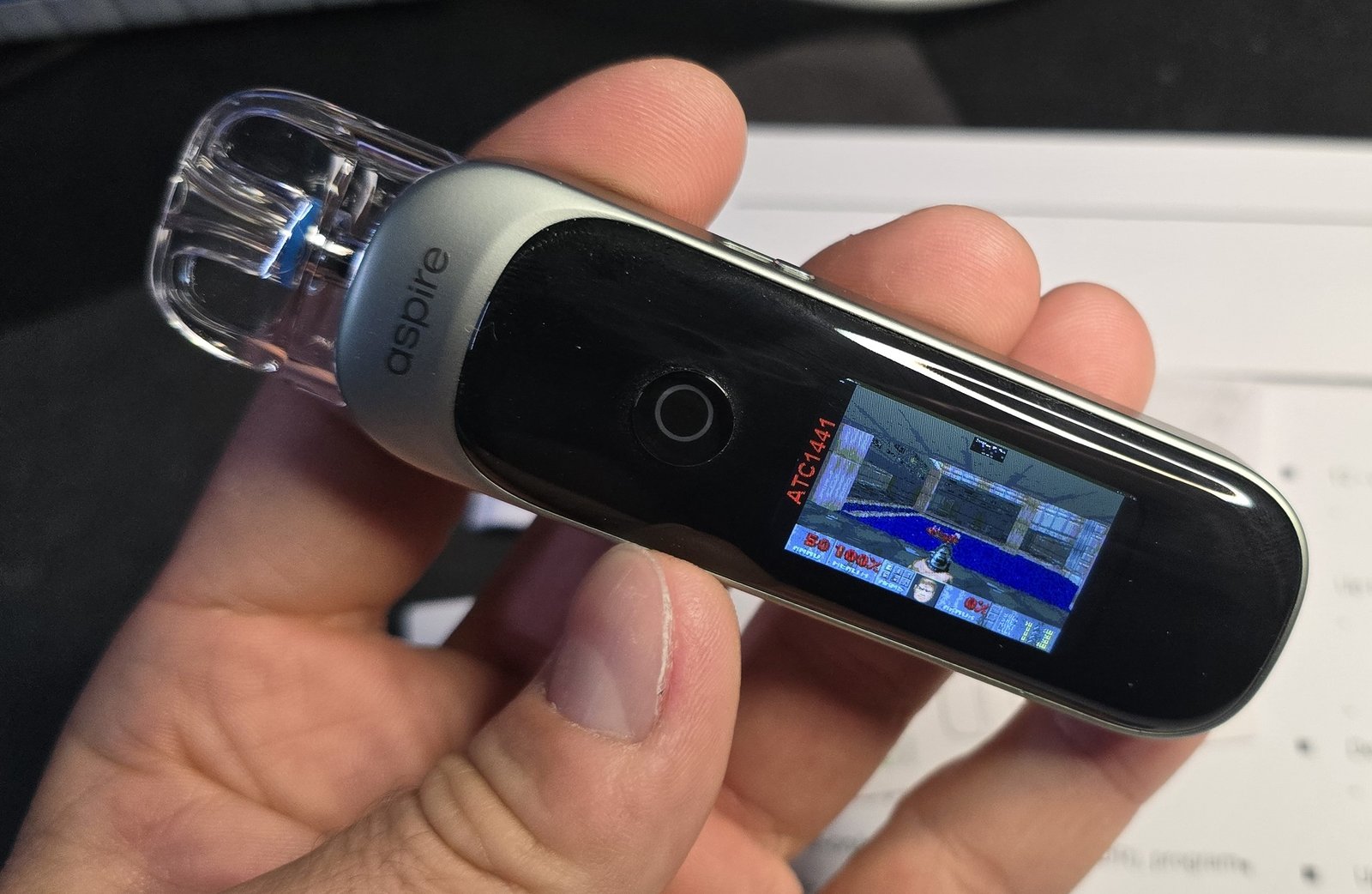
A reel crossed my feed this week and I have not been the same since. A guy picks up an Aspire vape, the little pen-shaped cloud machine with a tiny color screen on the side, and the screen is not showing battery level or puff count. It is showing Doom. The 1993 one. Playable. On a vape.
The man behind it is Aaron Christophel, a hardware hacker who goes by atc1441, and once you know what is inside the Aspire PIXO, the crime starts to make sense. As Notebookcheck and VideoCardz both reported in September 2025, this roughly 30 euro vape carries a Puya PY32F403XC ARM chip, 64 KB of RAM, flash storage, and a 323 by 173 pixel touchscreen. Read that again. The disposable cloud stick has a touchscreen, a real processor, and opinions. Christophel wrote custom firmware for it, because of course he did, and Doom ended up on the vape.
I am a simple man. I see a game from 1993 running on a device designed to be thrown away, and I have questions. The main one being: how deep does this rabbit hole go? Friends, the rabbit hole has no bottom. It has a basement, a sub-basement, and in the sub-basement there is a light bulb playing Doom. We are going through all of it, in escalating order of stupid, and I promise you the vape does not even make the top five.
The law of Doom
There is an unwritten law of technology, and after thirty years of evidence I am ready to call it a law: if a device has a chip and anything that can pretend to be a screen, someone will run Doom on it. Not might. Will. It is not a question of if, it is a question of which hacker gets there first and how funny the photo looks.
Why Doom? Because id Software built the perfect cockroach of a game. It was written in C, it is tiny, and in 1997 id released the source code, which is the moment the floodgates opened forever. Programmers have treated “can it run Doom?” as the official first exam of every hacked device ever since. It is the “hello, world” of hardware crimes.
Now let me give you the numbers, because the numbers are where the comedy becomes disrespectful. The original Doom shareware episode, the thing that conquered the planet in 1993, was a download of roughly 2.4 MB. Two point four. Your phone takes photos bigger than that. One screenshot of your lunch has more data than the game that invented a genre.
Compare that to the game this entire site is counting down to. GTA 6 is reported to need around 210 GB of storage on PS5, with a reported firmware requirement on top of it, and I have already written a whole article on this site about clearing space and preparing a small financial plan for launch day. Doom needs a potato with a screen. GTA 6 needs a storage strategy, a firmware update, and your rent money organized by November 19. Doom ran on a pregnancy test. Let that ratio live in your head for a second, because you could fit the 1993 shareware into GTA 6’s install size tens of thousands of times over, and the shareware would still have better hardware compatibility.
It started innocently enough, by the way. In the early 2000s, Doom showed up on Texas Instruments graphing calculators, the TI-83 Plus and its brothers, smuggled into math classes everywhere by students who had correctly identified that algebra was optional and demon hunting was forever. ticalc.org still hosts the files. That was the warning shot. Humanity looked at a calculator playing Doom and said “cute” instead of “we should probably stop this before it reaches the appliances.” Big mistake. Huge.
And so we arrive at the list. Fourteen hosts, ranked by escalating absurdity, each one a real project by a real person with a name and a story. You think the printer is weird? Wait until you see the one you pee on.
14. A Canon printer (2014)
Our story begins in an office, with a security researcher named Michael Jordon (not that one) at a British firm called Context Information Security. In 2014, Jordon spent four months doing something beautiful: he hacked a Canon Pixma printer, over the internet, because the printer’s web interface had no username and no password, and its firmware update system was protected by what The Register politely called weak encryption.
His goal was serious. He wanted to prove that a random printer on a random office network was a wide open door for attackers. And his way of proving total control over the machine was the traditional one: he installed Doom on it. The printer had a 32-bit ARM chip, about 10 MB of memory, and a little status screen, and that is more than enough computer to go to Hell. He presented the whole thing at 44Con in London, Doom running on the printer, as reported by the BBC, Engadget, and The Register.
Two details make this perfect. First, Canon responded like an adult and promised fixes, which is more than I can say for most companies in these stories. Second, the same research noted the hack could also burn through the printer’s ink by printing hundreds of pages. So the printer could play Doom AND waste your ink, which means the printer was honestly just doing its normal job with extra steps.
If a printer is only number fourteen on this list, you understand the scale of the problem. And if you think office equipment is the peak, wait until we rob a bank.
13. An ATM (2014)
Same year, other side of the planet. A group of Australian tinkerers led by a man named Ed Jones, Aussie50 on YouTube, got their hands on a retired NCR Personas ATM, the kind that used to dispense cash and judgment in equal measure. According to Hackaday’s coverage, picked up by PCWorld and GameSpot, the machine ran Windows XP under the hood, which made the first part easy. The hard part was the controls, and that is where it gets good.
They wired the ATM’s side buttons into an I-PAC2 board, a little arcade circuit that translates button presses into keyboard input, and suddenly the cash machine was a Doom arcade cabinet. The PIN pad was next on their list. They even found the ATM had a stereo amplifier inside, because apparently cash machines have better audio than my first car. Their stated dream was to make the receipt printer spit out your high score when you finished.
Think about the poetry of this. An ATM is a machine whose entire personality is telling you your balance is lower than you hoped. Playing Doom on it is the first time in history an ATM has taken money’s worth out of you fairly, one demon at a time, no fees, no overdraft, just skill issues.
12. A McDonald’s cash register (2019)
In 2019, a 19-year-old Australian named Ryan Edgar got hold of a McDonald’s cash register that the restaurant was throwing out during a hardware upgrade. Most people see a discarded register and think “trash.” Ryan saw a battlestation. Per Kotaku Australia’s reporting, he copied ZDoom onto a USB stick, plugged it into the register, ran it, and hooked up a keyboard and mouse through a USB splitter. Doom, on the register, at the counter where happiness goes to be upsold.
The official Doom account on Twitter replied to his photos with, and I quote, “I’m lovin’ it.” When the game’s own social media team is doing fast food puns about your register, you have won the internet for the day.
Hold on to this story, because there is a famous sequel photo of Doom on a McDonald’s self-service kiosk that you have probably seen, and it belongs in the fine print section at the end. The register was real. The kiosk, well. Patience.
11. The MacBook Pro Touch Bar (2016)
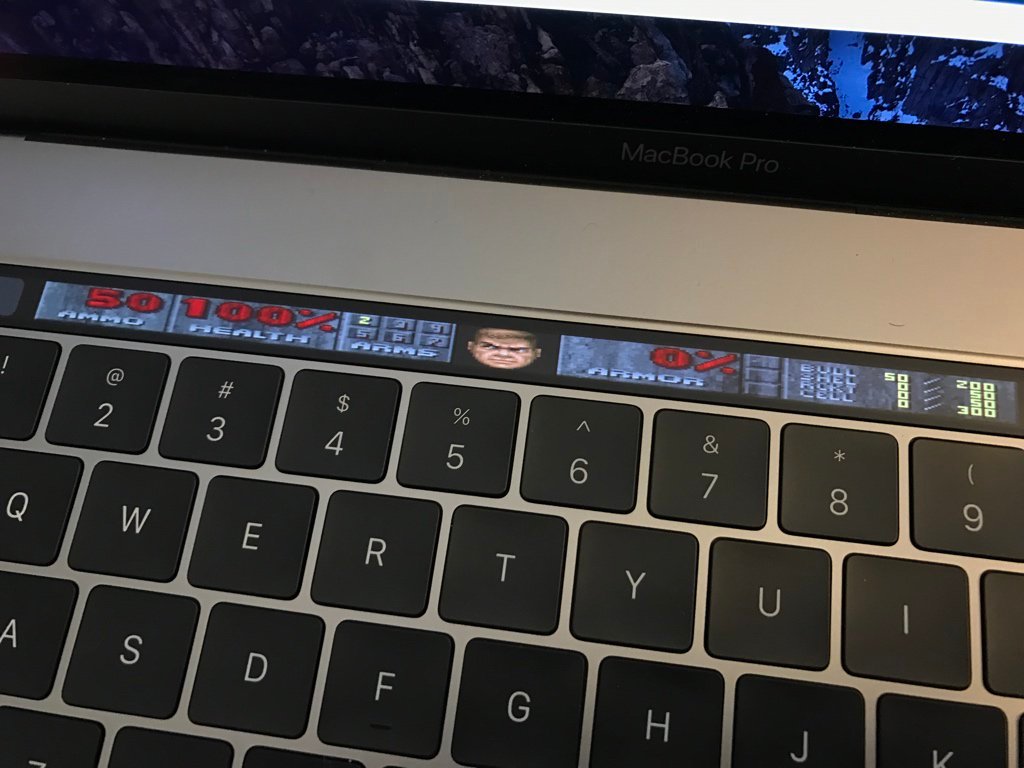
In November 2016, Apple launched the MacBook Pro with the Touch Bar, a thin OLED strip where the function keys used to live, and the entire internet had opinions. iOS engineer Adam Bell had exactly one opinion, and it was the correct one: he got Doom running on the strip itself, within days of the laptop’s release, as AppleInsider and Gadgets 360 reported at the time.
The Touch Bar’s resolution is 2170 by 60. That is not a typo. The game is squeezed into a ribbon sixty pixels tall, a cinematic experience in roughly 36:1 aspect ratio, like watching Doom through a mail slot during an earthquake. You can recognize a door opening. You can hear the shotgun. Everything else is interpretive art. Bell himself joked that the HUD looked great on it, which is the confidence of a man who knows nobody can prove him wrong at that resolution.
The family connection makes it better: the Touch Bar ran on Apple’s T1 chip with a variant of watchOS, and Doom had already been on the Apple Watch since 2015, when Lior Tubi and Mehdi Mulani from Facebook’s Tel Aviv office ported it during a ten hour hackathon using an invisible 3 by 3 grid of touch buttons, as VentureBeat covered. Apple built a tiny watch computer, glued it above a keyboard, charged a fortune for it, and the Doom community treated both versions as free real estate.
Apple has since killed the Touch Bar. Doom remains undefeated. There is a lesson in there somewhere.
10. An IKEA light bulb (2021)
Now we leave the world of screens entirely, because the next host does not have one. In 2021, a hacker collective called Next Hack, led by software engineer Nicola Wrachien, decided to run Doom on the brain of an IKEA Trådfri smart light bulb. A bulb. The thing whose whole job is “bright” and “less bright.”
GameSpot and TechSpot covered the project, and the rules the team set for themselves are what make it art: the game had to run on the bulb’s own microcontroller, no swapping in a bigger brain. Their first attempt failed honestly, because the older Trådfri chip had only 32 KB of RAM, and even Doom has standards. Then IKEA released a newer bulb with an 80 MHz Cortex-M33 chip and 108 KB of RAM, and it was game over for the demons. They added 8 MB of extra flash storage for the game files and attached a small 160 by 128 display, because, and this is important, light bulbs do not come with screens. Some assembly was required. It is IKEA, after all.
The result is a lamp’s brain playing Doom at a perfectly respectable speed, and my favorite part is the philosophy of it: your smart home is full of little computers pretending to be furniture, and every single one of them is a Doom machine in witness protection. The bulb in your ceiling has more in common with a 1993 gaming PC than with the light bulbs your grandparents screwed in. Sleep tight.
9. A LEGO brick (2022)
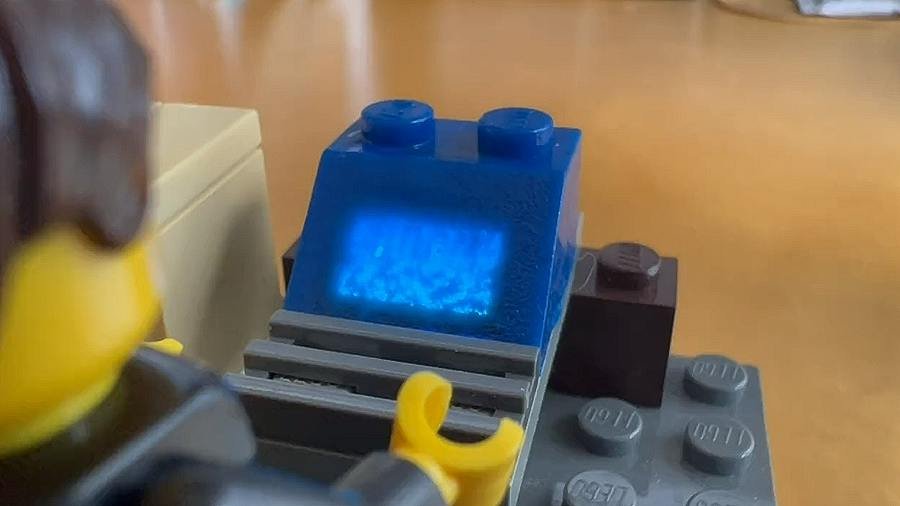
In June 2022, a maker named James Brown asked a question nobody in Denmark’s legal department saw coming: what if the little sloped LEGO computer brick, the one with the screen printed on it, had a real screen? As Hackster and PC Gamer reported, Brown hollowed out the classic brick and installed a 0.42 inch OLED display and a tiny STM32 microcontroller inside the plastic.
The screen resolution is 72 by 40 pixels. Seventy-two. By forty. The whole of Doom, a game about vast Martian bases and armies of Hell, rendered on a postage stamp for ants. It is monochrome, one bit per pixel, and the two studs on top of the brick work as capacitive touch points so you can turn. The brick is wired up as a tiny external monitor, a detail I will be honest about in the fine print, but the photo is real, the game is playable on a LEGO brick, and somewhere a minifigure is having the best day of its plastic life.
Every kid who ever built a LEGO computer desk imagined the little screen turning on. It took until 2022, but the dream shipped. Just do not step on this one barefoot at night. It will hurt, and now it will also corrupt your save file.
8. A John Deere tractor (2022)
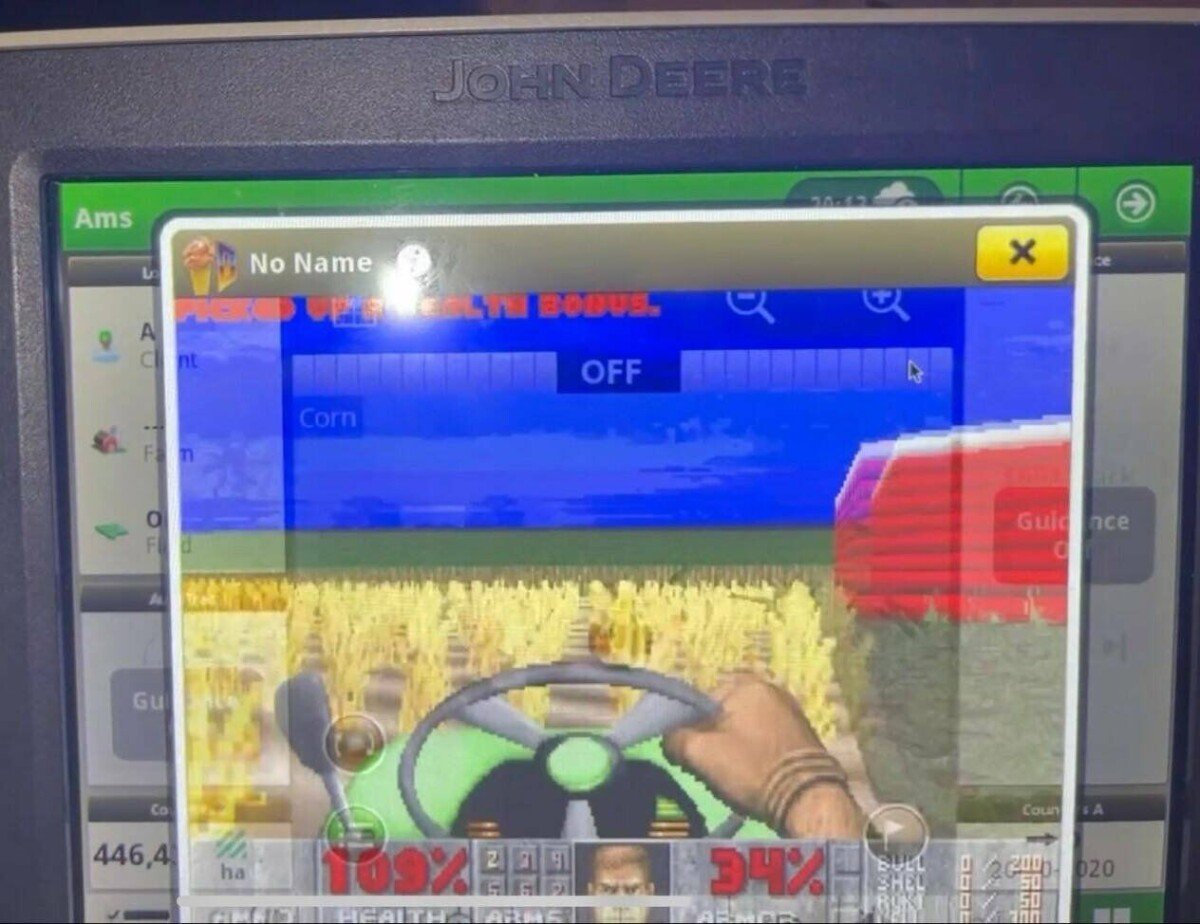
Time to leave the desk and go outside, where the big machines live. At DEF CON 2022 in Las Vegas, Australian security researcher Sick Codes presented a jailbreak of John Deere tractor displays, the 2630 and 4240 touchscreens that run entire farms. As Wired reported and The Drive and TechSpot covered, he had spent months soldering his way past the company’s locks to get root access, mostly to make a serious point about farmers not being allowed to repair their own equipment.
And then, because he is one of us, he proved his total control of the tractor computer the sacred way: he booted Doom on it. Not plain Doom either. He teamed up with New Zealand modder Skelegant, who reskinned the game into a farm themed fever dream, with the action moved to a wheat field. You are a combine harvester of souls. The demons picked the wrong crop.
This might be my favorite entry on the whole list, because the stakes were real. John Deere had spent years telling farmers the software in their tractors was not theirs to touch. Sick Codes answered with months of work, a soldering iron, and a wheat field full of imps. That is not just a port, that is an argument, and the argument won.
You think heavy machinery is the ceiling? A corporation is about to join the meme officially, and then we are going to space. Patience.
7. A robot lawn mower, officially (2024)
Every entry so far was a hacker doing hacker things. This one is a press release. In February 2024, Husqvarna, yes, the chainsaw and lawn people, announced “one hell of an update” for its Automower NERA robot lawn mowers: an official, licensed, free copy of Doom’s first episode, playable on the mower’s own screen and control knob, as Hackster, Bleeping Computer, and Husqvarna’s own press release confirmed.
The controls deserve their own paragraph. You turn with the mower’s control knob. You run by pressing START. You fire by pressing the knob. The mower does not drive while you play, which was considerate of Husqvarna’s legal team. The company had demoed the madness at DreamHack Winter 2023 with what it billed as the world’s first multiplayer Doom tournament on a non-gaming device, then rolled the update out to roughly 30,000 mower owners in April 2024.
And here is the punchline history will remember: on September 9, 2024, a mandatory update removed Doom from the mowers. Gone. Patched out of a lawn. Doom is the only game in history that has been officially released on a robot mower and then officially recalled from one, like a defective airbag made of demons. Also note, for my fellow Americans feeling left out: the update never came to the US or Canada. Freedom, denied by a Swedish mower company. We riot at dawn, right after the lawn is done.
6. Your documents: a PDF, a Word file, and Notepad (2022 to 2025)
At some point the hackers ran out of hardware and started invading file formats, and honestly this era scares me the most, because these are things on your computer right now.
Exhibit A: in January 2025, a high school student named ading2210 released DoomPDF, a fully playable Doom that lives inside a PDF file, as Kotaku and PC World reported. PDFs support JavaScript in Chromium browsers, he compiled Doom into it, and because rendering 64,000 individual text fields per frame would melt the document, each row of the screen is a single text field filled with ASCII characters, drawing the game in six shades of monochrome text at about 12.5 frames per second. It looks like Doom typed by a ghost, and it plays.
Exhibit B: days later, Dutch developer Wojciech Graj answered with Doom inside a single Microsoft Word document, a 6.6 MB file, covered by Tom’s Hardware and TechSpot. The document hides the game data in base64, and a VBA macro unpacks it and runs the game right there in Word at the original 320 by 200 resolution. The catch is my favorite detail in this entire article: to play it, you must enable macros, the exact thing every corporate security training on Earth begs you never to do. Somewhere, an IT manager felt a disturbance.
Exhibit C: the elder of the trio. Back in October 2022, developer Sam Chiet, known as Samperson, got Doom running inside Windows Notepad at 60 frames per second, converting each frame to ASCII text and injecting it into Notepad’s text field sixty times a second, with a completely unmodified Notepad, as Ars Technica explained. The footage is hypnotic. The most boring program on your PC, a program whose entire feature list is “letters appear,” running Doom smoother than some consoles I have owned. John Romero himself amplified the video. When the creator of Doom stops scrolling to watch Doom in Notepad, the bit is complete.
Your homework files are compromised. Your tax documents could be compromised. Nothing is sacred. And we have not even reached the entries where Doom starts eating itself.
5. Doom, inside Doom (2022)
In July 2022, a modder named kgsws found a code execution exploit hiding inside the original DOS version of Doom II, a vulnerability that had sat there, undiscovered in any useful way, for almost three decades. As Hackaday reported, he used it to boot a second, separate copy of Doom, the Chocolate Doom port, inside the first one.
He built a cinema room inside Doom II, walked his Doomguy into it, sat down in front of a giant screen, and played Doom. Inside Doom. The inner game is fully playable, controllable with a key press to swap control between the two copies, and he also got Heretic running in there, because restraint is not a value this community holds. His own documentation notes the double setup wants at least 16 MB of RAM, which in 1993 money was a rich man’s flex, and in 2026 money is a rounding error on a rounding error.
I want you to appreciate the philosophy here. For thirty years, the question was “can this thing run Doom?” In 2022 the answer became “Doom can run Doom.” The snake ate its own tail, the student became the master, and the port became the platform. From here, the list stops being about hardware at all. It gets personal. It gets biological. It gets into orbit. But first, Doom gets a job in website security.
4. The DOOM CAPTCHA (2025)
You know the little test that makes you click every picture with a bus in it to prove you are not a robot? In January 2025, Guillermo Rauch, the CEO of Vercel, looked at that test and said: what if, instead of buses, murder. His DOOM CAPTCHA, covered by TechCrunch and Hackaday, drops you into a slice of Doom’s secret level E1M9 in your browser and gives you one job: kill three demons to prove you are human.
Here is the catch, and it is a beautiful one: the difficulty is Nightmare, the hardest setting, enemies are fast and aggressive, you start with only the pistol, and there is no mouse aim, keyboard only, like it is 1993 and you are in a computer lab you should not be in. The idea had an ancestor, a 2021 version by developer Miquel Camps Orteza that asked for four demons, but Rauch’s version is the one that went everywhere, because nothing unites the internet like watching professionals fail a login test.
Consider the implications. CAPTCHAs exist because bots got too smart for squiggly letters. So humanity’s defense is now a game that bots will, of course, eventually learn to speedrun, at which point the only creatures on Earth who cannot log in will be us. I have failed regular CAPTCHAs with traffic lights. I would fail this one with honor, repeatedly, on purpose, because any excuse to keep playing is a good excuse. A login screen you lose to on purpose is not a security feature, it is a feature feature.
3. A pregnancy test (2020)
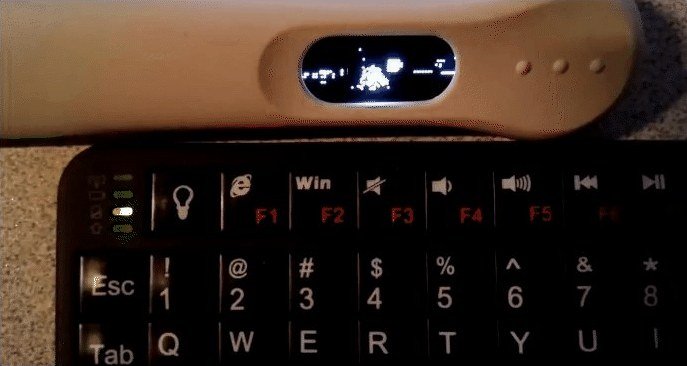
We have arrived at the legend. In September 2020, hardware necromancer Foone took an Equate digital pregnancy test, one of those sticks whose entire user interface is supposed to say “pregnant” or “not pregnant,” and made it play Doom. Gizmodo, GameSpot, and GamesRadar all covered it, John Romero reacted with “Definitely incredible!”, and the photo of that tiny screen became the Mona Lisa of this entire genre.
The display is 128 by 32 pixels, monochrome. That is not a screen, that is a rumor of a screen. Foone first got video playing on it, Skyrim’s intro, Rick Astley, the classics, and then did the real work of making Doom actually playable on it with a little keyboard, gamma cranked up so you can almost see the demons, which at 128 by 32 is doing a lot of heavy lifting. The game is unmistakably Doom and barely visible, like watching a thunderstorm through a keyhole, and it does not matter at all, because the point was never the graphics. The point is that a device designed to detect a hormone looked at id Software’s catalog and said: yes, that one, put it in me.
Now, this entry comes with the most famous asterisk in the whole Doom universe, and Foone, to his eternal credit, never hid it. It is so good it gets its own section below. Keep the asterisk in your pocket. We are almost at the top, and above the pregnancy test there are only two places left to go: up, and inside you.
2. A satellite, in actual orbit (2023 to 2024, told in 2025)
Everything so far had one thing in common: it happened on Earth, like a coward. So let us fix that.
The European Space Agency flies a satellite called OPS-SAT, a “flying laboratory” launched so researchers could experiment with real spacecraft software instead of just simulating bravery. As ZDNet and Tom’s Hardware reported from the Ubuntu Summit in October 2025, Icelandic developer Ólafur Waage and ESA engineer Georges Labrèche got Doom running on it while it was in orbit. Actual orbit. The satellite’s experimental computer ran Ubuntu, they chose Chocolate Doom because it was the version that would build on the satellite’s Ubuntu 18.04 setup, and the first proof of success was gloriously anticlimactic: a line in a log file. Doom was running in space and the only witness was a text log.
That was not enough for them, because it should never be enough for anyone. The satellite has no screen, so they used doomgeneric to render frames as screenshots onboard, and then they did the single coolest cosmetic mod in the history of this list: they took photos of Earth with the satellite’s own camera and swapped them in as the sky inside Doom. Doomguy was no longer under the red skies of Mars. He was under the real sky, photographed from orbit, by the machine he was running on. The satellite has since been decommissioned and burned up in the atmosphere in 2024, which means Doom’s most extreme platform no longer exists. It died in orbit, undefeated.
And because this story refuses to end, the family business continued: the OPS-SAT PRETTY satellite, a sister experiment, was later commanded by a spoken human voice over amateur radio to launch Doom, the first time a satellite has ever taken a voice command, according to the project’s own page. A man spoke into a microphone in Oslo and a machine in space started playing Doom. We are not the main characters of technology anymore. We are its voice actors.
There is exactly one frontier left, and it is not up. It is in.
1. Your gut bacteria (the final boss)
In 2023, MIT biotechnology researcher Lauren “Ren” Ramlan presented a project for a synthetic biology class with a title that belongs in a museum: “1-Bit Pixels Encoded in E. coli for the Display of Interactive Digital Media.” Coverage from Rock Paper Shotgun, Ars Technica, and half the internet followed in early 2024, because what she designed is the most unhinged display technology ever proposed: Doom, rendered by gut bacteria.
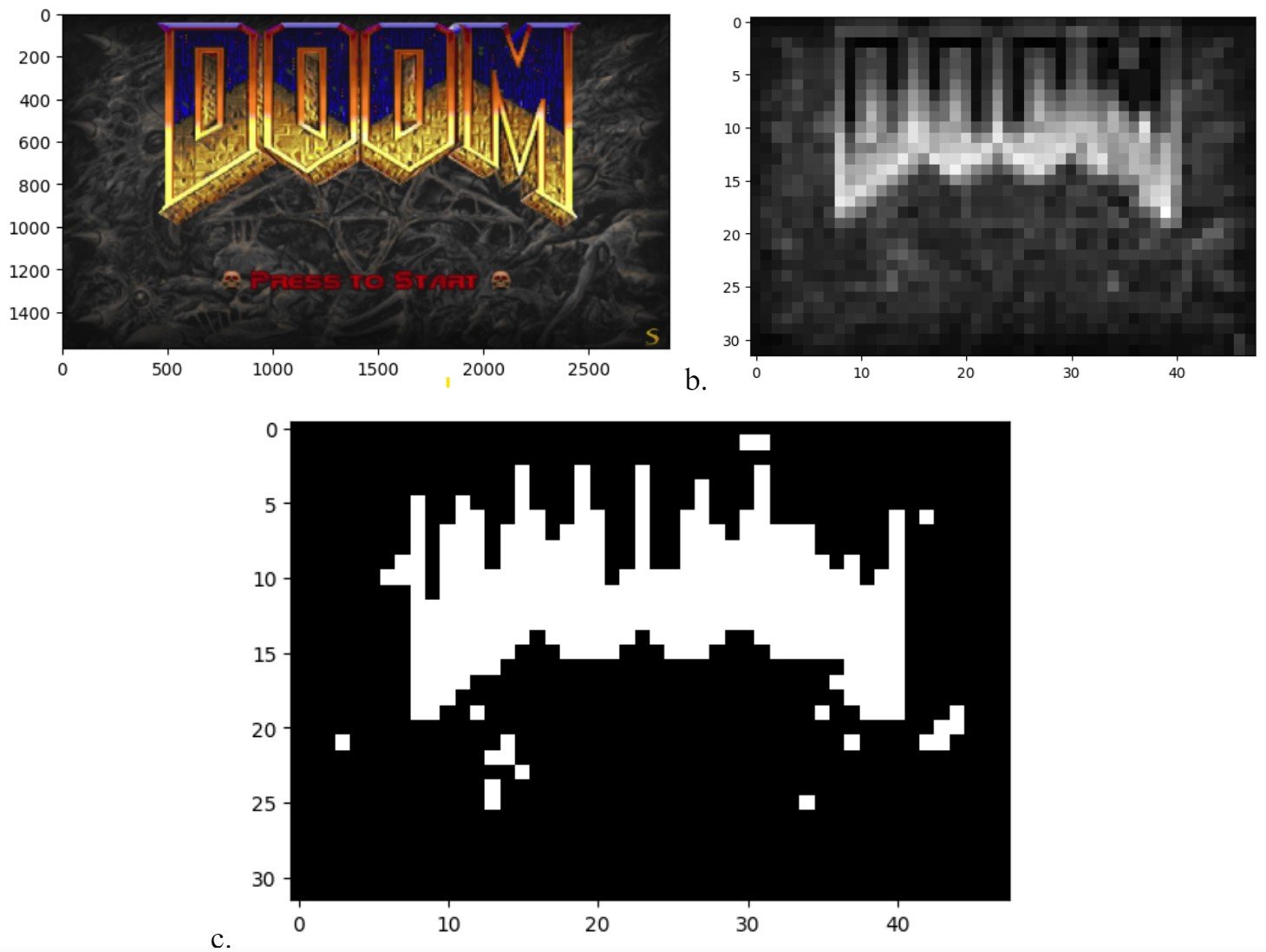
Here is the design, and it is real science wearing a clown nose. Take a grid of 32 by 48 wells of E. coli. Engineer the cells so each one can be switched to glow with a fluorescent protein, or not. Now every cell is one pixel, one bit, glowing or dark. Feed the grid a frame of Doom shrunk down to 32 by 48 black and white, and the bacteria become the screen. The game itself runs on a normal computer. The bacteria are the monitor. The slowest, wettest monitor in the history of computing.
Because now we do the math, and the math is where I lose my mind. In Ramlan’s model, a cell takes about 70 minutes to reach full glow, and about 8 hours and 20 minutes to complete its cycle and be ready for the next frame. That is a frame rate of roughly 0.00003 frames per second. Three frames per day, if the bacteria are having a good day. A normal playthrough of Doom takes around five hours of game time. At this frame rate, her calculation says finishing Doom on the bacteria display would take about 599 years. Start a run today, play perfectly, no deaths, and your descendants twenty generations down the line can gather around the tray to watch you beat the final boss sometime in the year 2625.
Every other entry on this list asked “can it run Doom?” This one asks “can Doom outlive us?” and the answer is yes, Doom will be playing inside a tray of bacteria long after every console I own is dust. Civilizations will rise and fall at 0.00003 frames per second. Empires will crumble before E1M2 loads. It is not the fastest Doom. It is not the prettiest Doom. It is the Doom with the longest deadline, and for that, it takes the crown.
The fine print: an honest asterisk section
I love this genre too much to lie to you, so let us do the receipts, because half the fun of “it runs Doom” is arguing about what “runs” means. There are levels to this game, and the community knows it.
The pregnancy test is a shell. Foone said it himself, in plain text, from day one: the original test’s chip cannot be reprogrammed and its little LCD can only show a few preset messages, so he replaced the display with a 128 by 32 OLED and replaced the microcontroller too. What remains of the pregnancy test is the plastic housing. Is it Doom on a pregnancy test? It is Doom in a pregnancy test’s body, which by Theseus rules and by comedy rules, counts. But you deserve to know.
The LEGO brick is a monitor, not a computer. James Brown was upfront about this too: the brick’s little chip drives the display, but a PC off camera renders the game and sends the picture. Same family as the first vape demo, by the way: Christophel’s original Aspire PIXO setup streamed the game from a PC over USB because the vape’s 64 KB of RAM could not hold Doom alone. Per his project page, a stripped-down native port built to run in almost no RAM came later, which means the vape eventually earned the belt for real. Redemption arc, on a vape.
The bacteria never touched a real game. Ramlan’s project is a rigorous design and a simulation, not a physical tray of glowing E. coli playing Doom in a lab right now. The cells are the display in the design, the computer does the thinking, and the 599 year runtime is her calculated model. It is still the funniest scientific paper I have ever read, and the math is the joke, so it keeps the crown.
The fridge was streaming, and it was the wrong Doom. The viral 2020 Samsung fridge video, by Richard Mallard, was Doom Eternal, the modern game, streamed through Xbox cloud gaming sideloaded onto the fridge, as The Verge and Polygon reported. Impressive? Yes. The 1993 original running natively on a fridge? No. The fridge is a cheater and everyone in the community knows it.
The McDonald’s kiosk photo was fake. The famous 2022 image of Doom on a self-service kiosk was a Photoshop of a photo of a kiosk showing the Windows blue screen of death, as GameSpot’s own update admitted. The cash register story above was real, with a name and a USB stick. The kiosk remains undefeated territory, and I respect it for holding out.
And the Porsche 911 was a hoax. The legendary 2017 video by YouTuber vexal, claiming you could play Doom II on a Porsche 911 using the steering wheel to turn, the shifter to swap weapons, and the horn to shoot, was an elaborate prank, as HotHardware and others debunked at the time. It fooled half the gaming press for a weekend, including some very serious car websites. I include it here with love, because a fake this good is part of the mythology now. But it is fake, and on this site we label our lies.
So the honest scoreboard is: most of these are real, a few are displays and streams wearing a trench coat, and two famous ones are fiction. The law survives anyway. The law always survives.
My shelf: Doom already lives at my house
Here is the part where I confess something. I did not need the internet to teach me that Doom runs on everything. I own the evidence.
My shelf has five jailbroken consoles on it: a Wii, a Wii U, a PSP, a PS Vita, and an Xbox 360, every one of them unlocked, and every single one of them runs Doom. The homebrew scene made sure of it. There is Wii-DOOM, a Chocolate Doom port that runs on the Wii and on the Wii U through its Wii mode, because of course the Wii U emulates a Wii and the Wii runs Doom, so the Wii U runs Doom squared. The PSP has its own long line of Doom ports, including PSP Legacy. The PS Vita has VitaDoom, one of the first things anyone installs after cracking a Vita open. The 360 has homebrew Doom ports too. My shelf is not a collection, it is a Doom distribution network with dust on it.
And then there is the PS5, sitting there stock, clean, untouched, firmware exactly where Sony wants it. Because in this house we have one rule, and the rule is older than the jailbreak article I wrote for this very site: the old consoles can do whatever they want, but the current machine stays pure for launch day. The Wii can run Doom. The Vita can run Doom. The PS5 runs GTA 6 on November 19 or it runs nothing. Priorities are priorities, and even Doom, the immortal, the unstoppable, the game that lives in light bulbs and bacteria, respects the queue.
What still does not run Doom (an open challenge)
After all this, is there anything left? A few white whales remain, and I am putting them in writing so the hackers know where the glory is.
As far as I can find, there is still no properly verified washing machine port. Smart fridges cheated with streaming, robot mowers surrendered, light bulbs fell, and the humble washing machine stands there with its little display and its spin cycle, undefeated. Whoever does it will be a legend. Bonus points if the boss fight syncs with the spin cycle.
Nobody has run Doom on GTA 6 yet, obviously, and I am not encouraging anyone, but let us be honest about the timeline: the modders had Doom on a mower before the mower company did, so give the PC version a weekend. And somewhere out there is a device with a chip and a screen that has never been tested, sitting in a drawer, waiting for its destiny. A thermostat. A hotel safe. A gas pump. The law does not sleep.
That is the real story underneath all the jokes. Doom is not just a game anymore. It is a unit of measurement. It is how we check if a machine is truly ours: can we make it do the stupidest, most joyful, most pointless thing possible? If yes, the machine belongs to us. If no, we do not own it, we are just renting it from a company.
Doom is forever. It was true in 1993, it was true on a printer, it is true on a vape in 2025, and when I am standing in line at midnight on November 19 with my stock, pure, launch-ready PS5, I will be thinking about the fact that the most demanding game ever made is about to move into my house, while the least demanding one already lives in my light bulbs. See you at launch. Bring storage space. The bacteria will still be on frame one.
Sources
– Notebookcheck and VideoCardz (September 2025): Aaron Christophel’s Doom on the Aspire PIXO vape, hardware specs, and the original screen-sharing approach; the native port details are from Christophel’s own project page on GitHub (atc1441).
– Gizmodo, GameSpot, and GamesRadar (September 2020): Foone’s playable Doom on the Equate pregnancy test, including Foone’s own disclosure about the replacement OLED and microcontroller.
– The Register, BBC News, and Engadget (September 2014): Michael Jordon of Context Information Security running Doom on a Canon Pixma printer at 44Con.
– Hackaday, via PCWorld and GameSpot (July 2014): Aussie50 and friends running Doom on an NCR Personas ATM with an I-PAC2 board.
– Kotaku Australia, via GameRant and ComicBook.com (October 2019): Ryan Edgar’s Doom on a McDonald’s cash register. GameSpot (July 2022, updated): the McDonald’s kiosk photo was a Photoshop.
– AppleInsider and Gadgets 360 (November 2016): Adam Bell’s Doom on the MacBook Pro Touch Bar; VentureBeat (2015): the Apple Watch port by Lior Tubi and Mehdi Mulani.
– GameSpot and TechSpot (June 2021): Next Hack’s Doom on the IKEA Trådfri light bulb hardware, led by Nicola Wrachien.
– Hackster and PC Gamer (June 2022): James Brown’s Doom on a LEGO computer brick.
– Wired, via The Drive and TechSpot (August 2022): Sick Codes’ John Deere jailbreak at DEF CON 2022, with Skelegant’s farm-themed Doom build.
– Husqvarna press release, Hackster, and Bleeping Computer (2024): the official Doom update for Automower NERA mowers, its April 2024 launch and September 2024 removal.
– Kotaku and PC World (January 2025): ading2210’s DoomPDF. Tom’s Hardware and TechSpot (January 2025): Wojciech Graj’s Doom in a Microsoft Word document. Ars Technica (October 2022): Sam Chiet’s Doom in Notepad.
– Hackaday (July 2022): kgsws running Doom inside Doom II via a code execution exploit.
– TechCrunch and Hackaday (January 2025): Guillermo Rauch’s DOOM CAPTCHA; the 2021 original concept was by Miquel Camps Orteza.
– ZDNet and Tom’s Hardware (October 2025): Ólafur Waage and Georges Labrèche running Doom on ESA’s OPS-SAT satellite, with the satellite’s Earth photos as the in-game sky. The voice-command follow-up on OPS-SAT PRETTY is from the Tanagra Space project page.
– Rock Paper Shotgun and Ars Technica (early 2024), reporting Lauren Ramlan’s MIT project “1-Bit Pixels Encoded in E. coli for the Display of Interactive Digital Media” (2023): the bacterial display design, frame timing, and the roughly 599 year playthrough calculation.
– The Verge and Polygon (October 2020): Richard Mallard streaming Doom Eternal to a Samsung smart fridge via Xbox cloud gaming.
– HotHardware (February 2017): the debunk of vexal’s Porsche 911 Doom video as a hoax.
– ticalc.org archives and GameBrew and GBAtemp: calculator Doom ports in the TI-83 lineage, Wii-DOOM, PSP Doom ports, and VitaDoom homebrew.
Leave a Reply