By Ruan Martini, Daily Checkpoint
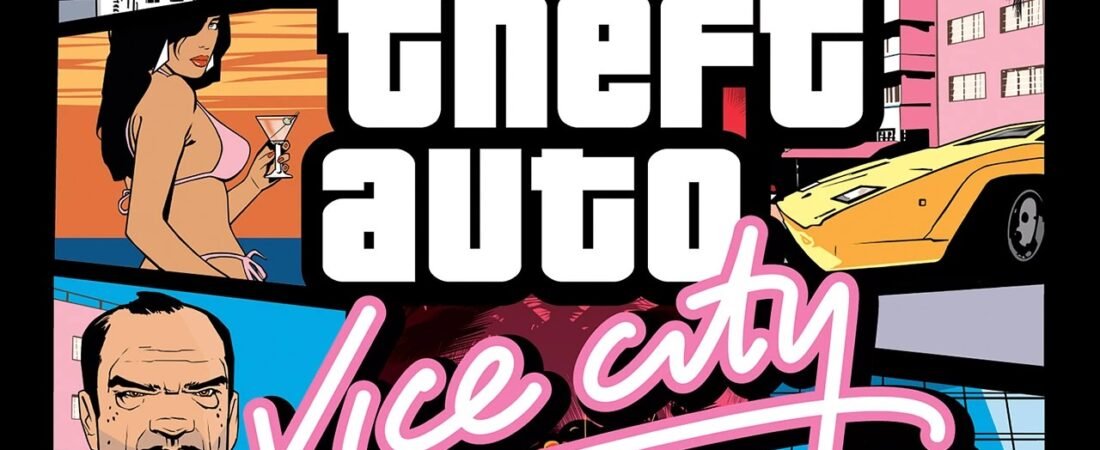
On November 19, a little over three weeks from now, I walk back into Vice City. Not the real one, not Miami. The Rockstar one, the neon one, the one that has been sitting in my head rent free for most of my life. GTA 6 is almost here, Jason and Lucia are about to take the wheel, and before the new game swallows my schedule I did the responsible thing: I went back to the 2002 original and played the ancestor.
I was four years old when Grand Theft Auto: Vice City launched. My Vice City came later, like it did for a lot of kids who grew up outside the US and met these games through older cousins, borrowed discs and eventually PC copies. Dan Houser, who co-wrote the thing, pointed out the time trick in a recent interview: his team made the game in 2002 and set it in 1986, which means the 80s were only sixteen years behind them. We are now twenty-four years past the game itself. We are farther from Vice City than Vice City was from the actual 1980s. Sit with that for a second, because it explains both why this game feels like a museum piece and why it still feels alive.
Built in about a year, out of spare parts
Vice City was never supposed to be this big. According to Edge magazine’s retrospective on the game, it started life as an expansion for GTA 3, extra weapons, vehicles and missions for Liberty City. The pile of content kept growing until Rockstar North, the Edinburgh studio behind the series, spun it off into a full game. GTA 3 had launched in October 2001. Vice City shipped on October 29, 2002. That is roughly thirteen months to build an entire new city, a new story and the most confident sequel of that console generation.
The budget tells the same underdog story. Wikipedia’s development history puts the cost at about 5 million dollars, which made it Rockstar North’s most expensive game at the time. Read that number again and then look at what games cost now. Five million. There are single trailers in 2026 with bigger catering budgets.
The team, led by producer Leslie Benzies with Sam and Dan Houser steering the creative side, announced the game at E3 on May 22, 2002, went gold by October 15, and had to push the release back a week, from October 22 to October 29, because they needed to print enough discs to meet demand. It launched as a PlayStation 2 exclusive. PC players waited until May 2003, and the Xbox version arrived later that year.
Why Miami, why 1986? Benzies described Miami as “a party town, all sun and sea and sex, but with that same dark edge underneath,” and Sam Houser called the period “the grooviest era of crime.” The art team took research trips to Miami, and art director Aaron Garbut used a certain TV show as the reference point for the neon. Which show brings us to the DNA test.
Scarface in the walls, Miami Vice in the paint
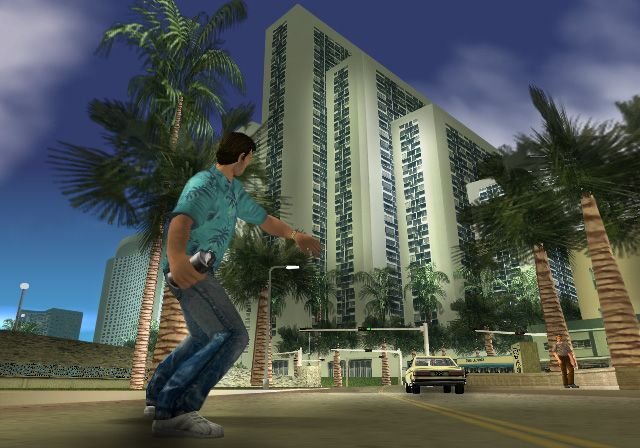
Every game has influences. Vice City wears its influences like Tommy wears that first suit: loud, unbuttoned and proud of it, and this is not me guessing. Dan Houser named the recipe himself in that same recent interview: “Scarface, Miami Vice, and our ’80s childhoods.”
Scarface, Brian De Palma’s 1983 film, is the skeleton. A nobody arrives in Miami with nothing, gets burned in a drug deal gone wrong, and claws his way up the cocaine ladder until the city is his. That is Tommy Vercetti’s arc almost beat for beat. The game keeps winking at the film: an apartment early on recreates the movie’s infamous chainsaw scene, and Tommy’s story ends with a mansion assault on Starfish Island that plays like the film’s finale rewritten by a player who refuses to lose. Tony Montana dies face down in his own fountain. Tommy wins. Vice City is Scarface with the good ending, and the game knows it.
Miami Vice, the TV series that ran from 1984 to 1989, is the skin. The pastel palette, the art deco hotels on Ocean Drive, the neon soaked into every night street, the suits with the sleeves pushed up. The development team watched the show throughout production, and the casting department went one better: Lance Vance, Tommy’s partner, is voiced by Philip Michael Thomas, who played Detective Tubbs on Miami Vice itself. Tommy and Lance’s dynamic was deliberately built to echo Crockett and Tubbs, only with the cops replaced by the criminals they used to chase. Even the cars nod along. The Stinger and the undercover Cheetah in the game trace their lines back to the Ferraris Crockett drove on the show. Wikipedia’s development notes also credit Carlito’s Way for some of the character shading, and you can feel it in Ken Rosenberg, the twitchy lawyer who is one bad phone call away from a heart attack at all times.
Tommy talks, and Ray Liotta does the heavy lifting
Here is a series first that changed everything and gets taken for granted now: Tommy Vercetti speaks. Claude, the GTA 3 protagonist, was silent for a whole game. Tommy never shuts up, and the voice coming out of him belonged to Ray Liotta, Henry Hill himself, fresh in every player’s mind from Goodfellas.
The stories around that casting are gold, and they come from Houser’s own recent interviews looking back at the game. Rockstar cold-called Liotta’s agent and offered a fee for what was pitched as roughly four days of work. There was a dinner the night before recording where the team was, understandably, a little terrified of their own leading man. Then came two days in a New York studio, a rough first pickup session in Los Angeles months later, and a second day where Liotta settled in and knocked out around five hours of lines in one go. Houser’s verdict on the whole experience is the most honest credit a writer can give an actor. He has said, in as many words: “My writing’s awful, and he made it sound good.”
It was not all smooth. Director Navid Khonsari found Liotta difficult on set, Sam Houser remembered sessions where the actor was “very dark and couldn’t work,” and after the game exploded, Liotta reportedly complained he had been underpaid for the role. What matters for the game is what is on the disc: 8,000 lines of recorded dialogue, four times what GTA 3 had, wrapped around a cast that reads like a casting director showing off. Burt Reynolds, Tom Sizemore, William Fichtner, Dennis Hopper, Danny Trejo, Luis Guzman, Gary Busey, Lee Majors, Deborah Harry, Jenna Jameson. In 2002, that was not a video game cast. That was a crime film that happened to ship on a disc.
Liotta died in May 2022, at 67, and GameSpot’s obituary put his Tommy right next to Goodfellas in the first paragraph, which tells you where the performance landed in his legacy. When I hear Tommy now, I hear a guy who treated a weird side gig in a booth like it was a Scorsese picture. The whole series has been chasing that energy since.
The radio did half the acting
Ask ten people for their first Vice City memory and eight of them will hum something. The soundtrack was not decoration. It was the second protagonist.
The raw numbers, from the game’s development record: over nine hours of music, more than 113 songs and commercials, and only a handful of original tracks in the whole package. Almost everything was licensed, which was nearly unheard of at that scale in 2002. Nine stations covered the dial: Flash FM for the pop sugar, V-Rock for the hair metal, Wave 103 for the new wave, Fever 105 for the soul and funk, Emotion 98.3 for the power ballads, Radio Espantoso for the Latin jazz, Wildstyle for early hip hop, plus the KCHAT and VCPR talk stations arguing with themselves in the background. Rockstar and Epic Records even sold the thing separately as a seven CD box set, which GameSpot noted was the first major mainstream release of a video game soundtrack in the United States.
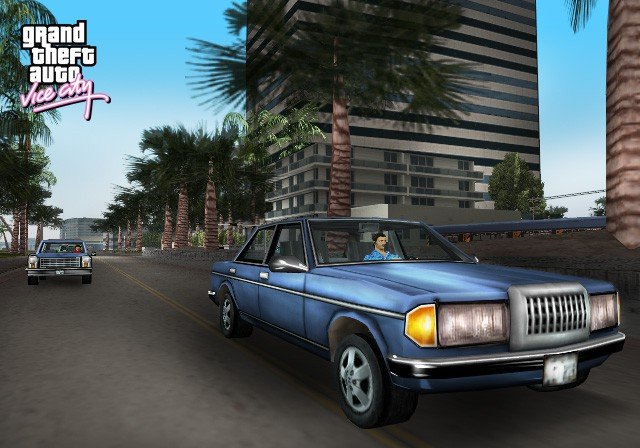
And the game knew exactly what it had. Your first real car ride in Vice City is scored to Michael Jackson’s “Billie Jean” on Flash FM. That is not an accident, that is a thesis statement. Music tells you what year it is, what city you are in and who Tommy wants to be, faster than any cutscene could.
The sad footnote is licensing. Songs expire, contracts end, and the GTA Wiki’s radio documentation confirms that re-releases from the 2012 mobile edition onward quietly lost tracks. Wave 103 kept its full original lineup; other stations did not. So the Vice City you can buy today is a few songs less 1986 than the one that shipped in 2002. Hold on to your old discs, people. They are the director’s cut.
The receipts
Nostalgia is nice. Numbers are better. Vice City was not a cult hit that grew over time, it was a detonation.
Within 24 hours of release it sold over 500,000 copies. Within two days it was at 1.4 million, which made it the fastest-selling game in history at that moment. NPD’s year-end data, reported by GameSpot at the time, made it the best-selling video game of 2002 in the United States, ahead of everything, including its own predecessor sitting at number two. Critics matched the crowd: a 95 on Metacritic from 62 reviews, the highest-rated PlayStation 2 game of 2002, with IGN scoring it a 9.7.
The long tail kept going. Trade publication Next Generation calculated that by July 2006 it was still the best-selling PS2 game in the American market, with an estimated 7 million US copies and 300 million dollars in US revenue alone. The PlayStation 2 version by itself accounts for about 14.2 million copies according to Wikipedia’s sales summary. And the lifetime total? This is my favorite receipt in the whole article. Take-Two’s own figure, reported back in March 2008, is 17.5 million copies. In February 2026, Take-Two’s lawyers filed a trademark complaint against a sandwich shop that wanted to call itself Vice City Subs, and Stephen Totilo’s Game File dug into the filing: nearly eighteen years later, the lawyers were still citing the same 17.5 million. The GTA Wiki claims over 20 million as of 2011, and maybe the true number lives somewhere in that gap, but I love that the official story of this game’s sales ends with lawyers, a sandwich shop and a number nobody has updated since the PS3 era. Five million dollars to make. Seventeen and a half million copies at minimum. Do that math and try not to laugh.
Two islands and a bridge
Now the part that hits different in 2026: the map is small. Properly, honestly small.
Community map measurements, the fan-made kind where people trace every street, put the 2002 Vice City at about 9.11 square kilometers of total map, roughly 3.5 square miles, water included. Two islands, Vice Beach and the mainland, joined by bridges, with the second half of the city locked away until the story opens it. You can drive the thing in a few minutes. By the same fan measurements, GTA 5’s Los Santos and Blaine County cover about 75.84 square kilometers, more than eight times the footprint. And GTA 6 goes bigger still: the Edge cover story on the new game, which we broke down on this site, describes the state of Leonida as roughly twice the size of GTA 5. Community satellite overlays built from the trailers go further and suggest the entire 2002 map fits inside the new Vice City alone a couple of times over. None of that is Rockstar-published data, so hold it as fan math, but the direction is not in doubt.
Here is the twist I did not expect on this replay: the smallness is a feature in my memory, not a bug. With nine square kilometers, I learned Vice City the way you learn a neighborhood. I still know the run from the Ocean View Hotel to the Malibu Club like I drove it yesterday. Bigger maps gave the series scope; this one gave it intimacy. Leonida will bury it on size by an order of magnitude, and part of me is thrilled, and part of me knows I will never memorize the new one the way I memorized this postage stamp with neon.
What aged well
The bones are embarrassingly strong for a game built in thirteen months.
The empire loop is the headline. Halfway through the story, Vice City stops being a mission list and becomes a business portfolio: buy the Print Works, the Malibu Club, the InterGlobal film studio, the taxi firm, do their jobs, and watch the money roll in while those businesses feed back into the finale. Games are still copying that structure. Vice City did it in 2002, and the asset missions feel like story because they are story: every purchase is Tommy tightening his grip on the city.
Then there is the list of series firsts hiding in plain sight. Motorcycles did not exist in GTA 3; Vice City put half its personality on two wheels. Real helicopters and a seaplane replaced GTA 3’s clipped-wing Dodo, which could barely stay airborne. You could change outfits, walk into interiors like the Malibu and the mall, and rob stores for petty cash. Edge’s retrospective calls out the ambient side missions and the sense that the citizenry exists beyond being props, and that is the game I remember: dense with intent, even when the streets look sparse now.
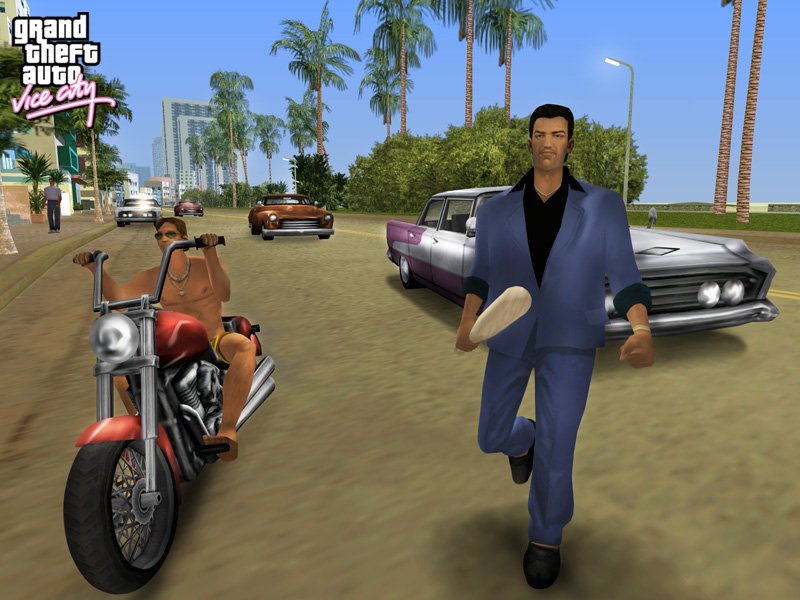
And the art direction cheat code still works. The polygons are 2002, the draw distance is 2002, but the pastel sky at sunset over Ocean Drive does more for this game’s looks than a remaster ever could. Style ages. Specs do not.
What aged badly
Now the honesty tax, because worship helps nobody.
Tommy Vercetti, king of Miami, cannot swim. Deep water is an instant death sentence in Vice City, a fact your muscle memory will rudely rediscover the first time you overshoot a bridge. Swimming only arrived with San Andreas in 2004, a game I have already filed my feelings about, and going back to a Tommy who drowns in a marina feels like a prank.
The save system is pure 2002 discipline. You save at cassette icons in safehouses, there are no mission checkpoints, and when a long mission goes sideways you do the drive of shame back to the start and do the whole thing again. Veterans still wake up sweating about a certain remote control helicopter mission involving a construction site. I will not name it. You know it. We all know it. It knows us.
The aiming and camera belong to their era too, a lock-on system with the precision of a weather forecast, and the famous coastal fog that made the map feel mysterious was also the PS2 hiding its homework, keeping the draw distance short. The 2021 Definitive Edition should have been the clean way back in, and its launch was rough enough that Rockstar ended up apologizing for the state of the trilogy. The original deserves its legend. It does not deserve blind loyalty, and neither does any remaster.
Going home
So where does that leave the 2002 game, three weeks out from GTA 6?
It leaves it as the postcard. Vice City was sixteen years of nostalgia compressed into a five million dollar game by people who had lived the era, carried by a movie star who thought he was doing four days of booth work, and scored by the greatest licensed radio in the medium’s history. It is small, it is stiff in places, it cannot swim, and I would still rather cruise its Ocean Drive at sunset than half the open worlds released this year.
On November 19, I will be live at midnight, work the next morning, no regrets, and my first drive in Leonida has a destination: I want to find the new Ocean Drive, park whatever Jason is driving, and just listen to the radio for a minute. Twenty-four years after Rockstar shrank Miami into nine square kilometers and changed the industry, the series is finally coming home to the city that made it. The new place is bigger. The question the whole launch will answer is whether bigger can feel that personal again.
First street you are visiting when you land: tell me yours in the comments. Mine is already picked.
Sources
Wikipedia, Grand Theft Auto: Vice City (development history, $5 million budget, release dates and delay, 8,000 lines of dialogue, soundtrack totals, sales milestones, 14.2 million PS2 copies). Metacritic, Grand Theft Auto: Vice City (95 from 62 reviews, highest-rated PS2 game of 2002). GameSpot (NPD 2002 year-end sales; Vice City soundtrack CD series and its US first; Ray Liotta obituary). Game File, Stephen Totilo (February 2026 Take-Two trademark filing against Vice City Subs, 17.5 million figure), via GTABOOM and TheGamer. GamesRadar+ (Dan Houser on Ray Liotta, October 2026; Edge magazine retrospective, series firsts and the expansion origin). CBR (Houser naming Scarface, Miami Vice and “our ’80s childhoods”; the sixteen-year observation). GTA Wiki (radio stations, licensed music, soundtrack cuts in post-2012 re-releases). Community map measurements via GTA6Map, ExpertBeacon and WikiGTA VI (2002 map at 9.11 km², GTA 5 at 75.84 km², trailer-based Leonida overlays). Edge magazine issue 430, GTA 6 hands-on (Leonida at roughly twice GTA 5).
The Checkpoint Poll
Leave a Reply