Every franchise has a biggest game. Valhalla is the rare case where biggest is not an opinion, it is an accounting fact.
By Ruan Martini, Daily Checkpoint, November 1, 2026
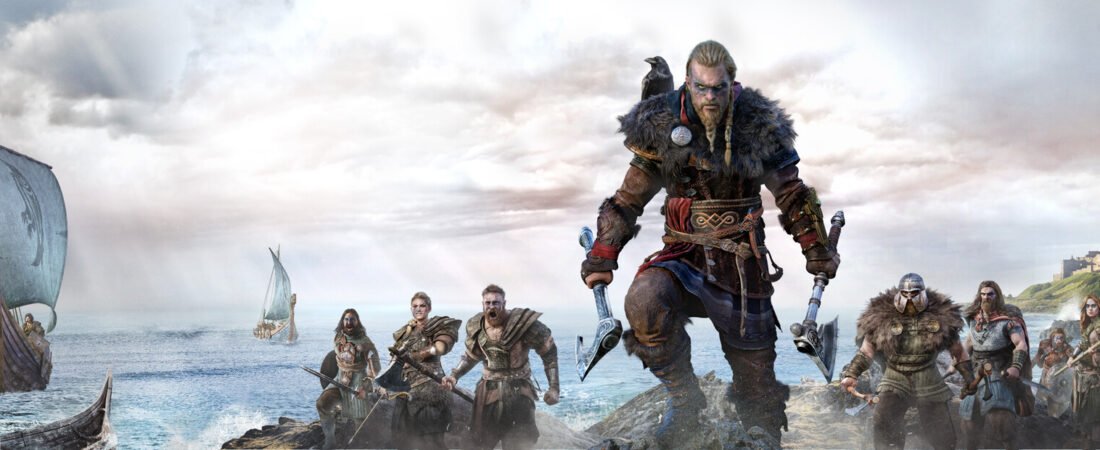
Eivor, the raven, two axes and a beach full of bad decisions. Image: Ubisoft.
Let me set the scene the way I remember it. November 2020. A brand new console generation was launching in the middle of a pandemic, half the world was stuck at home, and Ubisoft decided the correct answer to all of it was a Viking. Not a Viking cameo, not a Viking skin. A full ninth century saga about leaving Norway, landing in England, and building a home with an axe in each hand. I respect a swing like that. Assassin’s Creed Valhalla is the biggest swing this series ever took, and by the only scoreboard publishers truly care about, it is also the biggest hit the series ever had. It is the first Assassin’s Creed game to pass one billion dollars in consumer revenue. Say that sentence slowly. One billion. With a B. From a game about people who paid for things by stealing other people’s things.
And yet, if you bring up Valhalla in a room full of Assassin’s Creed fans, the first word you hear is not billion. It is long. This is the game that turned “how long is it” from trivia into a personality test. Both things are true at the same time, and that tension is the whole story of this game. Valhalla promised an epic. It shipped an epic. Then it kept shipping the epic for two more years, until the epic needed its own map legend. Let us go through it properly, the way this series of retrospectives does it: the promise, the game, the receipts, and where the Raven Clan stands now.
The Promise: A Viking Saga, Not a Viking Skin
Ubisoft revealed Valhalla in April 2020, and the pitch was wonderfully specific. You would play Eivor Varinsdottir of the Raven Clan, male or female, your choice, swappable through the Animus if you changed your mind. The year is 873 AD. Norway has run out of room and food, so your clan crosses the sea to England, a broken country of rival kingdoms, and tries to build a permanent home called Ravensthorpe on land that other people already consider theirs. That is a fantastic setup for this series, because it is not just conquest. It is immigration with swords. The fantasy was not “be a tourist in history,” the way some earlier games felt. The fantasy was “found something, grow it, defend it, and watch it change because you were there.”
The marketing also promised a course correction from Odyssey. Stealth players had spent two games feeling like guests at an RPG party, so Valhalla promised the hidden blade back on the wrist, one hit assassinations back on the table, and social stealth back in crowds. Combat would get heavier and meaner, dual wielding almost anything, shields back in hands, finishers with real weight. And the whole thing would ride into the new console generation as a launch window
showpiece. Ubisoft even moved the release date up a week, from November 17 to November 10, 2020, so Valhalla would land on the exact day the Xbox Series X and S arrived. Confidence is a release date you move closer, not further away.
What Shipped: A Settlement, Four Kingdoms and an Axe for Every Occasion
The game that arrived on November 10, 2020 was enormous in a very deliberate shape. Ubisoft Montreal led development, with fourteen other Ubisoft studios contributing, and you can feel that army in the geography. England is divided into territories, and Eivor’s story is structured as a series of alliance arcs: pledge to a region, work through its local saga of kings, traitors and family drama, secure the alliance, come home. It plays like a season of a prestige TV show where every few episodes change the cast and the accents. One arc is a murder mystery in the fog. Another is a full siege. Another is a weird, sad little story about a lord who lost everything. Some arcs are better than others, and I will get to that, but the structure itself was smart. It gave a gigantic game a heartbeat.
Holding it all together is Ravensthorpe, and I will defend this settlement with my life. You start with tents and a longhouse skeleton, and as you raid monasteries for supplies (yes, the game makes raiding churches an economy, the monks of 873 had a rough year) you build the blacksmith, the stable, the barracks, the tattoo shop, the bakery, the fishing hut. Every building unlocks something real. Every returning raider fills the place out. Games love telling you a place is your home. Valhalla is one of the few that makes you pour the concrete, and coming back after a brutal arc to see your people eating, drinking and arguing around the fire hits different when you built the fire.
The moment to moment game is the RPG trilogy at its most confident and its most stubborn. Combat is heavy, stamina based, and cheerfully violent, with a stun system that ends fights in executions that would make a Mortal Kombat character take notes. You can dual wield shields if you want. I did. It works better than it should. The old checklist of side quests is mostly gone, replaced by World Events, short strange encounters scattered across the map: a woman convinced her house is haunted, a man who wants you to fight his pet, a flyting duel where a Viking insults your mother in rhyme and you rhyme back for money. Flyting alone justifies the entire game. It is a rap battle in Old Norse country, and it is perfect.
Underneath it all sits a design decision I still think about: Valhalla mostly throws away hard level gates. Your power level comes from a giant constellation of skills you fill in star by star, in three branches themed around the raven, the bear and the wolf, and regions carry suggested power rather than invisible walls. A stubborn player can wander into dangerous country early and simply fight better. That freedom, plus a proper set of difficulty dials for combat, exploration and stealth, made this the most adjustable game in the series at the time. And when the England story needs a pressure valve, the game opens the door to Asgard and Jotunheim, full playable myth arcs where Eivor dreams as Odin. Other series do a dream sequence. Valhalla does two extra maps and a god complex. Restraint was never invited to this production, and honestly, the audacity is part of the charm.
And yes, the Assassin stuff is there, more than in Odyssey. The hidden blade is yours early. A settings option called Advanced Assassination restores guaranteed kills on stronger enemies if you nail the timing window, which is Ubisoft quietly handing the old fans their toy back. You also meet Basim and Sigurd, watch the Hidden Ones operate in England under their Roman era name, and follow a main story that goes to some genuinely bold places in its final act. The modern day thread, with Layla Hassan, ends on a cliffhanger that set up the series for years. Whatever else you think of Valhalla, it was not playing it safe with the lore.
The Receipts: Records, Then a Billion
Now the scoreboard, because with this game the scoreboard is half the legend. Critics were warm, not worshipful. Valhalla sits at a Metascore of 80 on PC at Metacritic, with an OpenCritic average of 83, and the review conversation settled quickly into a shape that has not changed since: gorgeous world, strong story arcs, fun combat, too much game. It picked up two nominations at The Game Awards 2020, Best Action Adventure and Innovation in Accessibility, and went home without either trophy. A good hand. Not a royal flush.
The players, however, showed up like the tide. On November 17, 2020, one week after launch, Ubisoft announced that Valhalla had sold through more units in its first week than any other Assassin’s Creed game in the same period, and that it was the biggest PC launch in Ubisoft’s history, driven by record sales on its own store. Launch day active players doubled what Odyssey managed. Ubisoft’s CFO later added the honest footnote that Assassin’s Creed III still held the launch quarter record in raw units, but that in value, in actual money, Valhalla was the biggest launch the franchise had ever seen. Then came the number that ends all arguments. In February 2022, during an earnings call, CEO Yves Guillemot confirmed that Valhalla had passed one billion dollars in consumer revenue back in December 2021. First Assassin’s Creed ever to do it. The highest earning game in the history of the franchise. That is not a fan talking. That is the man who signs the checks.
The support run matched the sales. Valhalla was the most supported game in series history up to that point: two season pass expansions, Wrath of the Druids in Ireland and The Siege of Paris, then the giant Dawn of Ragnarök expansion in March 2022, which sent Eivor into Norse myth as Odin and somehow got better the weirder it got. Free river raids, seasonal festivals, a Discovery Tour through the Viking Age, a crossover story where Eivor meets Kassandra from Odyssey, and finally The Last Chapter, a free epilogue in December 2022 that closed Eivor’s story after more than two years of updates. And the cherry on the saga: Dawn of Ragnarök’s score, by Stephanie Economou, won Best Score Soundtrack for Video Games at the 2023 Grammy Awards, the first year that category existed. A Grammy. For the Viking game. Odin accepts your apology.
The Honest Part: The 150 Hour Question
Here is where I stop being a hype man, because this retrospective series does not do that. Valhalla’s size is also its wound. According to HowLongToBeat, the main story alone runs about 61 hours. Main story plus the good extras lands around 99 hours. A completionist run sits near 150 hours, before expansions. Read those numbers again. The main story of this game is longer than the entirety of most games, and it does not always earn those hours. Some alliance arcs sag in the middle. Some mysteries repeat their tricks. The gear system, with its small number of armor sets upgraded forever, divided players who wanted Odyssey’s loot fountain. If you bounced off Valhalla, I would bet real money you bounced somewhere in hour forty, looking at a map still full of England, doing math on your own free time.
It also deserves one more honesty receipt, the technical one. Valhalla did not launch clean. Players reported a familiar Ubisoft weather system of bugs at release, quest blockers, visual glitches and performance quirks on the brand new consoles, and Ubisoft spent months patching, tuning and rebalancing, including a big stealth and difficulty overhaul in the 1.5.0 update in early 2022. The game you download today is measurably better behaved than the game reviewers scored in November 2020. That does not erase the launch, but it is part of why the reputation keeps warming up: a lot of people are meeting the patched, complete, discounted Valhalla first, and meeting a better game than the discourse remembers.
My honest take, six years later, is that the length debate was really a pacing debate wearing a fake beard. Valhalla is not too long hour by hour. It is too long arc by arc, because three great regional sagas are padded by a few merely okay ones, and the game never once suggests you are allowed to skip the vegetables. Played as a winter game, one alliance at a time, with the settlement growing between sessions, it is one of the coziest epics ever made. Played as a checklist to clear before the next release, it is a second job with better music. The game did not change. The calendar around it did.
Where It Stands Now
Valhalla today is the ceiling of the RPG era of Assassin’s Creed, the end point of the road that started with Origins in Egypt and ran through Odyssey in Greece. Nothing in the series has matched its revenue, and Ubisoft has never again supported a single entry for that long. Its legacy splits in two directions. On one side, it proved the giant mythic RPG could print money at a historic level. On the other side, the fatigue it created is the direct reason Ubisoft Bordeaux got to make Assassin’s Creed Mirage, a deliberately small stealth game built as an antidote, and we have a whole retrospective on that little miracle too. The series still lives in the tension Valhalla created: the money says go bigger, the players’ calendars say please, no.
For me, the final word is simple respect. This is the game where Assassin’s Creed stopped being a series about visiting history and became a series about settling it, where a clan of Norwegian raiders building a home in a foreign country carried a two year, billion dollar epic on their backs. It is too much game. It is also, at its best, the most generous game this franchise ever made. Both reviews are correct. The Vikings would not have wanted it any other way, and neither, on the good days, do I. If you go back, and you should at least once, do it properly: one alliance at a time, all the flyting, and build the bakery before the barracks. Priorities. Eivor would understand. For the game that taught this series how to be small and sharp in the first place, go read our Assassin’s Creed II retrospective, then come back to England. The longhouse fire is still lit.
Sources
Ubisoft press release, November 17, 2020 (first week sell through record, biggest Ubisoft PC launch, launch day players double Odyssey), via GlobeNewswire. Ubisoft Q3 fiscal 2020 to 21 earnings comments by CFO Frédérick Duguet, February 2021 (Assassin’s Creed III launch quarter unit record, Valhalla biggest launch in value), via Video Games Chronicle. Ubisoft earnings call, February 17, 2022, CEO Yves Guillemot confirming Valhalla passed 1 billion dollars in consumer revenue in December 2021, via Eurogamer and The Gamer, February 2022. Metacritic, Assassin’s Creed Valhalla PC listing (Metascore 80) and OpenCritic average (83). The Game Awards 2020 nominations (Best Action Adventure, Innovation in Accessibility). HowLongToBeat, Assassin’s Creed Valhalla (main story about 61 hours, completionist about 150 hours). Ubisoft, Dawn of Ragnarök expansion details, March 2022, and The Last Chapter free update, December 2022. The Recording Academy, 2023 Grammy Awards (Stephanie Economou, Best Score Soundtrack for Video Games and Other Interactive Media, for Dawn of Ragnarök).