After a decade of games that wanted your whole winter, Mirage asked for one weekend, and gave you Baghdad. I have thought about that trade a lot, and I keep landing on grateful.
By Ruan Martini, Daily Checkpoint, November 1, 2026
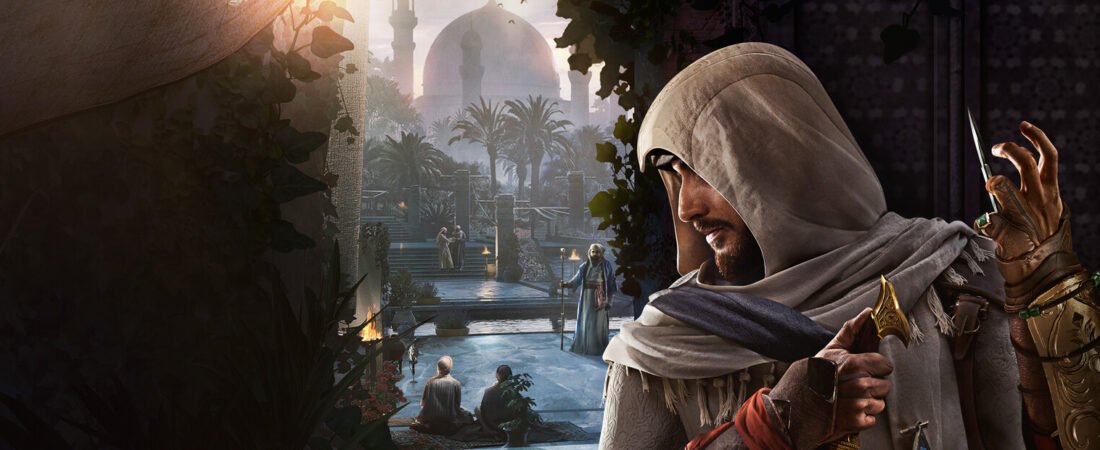
Basim, the white hood, and a city small enough to know by heart. Image: Ubisoft.
Some games you finish. Some games finish you. By 2023, Assassin’s Creed had become the second kind, and I say that with love, because I wrote a whole retrospective defending Assassin’s Creed Valhalla and its billion dollars and its 150 hour completionist run. But love has limits, and mine was somewhere around the third year of Viking content. So when Ubisoft announced a small one, a deliberately small one, set in a single city, focused on stealth, priced at fifty dollars like games used to be, I felt something I had not felt for this series in years. Relief. Assassin’s Creed Mirage is the deep breath between two giants, and three years later, it might be the Assassin’s Creed I think about most warmly. Let me tell you about the little one.
The Promise: It Started as DLC, and It Never Hid That
Mirage has the most honest origin story in modern games. Ubisoft Bordeaux, a studio that had mostly done support work and had built Valhalla’s Wrath of the Druids expansion, pitched a piece of Valhalla DLC: send Eivor to the Middle East, back toward where the series began. Creative director Stéphane Boudon and his team have said in interviews that the DLC pitch only lived for a few weeks. The idea grew a spine. It stopped being Eivor’s trip and became a full origin story for Basim, the enigmatic Hidden One from Valhalla, and Ubisoft greenlit it as a standalone game. Earlier reporting had already sniffed it out under the codename Rift, described exactly as that, a Valhalla expansion that outgrew its cage.
Announced properly at Ubisoft Forward on September 10, 2022, the pitch was a love letter with a budget: this would be the fifteenth anniversary game, a tribute to the original Assassin’s Creed from 2007. One city. Baghdad, in 861 AD, during the Anarchy at Samarra. A young street thief named Basim Ibn Ishaq, mentored by Roshan, voiced by Shohreh Aghdashloo, which is the kind of casting that makes you sit up straighter. No hundred hour map. No dialogue wheel. No loot fountain. Stealth, parkour, assassination, the holy trinity, in a city built dense instead of wide. Ubisoft even priced the promise at 49.99 dollars, a quiet admission that smaller scope should mean smaller price, a sentence the industry almost never says out loud. Then, in a move so confident it still makes me smile, they released it a week early, on October 5, 2023, instead of the announced October 12. Small game energy, start to finish.
What Shipped: One City, Loved Properly
Baghdad is the whole argument. The city is drawn as the Round City of the caliphs and split into four districts, with the Abbasid splendor of the House of Wisdom in Abbasiyah on one side and the markets and docks of Karkh on the other, plus the fortress of Alamut out in the wilds for when the Hidden Ones need their mountain. It is not huge. That is the point. Within a few hours you know the rooftops the way you knew Florence in the old days, and there is a specific joy in a game world small enough to memorize. The crowds are thick, the markets are loud, the call to prayer rolls over the domes, and for the first time in the entire series, the game shipped with a full Arabic voice dub, with Jordanian actor Eyad Nassar playing Basim. That detail matters. Baghdad is not a backdrop here. It is the main character, and the game treats it with respect.
The systems all serve the smallness. There is no XP bar grinding its teeth at you. You earn skill points by doing contracts and advancing the story, and you spend them on a compact tree that makes Basim better at the three jobs: hiding, climbing, killing quietly. The toolbox is a time machine: smoke bombs, throwing knives, a blowdart, traps, noisemakers, the classics, each upgradable, each actually useful. Combat exists, and it is deliberately the worst option, stiff and punishing if you try to sword fight a garrison, which is exactly the design pressure a stealth game needs. Get spotted instead, and the notoriety system wakes up: witnesses raise your wanted level, posters of Basim go up around the city, and you slink around tearing them down and bribing town criers like a man cleaning up his own reputation one lie at a time. It is charming. It is also, quietly, the most Assassin’s Creed this series had felt in a decade.
My favorite layer is the one nobody puts on a box. Baghdad in 861 was one of the great knowledge capitals of the world, and Mirage keeps bumping into that fact with a smile. The Banu Musa brothers, real historical inventors who genuinely lived in this city in this century, run the workbench where your tools get upgraded, which means the man improving your smoke bombs is a figure from actual history books. The game is full of codex entries on the House of Wisdom, on the Round City that Caliph al-Mansur founded as a perfect circle, on the astronomy and medicine flowing through the streets you are parkouring over. Years later Ubisoft even turned that layer into a free Discovery Tour style mobile app, which feels right. Baghdad deserved homework. Most game cities get a collectible count. This one got a syllabus.
The missions themselves are built like little puzzles with the doors left open. The big story assassinations run as black box missions, the design the series introduced in Unity and then mostly abandoned: here is the target, here is the building, here are three or four ways in, from stolen keys to bribed guards to a conveniently open window, and the method is your business. In between, a contracts board at each bureau hands you optional jobs with bonus conditions, kill only the target, stay unseen, finish without tools, and suddenly a small game has a reason to be replayed mission by mission, mastery style. That structure is why Mirage’s 16 hours feel denser than other games’ 40. There is almost no travel time, almost no filler, almost no moment where the game is waiting for you to finish walking. It respects the clock in a way its giant siblings structurally cannot.
The story keeps the same discipline. Basim goes from pickpocket to novice to a man being pulled apart by visions of a jinni he does not understand, and if you played Valhalla, you know where that road ends, which gives the whole game a soft, sad glow. The investigation boards, where you pin clues and choose the order of your targets, make the middle of the game feel like detective work rather than errands. It ends where it must, in Alamut, with a choice that is not really a choice. It does not overstay. Producer Fabian Salomon had said before launch that most players would see the credits in about 20 to 23 hours, and the community numbers at HowLongToBeat landed right in that spirit, about 16 hours for the main story and about 30 to see absolutely everything. A whole Assassin’s Creed, finished, in your heart and not just your backlog. I had almost forgotten games could do that.
The Receipts: Modest Numbers, Warm Hands
Let us be accurate about how Mirage did, because cozy does not mean imaginary. Critics gave it a Metascore of 76, with an OpenCritic average to match, and the shape of the reviews was consistent: Baghdad praised, stealth praised, Basim praised, and fair criticism for combat that felt stiff, a story that played it safe, and mechanics that some reviewers called dated. All of that is reasonable. Mirage was not trying to win a revolution. It was trying to be a good version of a beloved old thing, and 76 is about what that ambition earns in a world that grades novelty higher than comfort.
The players were kinder than the score suggests. Ubisoft announced that Mirage was its biggest launch of the new console generation in unit sales during its first week, and shared the kind of statistics that tell you people were having fun: 60 million leaps of faith and 1.2 million street cats petted in the first days. Petting cats made the official report. That is the game’s whole legacy in one stat. Reporting by Insider Gaming put Mirage at 5 million players and around 250 million dollars in revenue by January 2024, and then, in November 2025, Ubisoft confirmed the quiet long game had worked: Mirage reached 10 million players. Ten million people visited a fifty dollar side project that started life as downloadable content. There are mainline sequels in this industry that would trade their marketing budget for that sentence.
And then Ubisoft did the coziest thing of all. In November 2025, more than two years after launch, Mirage received Valley of Memory, a completely free story expansion of roughly six hours, sending an older Basim to the ancient valley of AlUla to search for his father. Reporting around the expansion noted it grew out of a partnership involving Saudi Arabia’s Savvy Games Group, and whatever you make of the business side, the player side was simple: a finished, discounted, beloved little game got six more hours, for free, two years later, and its player activity doubled around the update. Small games are supposed to be disposable. Nobody told Mirage.
Where It Stands Now
Mirage stands today as the proof of concept that will not go away. It proved that an Assassin’s Creed at half scale and fifty dollars can review respectably, sell for years, and be remembered with a warmth the giants rarely get. It also proved the uncomfortable follow up: Ubisoft still followed it with the enormous Shadows in 2025, because the money in this series has always lived at the big end, and Mirage’s ten million players arrived slowly, the cozy way, not the launch weekend way. So the little game sits in the catalog like a question the series has to keep answering. Every time a fan says “I wish they made them like Mirage,” they are really asking whether Assassin’s Creed is allowed to be small ever again.
There is one more receipt worth framing, and it belongs to the studio. Before Mirage, Ubisoft Bordeaux was a support name in other games’ credits and the author of one well liked expansion. After Mirage, Bordeaux is the studio that shipped a mainline Assassin’s Creed, on time, at a lower price, to ten million players, and then supported it with a free expansion two years later. In an industry that keeps closing studios for missing impossible targets, there is something quietly radical about a team hitting a modest target dead center and being rewarded with survival and respect. If the big franchise model wobbles in the next few years, and it wobbles already, the Bordeaux playbook, small team, one city, fair price, long tail, is sitting right there in the catalog as evidence.
My answer, for the record, is that it has to be. Not always. Not instead of the epics. But a series that runs for two decades needs its short stories next to its novels, and Mirage is the best short story Assassin’s Creed has told in years. It is the one I recommend to friends who fell off the series, the one I would hand to somebody who loved the Ezio days and wants that feeling without a calendar commitment. One city. One thief. One weekend. Sometimes the most radical thing a giant franchise can do is remember the size of the game that started it all, and have the discipline to stop there. Mirage stopped there. That restraint is exactly why it lingers.
Sources
Ubisoft Forward, September 10, 2022 (Mirage announcement, fifteenth anniversary positioning) and Ubisoft release date communications, 2023 (launch moved from October 12 to October 5, 2023; 49.99 dollar standard price). Game Informer studio visit coverage and interviews with creative director Stéphane Boudon, 2023 (Mirage began as a Valhalla expansion pitch at Ubisoft Bordeaux and became a standalone Basim story within weeks). Bloomberg reporting, February 2022 (the project codenamed Rift described as a smaller Basim focused release grown from expansion plans). Ubisoft press communications, October 2023 (biggest new generation launch in units for Ubisoft; 60 million leaps of faith and 1.2 million cats petted). Metacritic, Assassin’s Creed Mirage listing (Metascore 76) and OpenCritic average (76). Insider Gaming reporting, January 2024 (5 million players, about 250 million dollars revenue, reported figures). HowLongToBeat, Assassin’s Creed Mirage (main story about 16 hours, completionist about 30 hours); pre release comments by producer Fabian Salomon (20 to 23 hours for most players), via Julien Chièze interview coverage, 2023. Ubisoft financial reporting, November 2025 (Mirage reaches 10 million players; Valley of Memory free expansion, November 18, 2025).