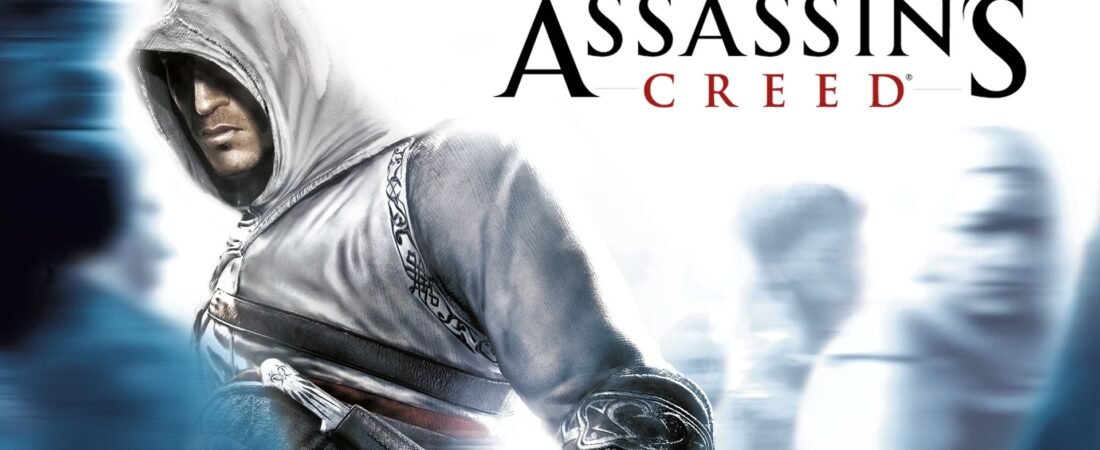
In November 2007, Ubisoft Montreal promised us a medieval world where you could climb anything, vanish into any crowd and kill like a ghost. What shipped was half of that promise, repeated nine times, wrapped around one of the boldest ideas games had ever had. I would not trade it for anything.
By Ruan Martini, Daily Checkpoint
The original key art, still the coolest image in the series: one white hood in a sea of strangers, and every single stranger is a place to hide. Image: Ubisoft.
Let me get f the way first. My Facebook bio quotes this series like it is scripture: nothing is true, everything is permitted. So when I say the first Assassin’s Creed is a flawed game, understand that I say it the way you criticize a beloved uncle. The man changed my life. The man also tells the same four stories at every family dinner, in the same order, for nine dinners straight. Both things are true, and this whole article lives in the space between them.
This is where our run through the whole franchise starts, so it feels right to begin with the game that had the biggest ideas and the smallest toolbox.
The Promise: A Prince of Persia Team Walks Into the Crusades
Assassin’s Creed was born inside Ubisoft Montreal as the next step for the team behind Prince of Persia: The Sands of Time. The project grew out of ideas for a new Prince of Persia before it became its own animal: a game about a bodyguard, then about an assassin, then about something much weirder and braver. Under creative director Patrice Désilets, the pitch hardened into three pillars that sounded impossible in 2007.
Pillar one: total movement. Not ledges with neon paint on them. Buildings. All of them. If you could see a handhold, Altaïr could grab it, and the whole city of Jerusalem was a jungle gym built out of stone and bad decisions.
Pillar two: social stealth. Stealth games in 2007 meant shadows, vents and cardboard boxes. Désilets and his team wanted stealth in broad daylight, in a crowd, at noon. You hide by behaving. Walk slowly. Sit on a bench. Drift inside a group of praying scholars and let the guards slide right past you, close enough to smell.
Pillar three: a story nobody had tried. You are Desmond Miles, a bartender kidnapped by a corporation called Abstergo and strapped into the Animus, a machine that reads genetic memory. Your ancestor is Altaïr Ibn-La’Ahad, a Master Assassin in the Holy Land in 1191, during the Third Crusade, hunting nine Templars across Damascus, Acre and Jerusalem. A sci fi frame around a history lesson, two timelines, one conspiracy. In 2007, that was not a pitch. That was a dare.
Ubisoft sold it with total confidence, producer Jade Raymond fronting one of the great reveal cycles of that generation, and the E3 demos made the game look like a medieval painting you could sprint across. The promise, in one line: be a ghost in a living 12th century world.
What Shipped: Three Cities, One Loop, Nine Funerals
Here is the honest structure of Assassin’s Creed, and every veteran of the series just felt a small pain in their chest. Altaïr opens the game at the top of his world and immediately faceplants: he breaks all three tenets of the Creed on a botched mission in Solomon’s Temple (stay your blade from the flesh of the innocent, hide in plain sight, never compromise the Brotherhood), gets demoted to novice, loses his gear, and has to earn his rank back the hard way. The hard way is a hit list. Nine targets. Three cities. One very patient boss, Al Mualim, waiting back at the fortress of Masyaf.
And here is the loop. You ride into a city. You climb viewpoints and synchronize, and the leap of faith off those towers, down into a cart of hay, is one of the great five second experiences in games to this day. Then you investigate your target. Then you do it again. And again. Because the investigation is where the dream goes to sit in the corner.
To unlock each assassination, Altaïr runs errands from a short fixed menu: eavesdrop on a bench, pickpocket a marked man, interrogate a speaker by beating the testimony out of him, or run a little errand for an informant. The first time through a city, this feels like detective work. The second city, it feels like routine. By the third city you realize the menu never changes, the same handful of mission types is going to serve all nine targets, and the most revolutionary stealth game ever announced has the mission structure of a photocopier.
I am not even exaggerating for comedy, which is new for me. The variety lives entirely in the assassinations themselves, and credit where it is due: those are often superb. The targets are staged in public, theatrical places, a hospital, a slave market, a funeral, a burning library of heretics, and you are free to improvise your way in and out. Killing William of Montferrat and then escaping across the rooftops of Acre with the whole garrison screaming behind you remains a top ten gaming memory for me. The kill is art. The homework before the kill is homework.
Two more honest complaints, because this series taught me to love it by arguing with it. The combat is a waiting room: Altaïr stands still, guards attack one at a time like they are queuing for a passport photo, and you press counter until the credits of their lives roll. And the ending pulls a cliffhanger so abrupt that players in 2007 genuinely checked the disc to see if the second half had scratched off. (The PC Director’s Cut, which arrived in April 2008, quietly added a few new investigation types. A kind patch. A small one. The loop remained the loop.)
And yet. The cities themselves carry the whole game on their backs, and the cities are miracles. Damascus glows. Acre sweats under siege. Jerusalem stacks domes and markets and rooftops into the best playground of its generation. The crowds were the largest anyone had put in a game, hundreds of people who shove, panic, gossip and scatter, and they were not decoration: they were the stealth system. Blending was not a gimmick. It was the game, and it worked, and nothing else on a shelf in 2007 did anything like it.
The Craft Underneath: Puppets, Crowds and One Great Score
It is worth pausing on how much new machinery this game had to invent just to exist, because the photocopier structure hides a pile of genuinely brave engineering. The controls were built on an idea the team called puppeteering: the face buttons map to Altaïr’s body, not to verbs. One button is his head (eagle vision, viewpoints), one is his armed hand, one is his empty hand, one is his legs, and a shoulder trigger shifts him between low profile and high profile, polite citizen and chaos goblin. It sounds like a trivia answer now, but in 2007 it was a small philosophy: you do not press “assassinate,” you move a man’s hands, and the animation system stitches your intentions together on the fly, feet finding ledges, palms finding beams. The seams show, and Altaïr occasionally parkours directly into a wall at full confidence, which I choose to read as character development.
The crowds were the other moonshot. Ubisoft Montreal built crowd technology that could fill a street with people who react as a fluid: shove through them and they stumble and shout and drop their pots, blend into them and you become invisible in plain sight. Jesper Kyd’s score wrapped the whole experiment in chanting, strings and dread, and it remains one of the great soundtracks of its generation, half cathedral, half warning siren. And threading through all of it is a story with real nerve: Altaïr is not a cuddly hero, he is an arrogant prodigy being slowly deprogrammed by his own hit list, and the late game twist, that his mentor Al Mualim is the final name the list was always pointing at, turns the whole structure into an argument about who gets to hold knowledge. The Desmond segments were the part everyone claimed to hate and secretly could not stop talking about, because that cliffhanger, and the strange writing it leaves on his bedroom wall, made the wait for a sequel feel less like marketing and more like a hostage situation. I mean that as praise. Mostly.
The Receipts: An 81 That Sold Like a 95
The critics of 2007 landed exactly where I land now, which is suspicious, because critics are never right. The game sits at 81 on Metacritic: generally favorable, with the praise and the complaint filed in the same sentence almost every time. Game Informer gave it a 9.5 out of 10, raved about the controls and the story, and still flagged frustration with the repetitive information gathering. GameTrailers scored the story a 9.7 and called out the repetitive gameplay and shaky AI in the same breath. Famitsu, in Japan, gave the PlayStation 3 version a 37 out of 40 and mostly adored it. Read the reviews today and they all describe the same animal: a revolution wearing a very repetitive coat.
The market, meanwhile, did not care about the coat at all. Ubisoft announced more than 2.5 million copies sold by mid December 2007, weeks after launch, beating the company’s own expectations. By April 2009, the company confirmed the game had passed 8 million copies. Eight million, for a brand new series, with a bartender in a machine and a hero who spends half the game sitting on benches listening to other people talk. The audience had voted: the ideas were the product. The repetition was a tax they were willing to pay exactly once.
That “exactly once” matters, because Ubisoft clearly knew it. The sequel arrived two years later with the variety problem treated like a crime scene, and my Assassin’s Creed II retrospective covers how completely Ezio’s debut answered every complaint on this page. The first game is the draft. It just happens to be a draft that invented the language the final version was written in.
Where It Stands Now: The Foundation Everybody Still Visits
The numbers got silly after this. In 2022, Ubisoft announced the Assassin’s Creed series had passed 200 million copies sold across its life, which makes this repetitive little bench sitting simulator the foundation stone of one of the biggest franchises in the history of the medium. Every open world game with a tower, a synchronization point and a leap into something soft owes rent to Altaïr. Half the industry spent a decade building on this blueprint, including, eventually, Ubisoft itself, several times, in several centuries.
The original is easy to live with today. The Director’s Cut is the standard PC version, and on Xbox Series X and S the game runs through backward compatibility with FPS Boost, which means the rooftops of Jerusalem now scroll at a smooth 60 frames per second, a luxury Altaïr’s original hardware could not dream of. Fans ask for a remake roughly once a week, and Ubisoft has never made one, so the 2007 original, hay carts and all, remains the only way to meet the man.
And the series itself keeps confessing its love for this game. When Ubisoft wanted to win back the old crowd in 2023, it made Mirage smaller, denser and stealth first: a love letter to the design rules written here in 1191. You can draw a straight line from that decision back to this game. Back to the photocopier. Back to the benches.
Should you play it now? Yes, with your expectations set to “museum with a pulse.” Play it to see where the language came from. Play it for the cities, the assassinations and the strangest, bravest frame story of its decade. Just know that between you and each great kill stands a small pile of eavesdropping, and that pile never gets smaller. Nothing is true, everything is permitted, and apparently everything includes pickpocketing the same man nine times. We take the Creed as we find it. Head over to the Games shelf for the rest of this series run.
Sources
Release dates, platforms and plot setup: Wikipedia, “Assassin’s Creed (video game),” covering the November 13, 2007 PlayStation 3 and Xbox 360 launch and the April 2008 Director’s Cut on PC.
Metacritic score of 81 for the original game: Metacritic, Assassin’s Creed (2007) game page.
Game Informer’s 9.5 out of 10 review and its criticism of the repetitive information gathering missions, and GameTrailers’ praise for the story alongside criticism of repetitive gameplay: coverage summarized on Wikipedia’s Assassin’s Creed (video game) reception section. Famitsu scores (37 out of 40 on PlayStation 3, 36 out of 40 on Xbox 360): same source.
Sales milestones: Ubisoft announcements as reported in December 2007 (more than 2.5 million copies) and April 2009 (more than 8 million copies), via GamesIndustry and Ubisoft financial communications of the period.
Series total of more than 200 million copies: Ubisoft announcement, September 2022.
Backward compatibility and FPS Boost support for the original game on Xbox Series X and S: Microsoft Xbox FPS Boost program listings.
The Checkpoint Poll
Leave a Reply