Ubisoft shipped it one year after Assassin’s Creed II and the internet called it an expansion pack with a price tag. Then we played it. Brotherhood took the best hero in the series, gave him one city, a family of recruits and the keys to Rome itself, and became the warmest power fantasy this franchise ever made.
By Ruan Martini, Daily Checkpoint
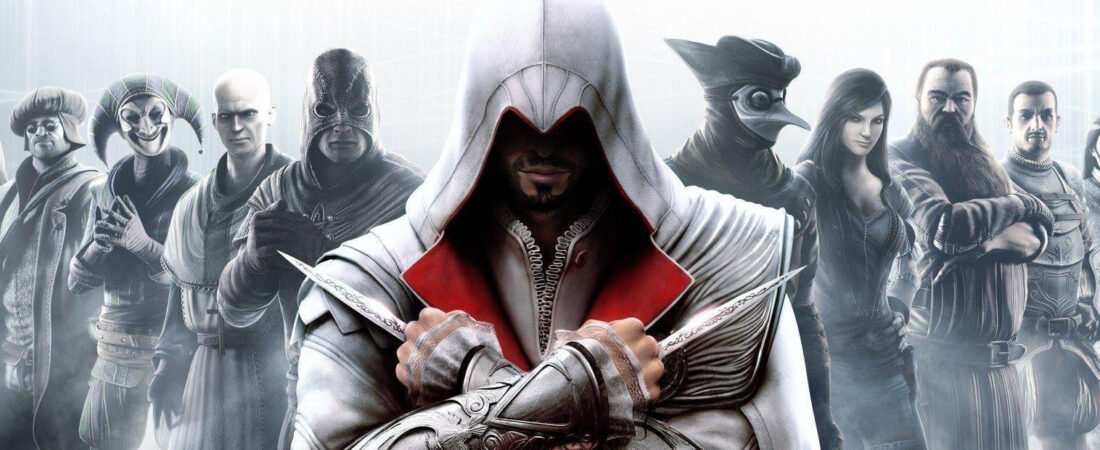
Ezio and the whole beautiful circus behind him: the personas of Brotherhood’s multiplayer, plus the best dressed mentor in games at the front of the line. Image: Ubisoft.
Confession before we start: if you made me keep one Assassin’s Creed game on a desert island with a generator and a suspiciously good TV, I would fight for Assassin’s Creed II, and then, at the last second, I would probably grab Brotherhood. II is the better story. Brotherhood is the better home. It is the one I lived in. This is the game where Ezio Auditore stops being a student of the Creed and becomes its father, and where a series about lone wolves quietly discovered it was always about family. Requiescat in pace, minimal effort sequels. This one did the work.
The Promise: Not a Sequel, Said Ubisoft. Sure, Said Everyone Else
The setup was a marketing problem of Ubisoft’s own making. Brotherhood launched on November 16, 2010, for PlayStation 3 and Xbox 360, barely a year after Assassin’s Creed II had fixed the series and won everybody back. One year is not a sequel gap, it is a heartbeat, so the pitch had to answer an obvious question: is this a real game, or is it the videogame equivalent of warming up yesterday’s pasta?
Ubisoft’s promises were specific. Rome, one enormous city instead of a tour of several smaller ones, the biggest single city the series had built. Ezio, now a Master Assassin, at war with the Borgia, the family sitting on the Vatican like it was a rented couch. A brand new system for recruiting and training your own brotherhood of assassins. And, for the first time in the history of the series, multiplayer: assassins hunting each other in crowds, the social stealth of the campaign turned into a sport.
The pasta question followed the game all the way to launch day. Then the reviews landed, and the question died of embarrassment.
What Shipped: One City, One Family, One Very Annoyed Pope’s Son
Brotherhood opens with a gut punch. Ezio goes home to Monteriggioni with the Apple of Eden secured and the war seemingly won, and Cesare Borgia, son of Pope Alexander VI, arrives with an army and burns the peace down in a single morning. Uncle Mario dies in that siege, and if you played II, that one lands in the ribs. Ezio crawls out of the rubble with nothing and travels to Rome, where the Borgia own the guards, the banks and the skyline, one district at a time.
What follows is my favorite loop in the whole franchise, and it is barely about assassination. Rome is a renovation project with a body count. Each district sits under a Borgia tower; kill the captain, burn the tower, and the neighborhood breathes again. Then you spend your florins reopening the blacksmiths, the tailors, the doctors and the banks, fixing aqueducts, buying landmarks, watching a grey occupied city come back to life in color, one street at a time. Modern games call this “systems.” Brotherhood made it feel like citizenship. I have played city builders with less satisfying city building, and none of them let me celebrate a new aqueduct by stabbing a tax collector.
And then there are the kids. Scattered across Rome are citizens fighting guards, people with nothing left to lose. Save one, and she joins you. This is the Brotherhood system, the beating heart of the game: you recruit ordinary Romans, dress them in the white, train them by sending them on contracts across Europe, and watch them climb from nervous recruits who might die in Prague to full Assassins in a ceremony that genuinely made me sit up straighter. In combat, they are a whistle away. You point at a problem, you tap a button, and your family falls out of the sky to solve it. The arrow storm, a full volley that clears a rooftop, remains the most satisfying button in the series. Altaïr worked alone in the first game because the Creed was a monastery. Ezio built a dinner table.
The rest of the toolbox is pure generosity. Combat learned to flow, with kill streaks that let Ezio chain executions from one guard to the next instead of queuing politely. The crossbow finally gave stealth a long arm. Leonardo da Vinci returns as the world’s most overqualified best friend, and a chain of optional missions sends you to destroy his own war machines before the Borgia can use them, including a tank, in 1503, because Leonardo contains multitudes. Optional objectives now come with Full Synchronization targets that reward doing the mission the stylish way. The campaign crosses Rome and beyond between 1500 and 1507, and it ends the Ezio versus Borgia war with a finale that swings from a siege to a fistfight with a pope’s son in a burning city. Cozy game. Very cozy. Occasionally on fire.
Now, the multiplayer, because Brotherhood did something nobody had done before and, criminally, almost nobody has done since. In modes like Wanted, you are dropped into a crowd of lookalikes with a portrait of your target. Somewhere out there, another player has your portrait. You cannot sprint, you cannot climb, because running makes you visible, and visible makes you dead. So you walk. Slowly. You sit on benches with your heart pounding like a drum while a stranger in a doctor’s mask circles the plaza. It was the campaign’s social stealth, weaponized against human beings, and it was brilliant: tense, funny, and completely unlike the military shooters squatting on the online charts in 2010. Ubisoft has since switched off the online services for the original releases, so that plaza is a museum now. I still think about it more than most modern multiplayer seasons.
The Rome Around the Edges: Horses, Factions and Cristina
The big systems get the headlines, but Brotherhood is stuffed with smaller kindnesses that explain why people sank a hundred hours into it. Horses, for the first time in the series, work inside the city, so you can gallop through Roman streets like a man who owns the place, which, by hour thirty, you legally almost do. A network of tunnels gives you fast travel that feels earned instead of menu flavored. The city’s factions, courtesans, thieves and mercenaries, hand out their own challenge ladders, and their guilds give Ezio excuses to be stylish in three different dialects of mischief. There are lairs to raid, including a genuinely spooky descent after a cult that dresses as wolves, because Renaissance Rome was apparently booked solid for weirdness.
And tucked into the margins is the game’s softest punch: the Cristina memories. Spread across the campaign are optional flashbacks to Cristina Vespucci, the love Ezio’s timeline never had room for, from their first ridiculous meeting as teenagers to a reunion that lands like a letter you open fifteen years late. They are small, quiet missions in a game about burning towers, and fans still bring them up first when Brotherhood comes up, which tells you everything about what this game’s real subject was. Underneath the empire building, it is a story about a man in his forties looking at the life he traded away.
The modern day story pulls its weight too. Desmond and his team, Lucy, Shaun and Rebecca, set up camp in the ruins of Monteriggioni itself, training in the sanctuary under the villa while the Templars close in, and the game ends on the most argued about cliffhanger the series ever produced, a forced hand, a fallen friend, and a voice from an ancient temple offering no explanations whatsoever. In 2010, that ending set forums on fire for a year. Brotherhood was supposed to be the small one. Nobody told the writers.
The Receipts: The “Expansion” That Won a BAFTA
The scoreboard tells the story with a straight face. Brotherhood holds an 89 on Metacritic, with the PlayStation 3 version peaking at 90, which put the one year “expansion” a single point behind the beloved AC2 and ahead of almost everything else in the series. It won the BAFTA for Best Action Game. It won the Writers Guild of America award for its writing, in a year when game writing was still fighting for a seat at the grown ups’ table. Reviewers who arrived ready to file it under “more of the same” kept running into the recruits, the renovation loop and the multiplayer, and kept having to write a different review than the one they had outlined on the plane.
Ubisoft’s own numbers backed it up. The company reported the game had shipped more than 6.5 million copies by early 2011, and it passed 7 million copies sold within its first year on shelves. For a game the internet had preemptively dismissed as downloadable content in a box, that is not a sales figure, that is a rebuttal with a receipt attached.
Where It Stands Now: The Template the Series Keeps Chasing
Brotherhood’s afterlife is mostly a story of influence. The recruit system became a series heirloom: later games kept handing you gangs, crews and homesteads to grow, because Brotherhood proved that power feels better when you share it. The one city, deeply yours model became the other pole of the franchise’s identity, the intimate counterweight to the giant country sized maps, and when Ubisoft made Mirage in 2023 as a smaller, denser return to basics, it was chasing a feeling that Rome defined first. Even the multiplayer cast a long shadow: three more games carried versions of that crowd hunting mode, and its death by server shutdown remains the single best argument for why games should not be built to evaporate.
Practically speaking, the game is easy to keep. It lives in The Ezio Collection, the remastered bundle Ubisoft released for PlayStation 4 and Xbox One in 2016, which later reached the Nintendo Switch in 2022, so Ezio’s Rome runs on basically everything short of a smart fridge. That is the version to play: the campaign intact, the recruits ready, the aqueducts awaiting your investment portfolio.
If II is the game I recommend to meet Ezio, Brotherhood is the game I recommend to live with him. It asks a question the series rarely asks anymore: what does an assassin do after the revenge is over? He builds something. He trains people. He fixes the aqueduct and burns the tower and comes home to a city that is visibly, measurably better because he refused to leave it. Nothing is true, everything is permitted, and in Rome, everything includes urban renewal. The rest of this series run is waiting for you on the Games shelf.
Sources
Release date and platforms: Wikipedia, “Assassin’s Creed: Brotherhood,” covering the November 16, 2010 PlayStation 3 and Xbox 360 launch and the 2011 PC release.
Metacritic score of 89, with the PlayStation 3 version at 90: Metacritic, Assassin’s Creed: Brotherhood game page, and ranked coverage of the series by Metacritic score.
BAFTA Best Action Game win and sales of more than 7 million copies by 2011: Screen Rant’s Brotherhood profile and contemporary Ubisoft reporting; shipped total of more than 6.5 million units by early 2011 per Ubisoft figures reported across the games press of the period.
Writers Guild of America award for videogame writing: contemporary awards coverage of the 2011 Writers Guild Awards.
Rome as the largest single city in the series at release, the recruitment system, Full Synchronization and the debut of series multiplayer: Ubisoft’s own pre release materials and contemporary reviews, summarized on Wikipedia’s Assassin’s Creed: Brotherhood development and gameplay sections.
The Ezio Collection release for PlayStation 4 and Xbox One in 2016 and its Nintendo Switch release in 2022: Ubisoft announcements.
Leave a Reply