
This game found me before I found it. The official A Dark Cave account left a comment on one of my RimWorld posts, I got curious about who makes a game like that, and a few days later I had twelve hours in a text based cave builder that I cannot stop thinking about.
Let me explain what this thing even is, because the screenshots do not sell it. A Dark Cave is a dark, story driven incremental village builder made by one person, Julian Bauer, a solo developer in Germany. It is free in your browser and $7.99 on Steam, where it launched on October 27, 2026. There are no graphics. None. You get text, buttons, numbers going up and down, and a little log in the corner that narrates your village either clawing its way up or falling apart in one quiet sentence at a time. Julian built it because A Dark Room stuck with him for years. After twelve hours, I get it. This game gets into your head and it does not leave.
One honest thing before anything else, because I am not going to fake this part. Twelve hours in, I have not seen the ending. The game has one, maybe more than one, and the deepest door in my run still has not opened. So this review is what those twelve hours actually gave me. The wins, the disasters, the systems I had to learn by bleeding. And honestly, the fact that a free browser game still has secrets left after twelve hours is kind of the review by itself.
It starts with a fire, like everything good
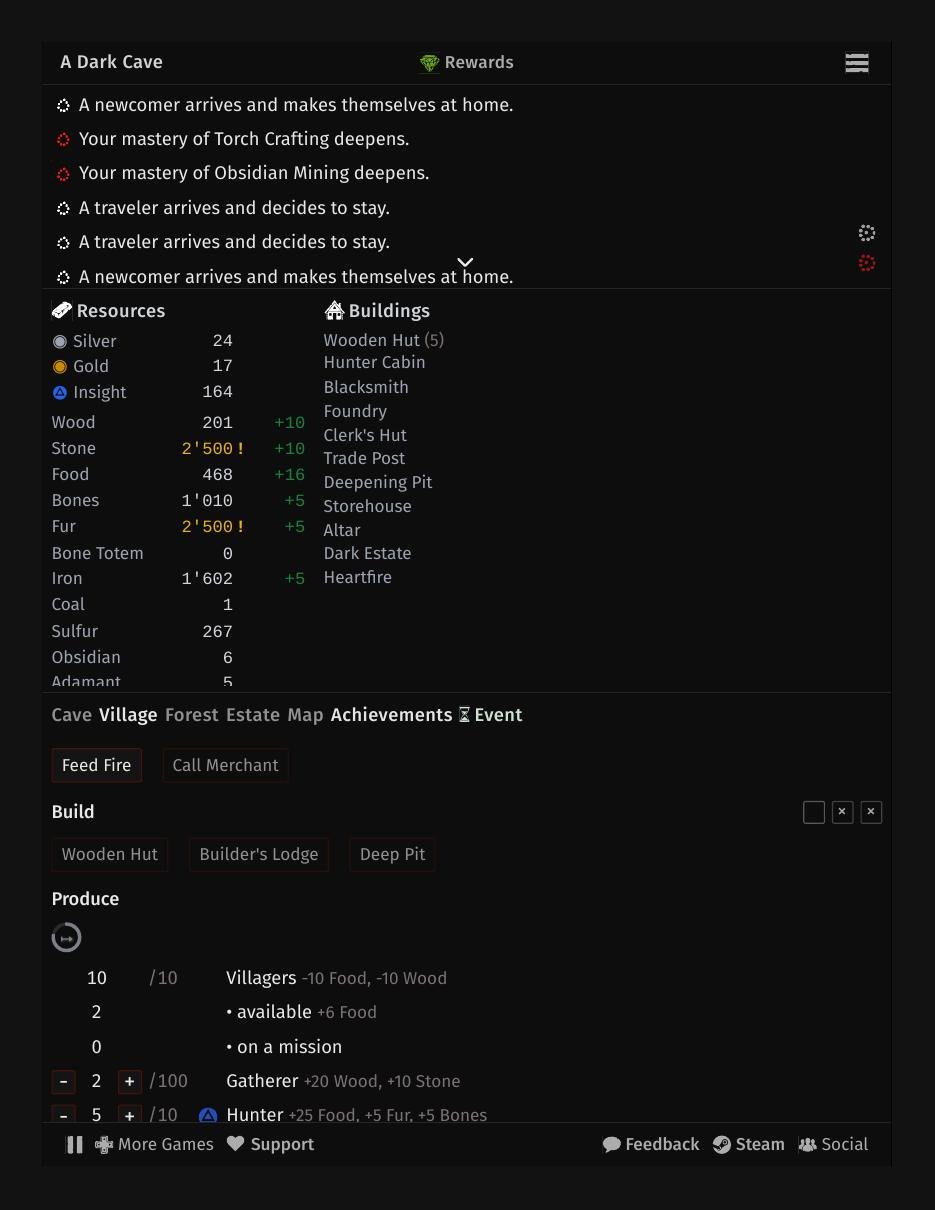
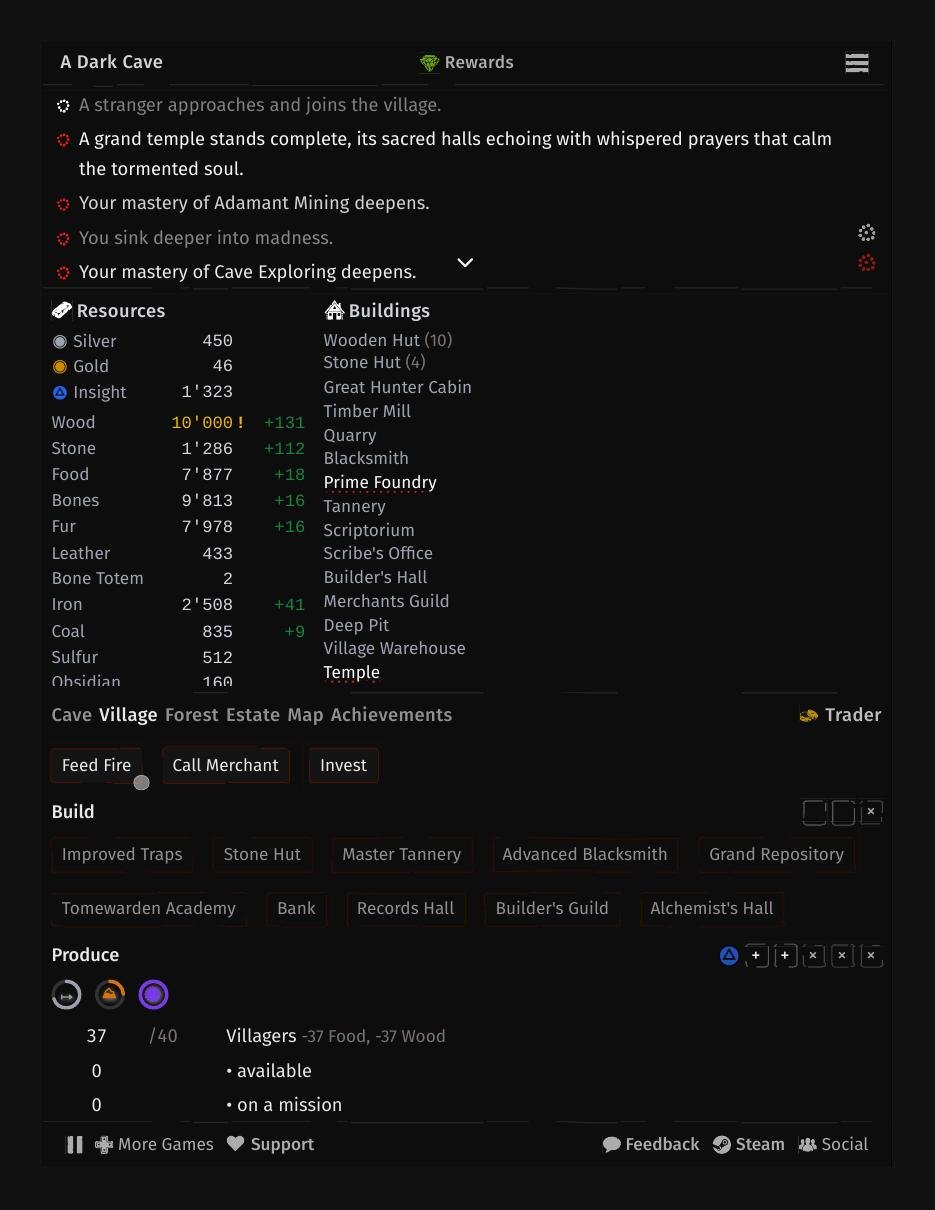
You wake up in a cave. You remember nothing. The game gives you almost nothing to click, and that restraint is the first thing it teaches you. You look around. You light a fire, and the darkness backs off just enough to show you a small chamber. You gather wood. You make a torch. You push a little deeper and find a dusty bag full of torches that somebody left behind, and right there, no cutscene, no voice acting, the game has already told you its whole deal. People were here before you. The cave remembers them even if you do not.
From that fire, the village grows one unlock at a time. A stone axe opens the Village tab. The first wooden hut raises your population cap, and strangers start walking in out of the dark, because of course they do, you have the only fire for miles. A hunter cabin gives you hunters. A blacksmith gives you crafting. Every new button is a small story beat, and the game almost never explains a system before handing it to you. It just trusts that a new button is its own tutorial.
That trust is the best and the worst thing about A Dark Cave, and I am going to keep coming back to it, because after twelve hours I have strong feelings about both sides.
How this game actually works, explained the way I wish someone had explained it to me
Under the horror mood, this is a production puzzle, and I say that with love. Your villagers eat food and wood every tick. Every job converts one thing into another. Gatherers bring wood and stone. Hunters bring food, fur, and bones. Miners pull iron and coal out of the cave, then obsidian, then a metal called adamant that sits at the top of the food chain for a very long time. Forgers turn iron and coal into steel. Everything costs something else, and food is the toll that every single road charges.
That food bottleneck runs your entire early and mid game. Exploring costs food. Mining the good stuff costs a lot of food. The big expeditions cost a thousand food and eight of your people. I spent hours stuck in a loop where my village was rich in stone and poor in dinner, watching the food number sit at zero while the log quietly told me my people were starving. Starvation kills fast here. A few ticks at zero and somebody dies. One line of text. That is the whole funeral.
The other hidden gate is storage, and this one genuinely fooled me. Every resource caps out, and the cap is a building. My storehouse held 2,500, so a building that costs 4,875 wood was not expensive. It was impossible. And the game never said that out loud. I had to figure out on my own that the Fortified Storehouse was not an upgrade, it was a prerequisite. That pattern repeats the whole way up. Warehouse, then a Grand Repository that holds 25,000. Half of progressing in A Dark Cave is realizing the wall in front of you is a building you have not built yet.
On top of all that sit four stats. Luck, Strength, Knowledge, and Madness. Strength and Knowledge mostly come from relics and strange events, not from grinding, which matters a lot for the cave story I am about to tell you. Luck bends little things in your favor. And Madness is its own problem. Madness gets its own section. It earned it.
The cave that killed fifteen of my people
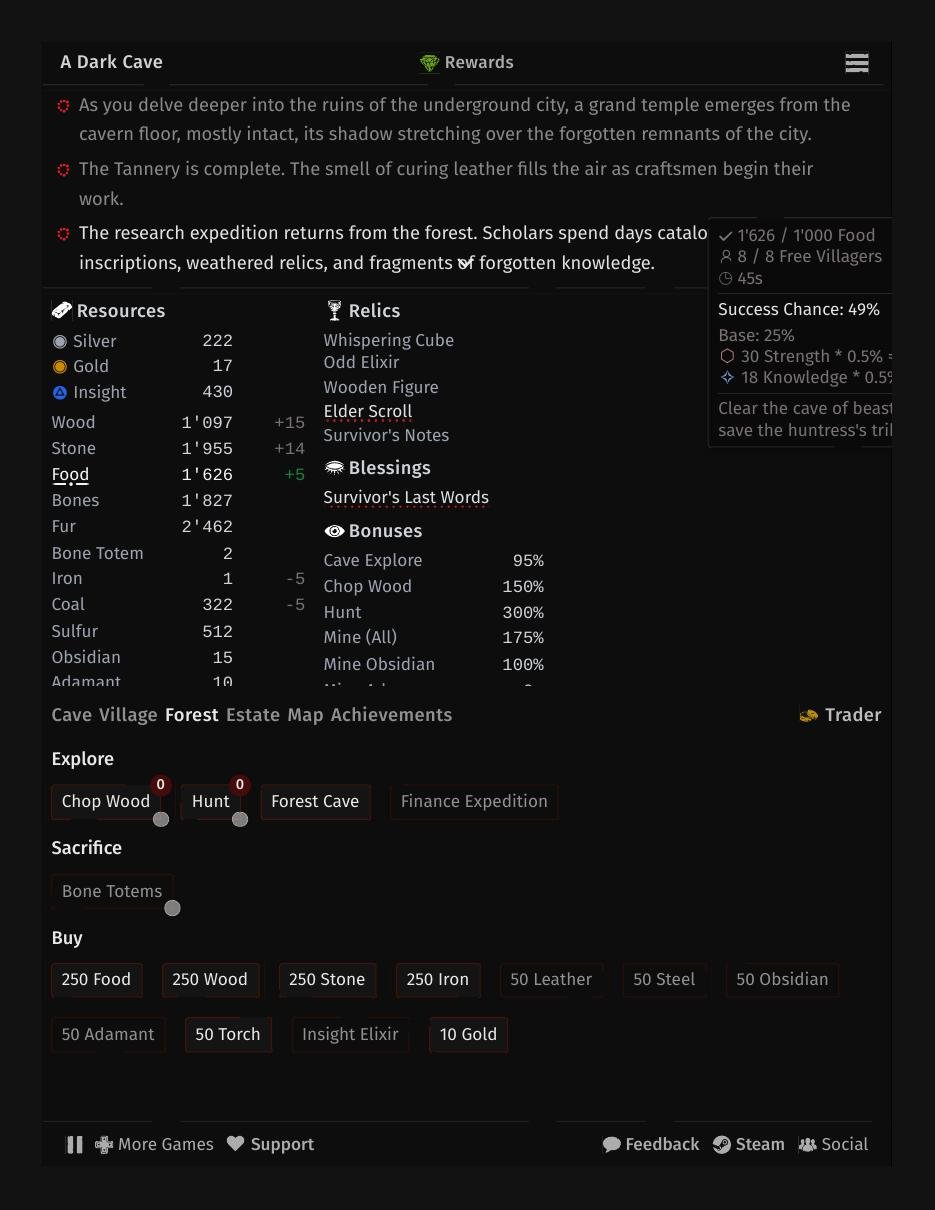

The emotional spine of my twelve hours was a rescue mission. A wildling huntress begged my village to clear a cave of beasts that were wiping out her tribe. I like that the mission shows you its math. Base chance 25 percent, plus half a percent for every point of Strength, plus half a percent for every point of Knowledge. You send eight villagers and a thousand food, you wait 45 seconds, and you find out who comes home.
My first attempt went in at 35 percent. Five villagers died. My population went from eight to three, and it took real time to crawl back from that. I want to be clear about how it felt, because a spreadsheet game is not supposed to hurt. It hurt. Those five were not units. I had watched every single one of them arrive at my fire.
So I made myself a rule. No retry without a new lever, something that actually moves the percentage. That rule carried the next several hours of my life. A hidden lake event gave me a crown and plus 3 Knowledge. An ancient scroll gave me plus 10. A scriptorium building promised plus 5 Knowledge and delivered plus 3, which is its own story and I will get to it. Attempt two, at 43 percent, killed six. Attempt three, at 49 percent, killed two. Attempt four, at 55 percent, killed two more and then nearly starved the village on the walk home, because the mission cost is not the whole cost. Your people keep eating while the expedition is out there, and I had a blizzard halving my production at the worst possible moment.
Attempt five went in at 57 percent, with a huge food buffer and no blizzard. Every single villager came home alive. The huntress’s tribe was saved, and the mission button just vanished from the forest, the way finished business does in this game. Fifteen dead across four failures. Zero on the win. Hours later the huntress came back, cut her own palm open, and swore a blood oath to my village. She joined my fellowship, taught my hunters her ways, and quietly fixed my food economy forever. That is how this game pays you. Not with loot. With people.
One thing deserves saying out loud, because it is the game’s whole difficulty curve in one sentence. A Dark Cave never beats you. There is no game over screen, no failed run, no moment where the game takes the keyboard away and tells you that you lost. When my first cave attempt went wrong, the population fell from eight to three and the game just kept going, quietly, like nothing structural had happened. The fire was still lit. I could rebuild. And I did, more than once.
The punishment is people. Every mistake in this game is paid for by somebody with a job and a place at your fire, and the payment is permanent. Starve the village and somebody dies. Misjudge an expedition and five somebodies die. Let Madness run and they start dying by their own hand. Difficulty here is not a wall you crash into. It is a weight that accumulates, one name at a time, until you look at your population counter and realize the number used to be bigger and it is never coming back.
Madness is a second game running underneath the first one
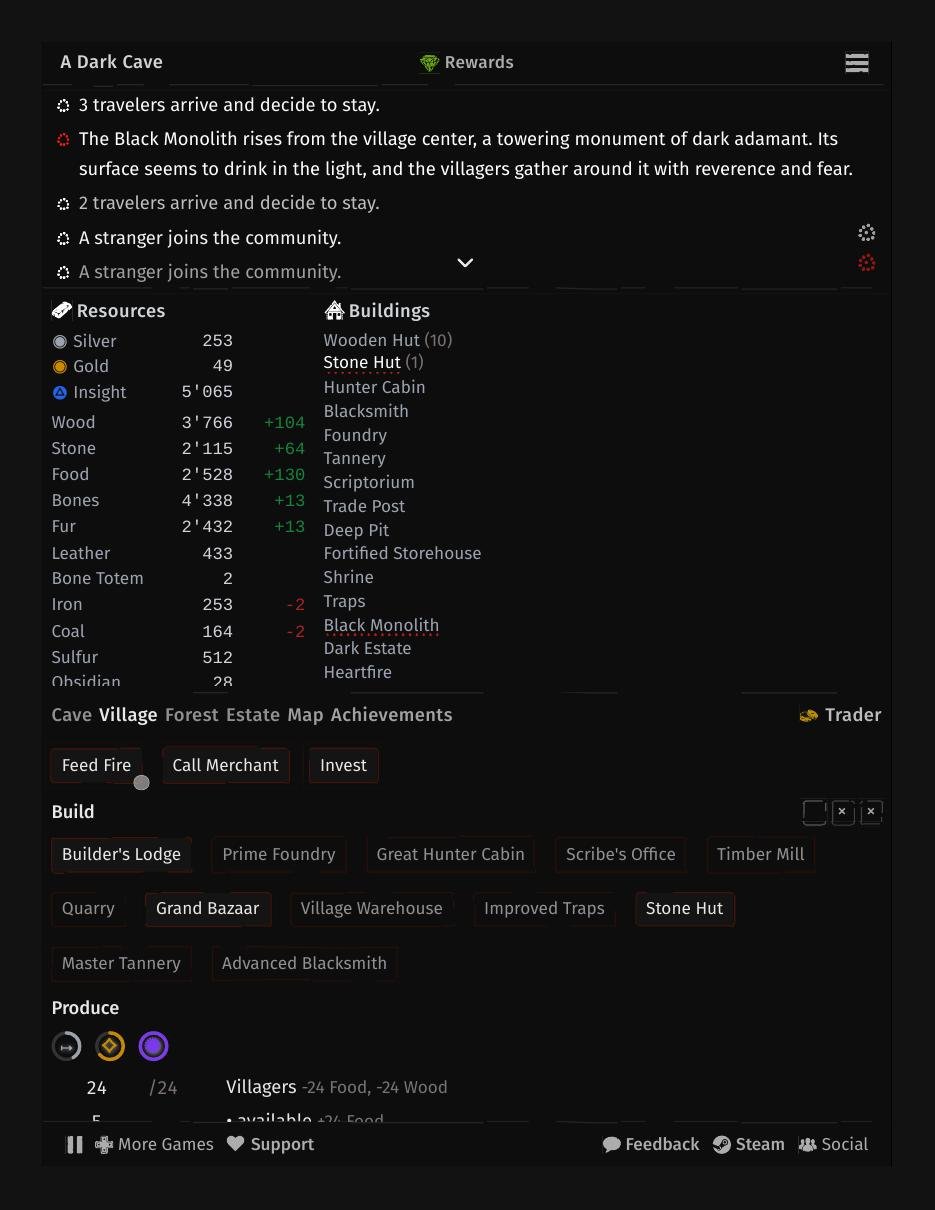
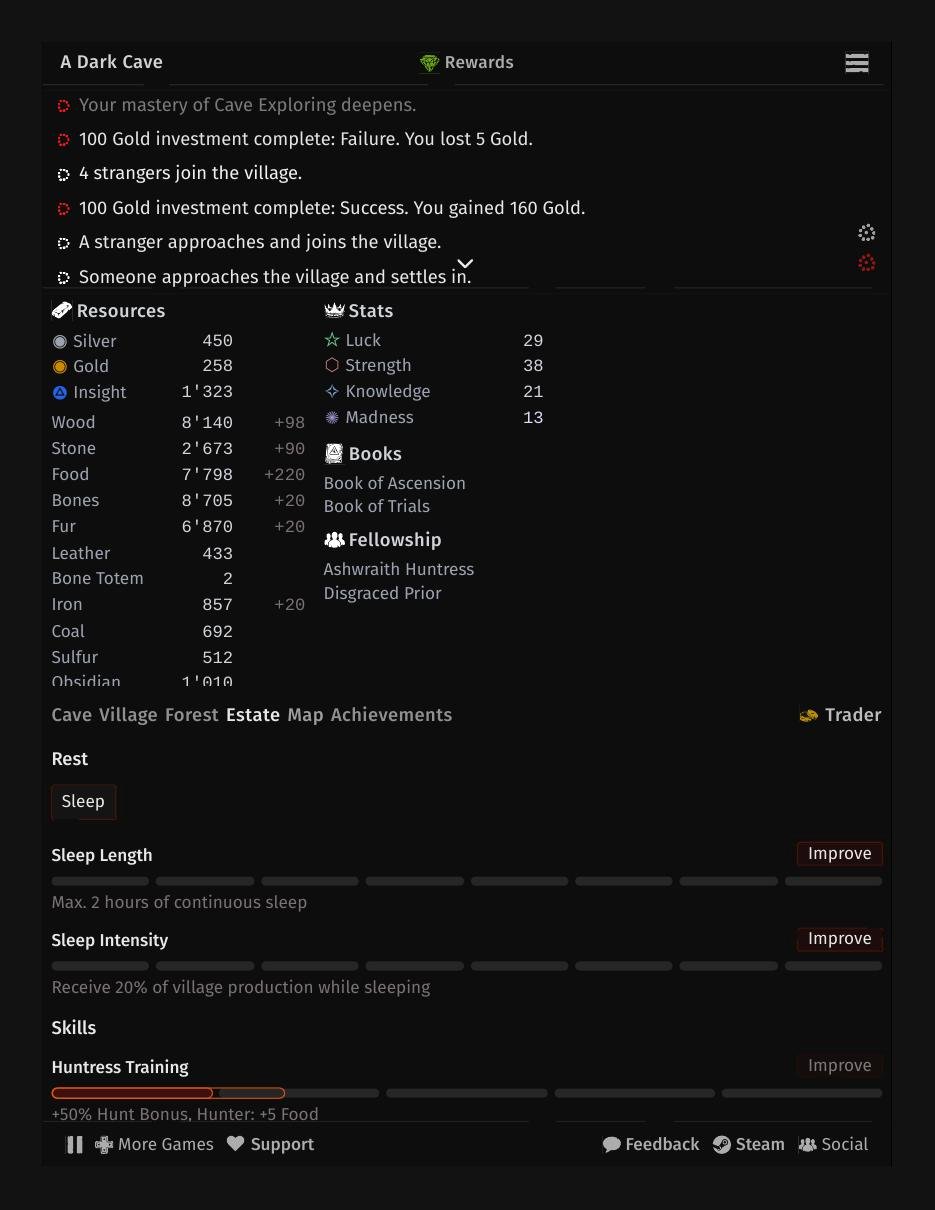
Somewhere in the middle hours, a second stat started running my village more than food did. Madness climbs from cursed relics, bad events, and things your people see moving in the walls. It does three nasty things at the same time. It lowers your workers’ yields, so a mad village is also a poor village. It pushes more bad events your way. And past a certain point, your villagers start taking their own lives. One line in the log. No warning you can actually act on.
At my worst I sat at 32 Madness and I was losing people roughly every hour, including one mass event where three died at once. The counters are all story flavored, which is very this game. An altar for minus 2. A shrine for minus 5. A black monolith that your own villagers demand you build, minus 5, and then animal sacrifices on top of it, minus 1 each. Except the price of every sacrifice climbs by 250 food, and nobody tells you that until you are reading the next tooltip with your hand already on the button. The full chain would have cost me 13,750 food. I stopped at six sacrifices and a Madness of 15 and decided to live with the risk, because the math stopped making sense. Making that call out loud, with my own people’s lives on both sides of it, is a decision no idle game has ever made me make before.
And the game keeps offering you more Madness with a smile on its face. Late in my run I woke up from a night terror with a ring on my finger that I did not own. Luck plus 5, Strength plus 5, Knowledge plus 5. Also Madness plus 10, which the game did not mention until I checked my stats later and found a 23 staring back at me. I kept the ring. Twelve hours in, I still have it on. Judge me if you want. Those stats are incredible.
The people who knock on your door are mostly predators
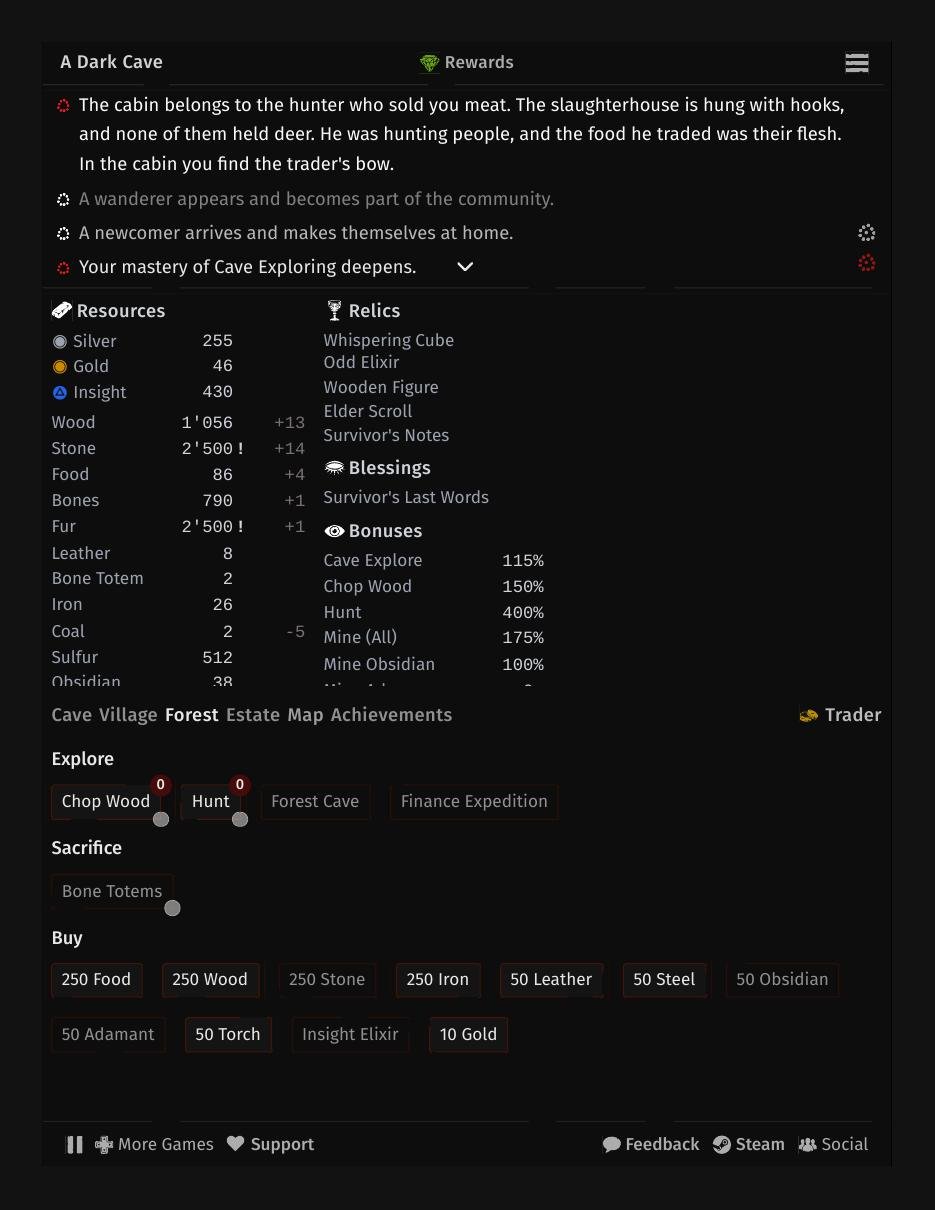
A Dark Cave has a cast, and all of it arrives through little timed events. A repairman I sheltered turned out to be a disgraced priest, and he joined my fellowship. A survivor I took in died in the night and left my village a blessing. A woodcutter I traded food with robbed me and vanished, and I was genuinely annoyed about it for hours, until the game brought him back wounded in the forest and gave me three buttons. Help, leave, or kill. I helped. He apologized, gave me his axe and five thousand wood, and walked out of my story redeemed. One of the best moments in my twelve hours, and it is made of two paragraphs of text.
Against that, the hunter who sold my village meat for weeks turned out to be hunting people, and the food was people. A handsome traveler I sheltered stole 200 silver in the night. A robed collector keeps showing up offering gold for my relics, and every offer is really an offer to get a little more mad or a little less strong. The game teaches you a bleak little worldview one visitor at a time. Kindness pays, sometimes. Kindness also gets you robbed, sometimes. You never get to know which one is standing at your door.
One door never opens at all. A trader keeps arriving because his daughter is missing near the forest, and the button to send a search party has been disabled on every single visit across twelve hours. I tested everything. Free villagers, lots of them. A scholar assigned. The cave quest finished. Money, food, hunters, a bone totem. Nothing. Either the key is a building chain I have not finished, or Julian built a rescue you are never allowed to attempt, in a game about a cave full of things eating people. I honestly cannot decide if that is a bug, a gate, or the cruelest joke in the game. It bothers me at night, which I suspect is the point.
Underneath it all, a story I have not finished
Through the whole run, a quiet plot ticks along in a list called Whispered Memories. A cube that woke up and found no record of who I am. A civilization that thrived and crumbled. Warriors sent deep underground to guard something so important that their descendants are still standing watch generations later, over a thing even they no longer remember. The memories stopped at six entries early in my run and have not moved since, even after I cleared the cave, built a temple, and dedicated it to a fire god I had to pick blind. No descriptions, no effects, just four names and a druid telling me to choose wisely.
So there is a locked room at the bottom of this game and I have not found the key yet. There are buildings I have read the tooltips of and never built. A bank that lets you invest 500 gold at once. An academy that teaches weapon enchantment. An alchemist who makes powders and explosives. Somewhere down there is whatever those warriors were guarding. Twelve hours bought me a thriving village of 37 people, 26 kinds of buildings, and more questions than I started with.
And then I went and lost the key myself. After the twelve hours I closed the browser and went to live my life, meaning to come back for the ending. When I came back, the save was gone. Browser games keep your progress inside the browser itself, and mine did not survive the pause. No village, no monolith, no cube. Twelve hours of other people’s lives, and the file that held them is just not there anymore.
So this story stays unfinished for a while, and that is on me, not on the game. A Dark Cave is already sitting in my Steam library, where a save lives somewhere safer than a browser tab, and I will go back down there someday and do it all again. Just not next week. I have other reviews planned and other games waiting, and a man can only bury so many villagers in a month.
What it teaches well, and what it makes you learn by bleeding
Since this section of the site is about playing the thing properly, here is my honest report card on how A Dark Cave teaches itself, mechanic by mechanic. Some of this I learned in minutes. Some of it I learned at funerals.
Jobs and production chains: easy to learn. You assign a villager, you watch the number, done. The costs are printed right on the buttons and the logic clicks within minutes.
The fire to village opening: beautifully taught. Unlocks arrive exactly when you are ready to want them. That first hour is the game at its most generous.
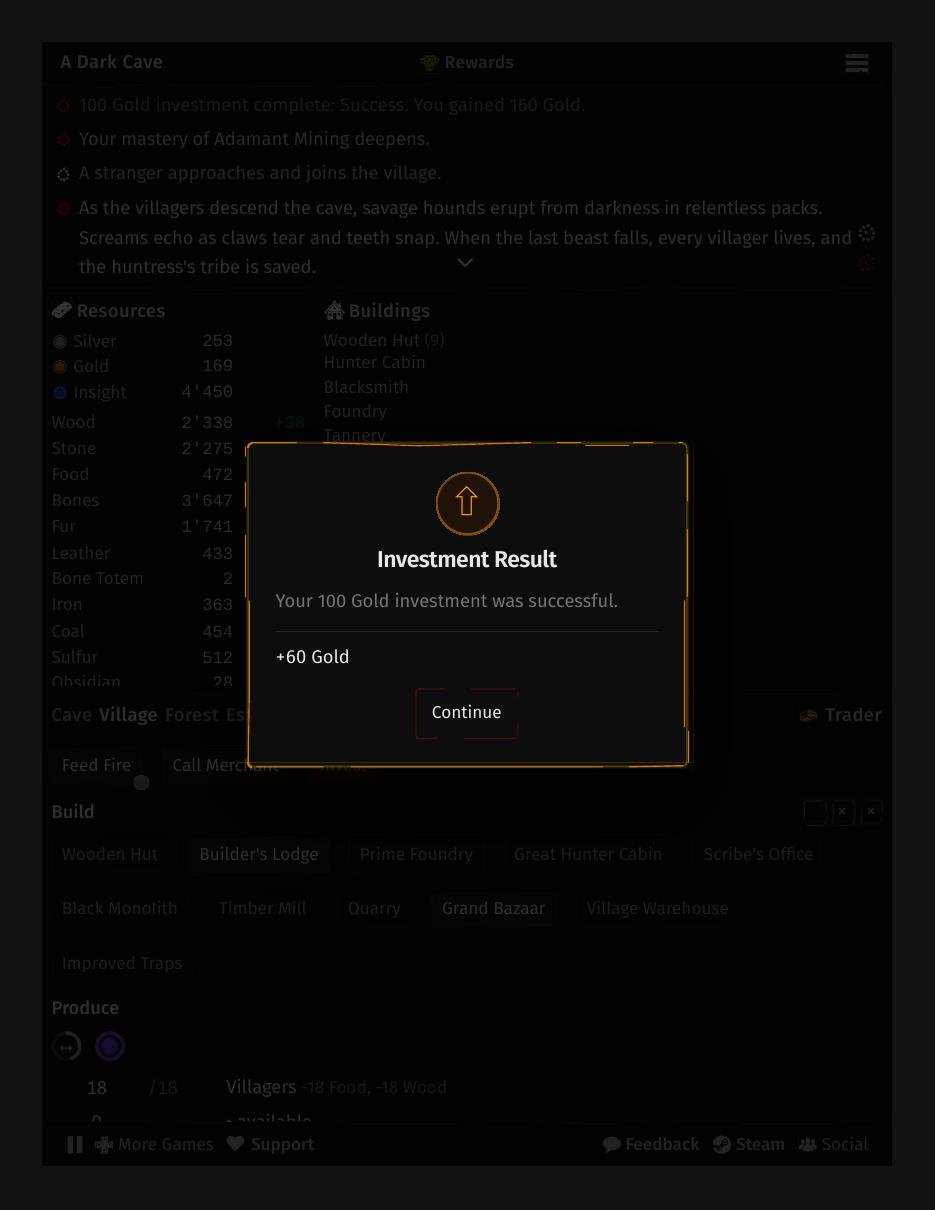
Investments, the little stock market you unlock with a coinhouse: the best documented system in the whole game. The dialog prints the odds and the payouts up front, like it respects you. It still took my money once at 82.5 percent odds, but at least it lied to my face honestly. One catch. There is a 15 minute cooldown between investment rounds that the dialog never mentions. You only find it later, hovering a dead button, wondering what you did wrong.
Mastery, the system where repeating an action makes you better at it: never explained, and it did not need to be. It clicks the first time a tooltip tells you your torches now come seven to a craft. Learned by doing, in the good way.
Storage caps: learned by bleeding. Nothing tells you the cap is the real progression wall. You find out when a building you cannot afford turns out to be a building you cannot hold.
Expedition math: shown honestly, learned brutally. The game tells you the percentage and the price. It does not tell you your village keeps eating during the mission, or that a blizzard on the same day turns a safe food buffer into a starvation event. I learned that one with two funerals.
Fellowship, skills, and blessings: these arrive with almost no explanation at all. A priest joins and suddenly there is a Skills section. A huntress improves, and her bonus only applies after you pay 250 gold to improve her training, a cost you can only see by hovering. Blessings turned out to be a draft pick from a hooded stranger, pick one of three, and the 500 Insight price was deducted silently. The second blessing cost me 750 against a card that said 500. I checked twice. The game either raises the price quietly or mislabels it, and neither answer is great.
Opaque gates: the worst offenders in the game. A smith called Brimstone Flux has visited me around ten times offering help, with a button that has never once been enabled, and I tested every resource and job combination I could think of before giving up for good. A book at the traveling merchant has sat disabled through a fortune in gold and insight. The trader’s daughter button I already told you about. Disabled buttons in this game do not show their requirements, and after twelve hours I still cannot tell which of these are puzzles and which are decorations.
Tooltip honesty: shaky, and this one is a real criticism. My scriptorium promised plus 5 Knowledge and delivered plus 3. My temple promised minus 8 Madness and I measured minus 3. Tooltips also show prices before your build discount applies, so the real cost is always a surprise deduction you have to catch in the numbers. In a game built entirely out of numbers, the numbers on the label should be the numbers in the box.
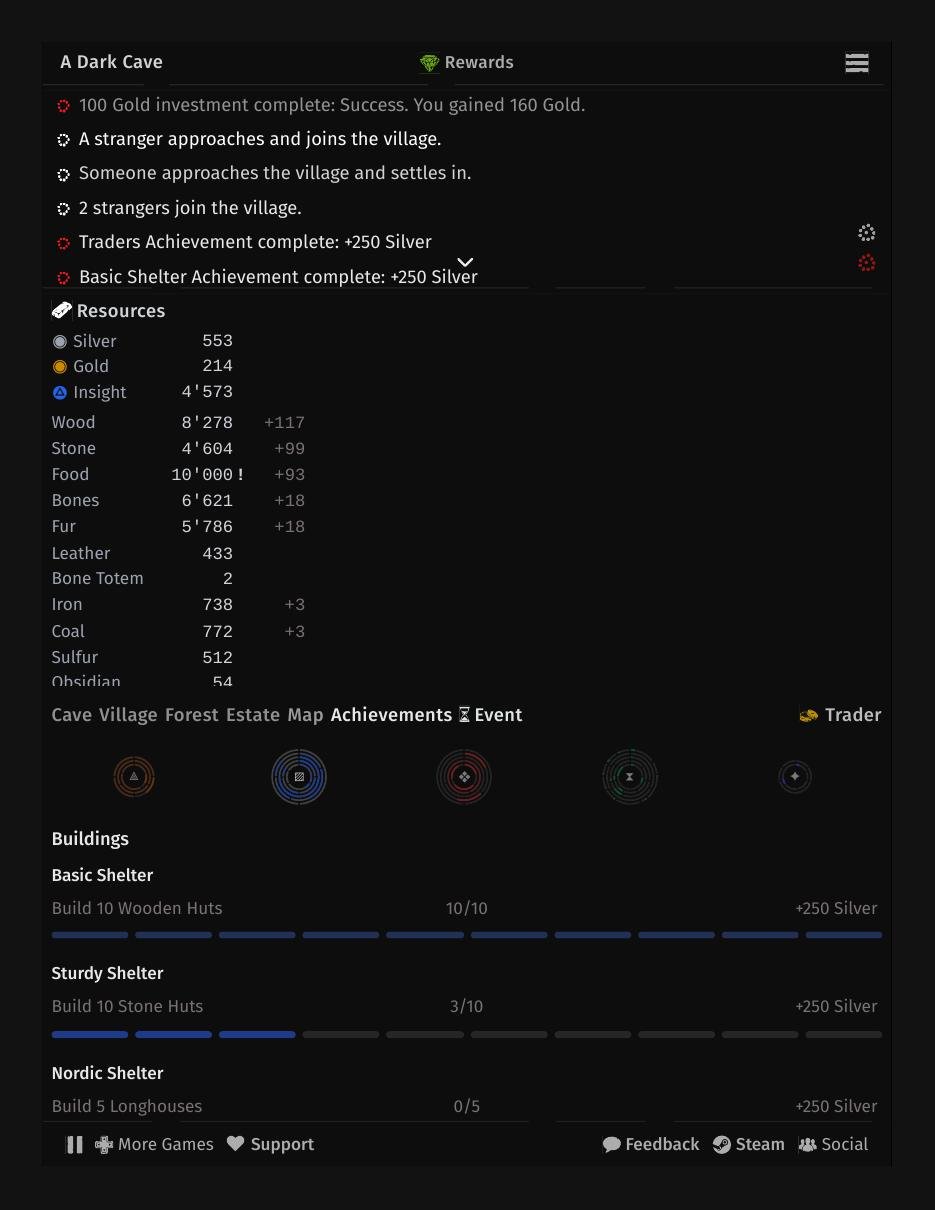
Small frictions that add up: tooltips stick to the screen and cover buttons until you hit Escape. Some achievement rewards are not given automatically. They wait silently in another tab behind a claim button, and I found a thousand silver sitting unclaimed that way. Finished buildings disappear from your buildings list when you upgrade them, which is logical once you know it and terrifying the first time your storehouse vanishes. Buffs end without a sound, so your food income can fall off a cliff and the only witness is a rate number you were not watching.
None of that stopped me. All of it would have been better with one more line of text from the game. That is the pattern, really. A Dark Cave is generous with story and stingy with instructions, and whether that sounds like a flaw or a feature depends on the kind of player you are.
The man who built the cave
This is the part of the review I care about most, because this section of my site exists for the people behind the games. Julian Bauer built A Dark Cave by himself, over roughly a year, in Germany, because A Dark Room got its hooks into him more than a decade ago and never let go. He is a dad. One of his devlogs is about spending four days drawing building outlines while his five year old reviewed the work as pizza making, which is the most honest game development diary I have ever read.
The browser version came first, back in November 2025, and he has kept shipping updates at a rough monthly rhythm ever since. New storylines, new systems, a whole post game Cruel Mode with dark pacts that landed on November 4, a week after the Steam launch. The Steam version sits at $7.99 with 77 achievements, cloud saves, and support for eleven languages. Two weeks after launch he posted that the game had 42 Steam reviews and 39 of them were positive, and reading those reviews you find things like a player saying Julian fixed their late game bug the same night they reported it, fast enough that they edited their review upward before bed. That is the solo dev deal at its best. No support team. Just a guy, his cave, and a same night patch.
The audience numbers floating around deserve one careful sentence. Julian has said the free web version passed 15,000 registered players, while one Taiwanese outlet headlined 500,000 people for it. Those cannot both mean the same thing. Visits and accounts are different animals, so I am going with the smaller, sourced one and treating the big number as unverified. Even the small one is a lot of people for one man and one fire.
I did catch myself thinking about what I would ask him if we sat down. Mostly whether the disabled buttons are doors I have not found or doors he nailed shut on purpose, and whether he knows his search party button is going to follow me around longer than most games I finish this year. Maybe one day he answers. For now the work speaks, and the work is good.
Verdict
A Dark Cave is a campfire with teeth. It looks like the simplest game on your screen, a column of text and some buttons, and inside twelve hours it gave me a production puzzle with real teeth, a rescue mission I failed four times and grieved, a madness system that turned my thriving village into a slow emergency, and a cast of strangers I trusted wrongly in both directions. It is also a game that lies on its tooltips, hides its prices, and refuses to explain some of its own buttons, and I am not going to pretend otherwise just because the mood is incredible.
Play the browser version. It is free, it runs on anything, and the first hour will tell you exactly whether you are the kind of person this game is hunting. If you are, the Steam version at $7.99 is an easy call, and you will be supporting one developer who is still in there shipping updates and fixing bugs the night they are reported.
Twelve hours in, my village stood at 37 people. The fire was lit. The monolith was fed. The cube never told me who I am, and in that run it never will. Round two is waiting in my Steam library. That is the review.
What it does well
Almost everything that matters. With a column of text and a fire, the game builds dread better than most horror games with a hundred times its budget. The systems hold hands in the dark: food feeds the workers, workers feed the expeditions, expeditions feed the graveyard, and Madness taxes every shortcut. Every death was a decision I had made earlier coming back to collect. That is game design, done with buttons and sentences.
What needs work
The teaching, mostly. Tooltips that promise one number and deliver another. Prices and storage limits you discover by crashing into them. Buttons that sit unexplained until a tooltip on a corpse clears them up. And the browser save, as I learned the hard way, is a fragile place to keep twelve hours of your life. None of it is fatal, all of it is fixable, and the developer fixes things the night they are reported.
Is it worth it?
I lost more than forty villagers, a cannibal ate my trust, and then the save itself died. I had a great time. The game is free in your browser and $7.99 on Steam, and I still want to go back down there and do it all again.
Twelve hours, forty funerals, one lost save, and I am still going back down there someday.
Leave a Reply