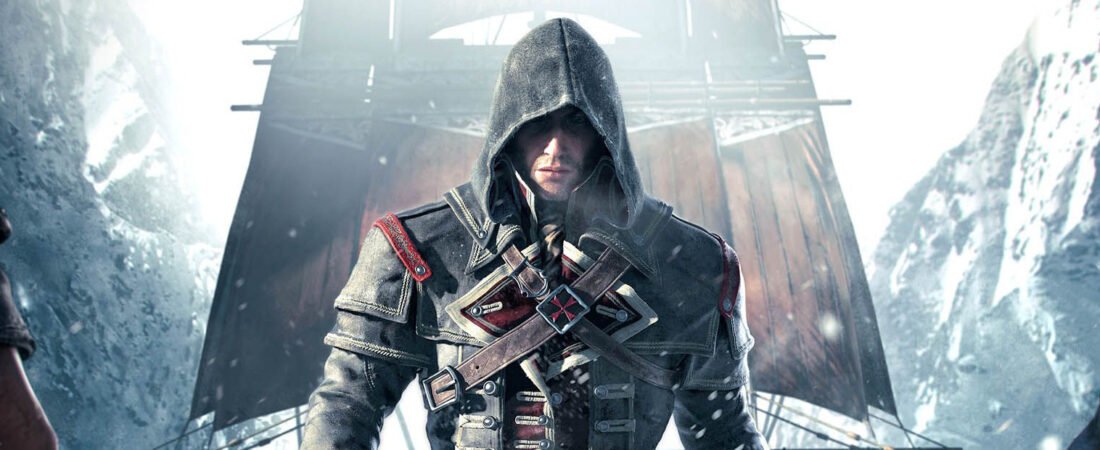
On November 11, 2014, Ubisoft released two Assassin’s Creed games on the same day. One of them got Paris, a marketing blitz and the cover of every magazine. The other one got sent to dying consoles with a fraction of the attention. Guess which one actually worked at launch.
By Ruan Martini, Daily Checkpoint
I want to talk about the most disrespected mainline game in this entire franchise, and I want to start with the crime scene. Autumn 2014. The PlayStation 4 and Xbox One are a year old, and Ubisoft decides to feed both generations at once. The new consoles get Assassin’s Creed Unity, a gorgeous French Revolution epic that launched with performance problems, glitches and one infamous bug where characters’ faces simply declined to show up for work. The old consoles, the PlayStation 3 and Xbox 360 that most players were in the process of abandoning, get Assassin’s Creed Rogue.
Same day. Same franchise. Two completely different fates. Unity became a punchline with great architecture. Rogue became a trivia question. And that is a shame, because Rogue is the game that did the bravest thing this series has ever done with its story. It let you join the other side.
The Pitch: What If the Assassins Are Wrong?
Rogue was developed by Ubisoft Sofia, a support studio finally handed a mainline game of its own, and the concept they ran with is still the boldest in the series. You play Shay Patrick Cormac, a brash young Irish recruit in the Colonial Brotherhood of Assassins during the Seven Years’ War. Early on, Shay is sent to Lisbon to recover an artifact from a Precursor temple. The artifact comes out, the temple does what Precursor temples do, and the result is the 1755 Lisbon earthquake, a real historical catastrophe, with Shay standing in the middle of the rubble understanding, all at once, that his mentors sent him to pull the trigger on a city.
That is the break. Shay confronts the Brotherhood, steals a manuscript that could lead them to more temples, gets shot by his own best friend for it, and wakes up in New York under the protection of the people he was trained to kill: the Templars. Under Haytham Kenway, yes, Edward’s son, the best dressed villain this franchise ever produced, Shay rebuilds himself as an Assassin hunter. His personal motto tells you the whole character in five words: I make my own luck.
Sit with how daring that structure is. For seven games, the series had trained players to see Templars as power hungry tyrants in nice coats. Rogue spends its campaign making the Templar argument from the inside, by a man whose grievance is completely legitimate. The Assassins in this game, his old friends, keep chasing artifacts that level cities, and they respond to his doubts with dogma. Ubisoft billed Rogue as the darkest chapter of the Brotherhood when it announced the remaster years later. Honestly, that undersells it. It is the chapter where the Brotherhood has to be stopped, and you are the one holding the rope.
Hunting Your Own Family
The back half of Rogue is a hit list, and every name on it hurts. Shay hunts the people who trained him, joked with him and trusted him. He kills Adéwalé, Edward Kenway’s loyal quartermaster from Black Flag, now an old Assassin legend. He comes for his mentor Achilles Davenport, and the confrontation leaves Achilles alive but broken, which quietly explains the bitter, limping old man who trains Connor years later in Assassin’s Creed III. And the finale takes Shay to Versailles, where he kills Charles Dorian, a French Assassin whose young son watches it happen. That boy is Arno. That murder is the opening mystery of Unity.
Read that again. The two games Ubisoft threw at the wall on the same day in 2014 are actually one story told from two ends, and the connective tissue is in the game nobody bought. Rogue is also the closing chapter of the whole North American saga that started with Haytham in Assassin’s Creed III and peaked with Edward in Black Flag. It ties off the Kenway family story, the Colonial Brotherhood, all of it. Required reading, published like an optional extra.
Black Flag’s Bones, a Colder Sea
Mechanically, Rogue is honest about what it is: Black Flag’s skeleton, refined and moved north. Your ship, the Morrigan, is smaller and faster than the Jackdaw, built for the North Atlantic, where you ram through ice sheets, dodge icebergs and sail past frozen coastlines instead of palm trees. There is a River Valley map full of French forts and settlements, and New York appears as a full explorable city, something the series had weirdly never done in this era. It is shorter than Black Flag, too, a tighter campaign that respects your evening, which in 2014 counted as a flaw and in 2026 counts as a feature.
The clever twist is that the Assassins now hunt you. Rogue introduces stalkers, Assassin enemies who hide in haystacks, crowds and rooftops exactly the way you used to, waiting to drop on Shay the moment you stop paying attention. If you have ever spent a decade air assassinating people in this series, getting air assassinated back is a deeply educational experience. There is a little audio whisper that warns you a stalker is near, and I promise you will never walk past a haystack casually again.
None of it is revolutionary. Rogue was built fast, on old hardware, out of proven parts. The reviews at the time landed exactly where you would expect for that recipe: respectful, a little tired. Critics praised Shay and the story’s nerve, and dinged the game for feeling like a colder remix of Black Flag. Nobody called it a disaster. Nobody called it essential. It just slipped under the water.
Buried by the Calendar
A decade later, this is what still annoys me. Rogue did not fail because it was bad. It failed because of scheduling malpractice. It launched the same day as its own big brother, on hardware its audience was actively selling, in the middle of the loudest launch disaster in franchise history. Every headline that month was Unity’s face bugs. Every marketing dollar pointed at Paris. Rogue had no oxygen. Ubisoft never even broke out a proud sales milestone for it, in an era where the company announced shipment numbers for everything that moved. The game was treated as a parting gift for the old consoles, and parting gifts do not get victory laps.
Players who did find it, though, kept the faith. When the remaster arrived on PlayStation 4 and Xbox One on March 20, 2018, the coverage had already turned affectionate. VGChartz’s review of the remastered version opened by calling Rogue, flat out, the best Assassin’s Creed game you never played, and that phrase became its unofficial subtitle. Retrospectives since then, like GamingBolt’s 2020 look back, keep circling the same conclusion: Shay’s transformation from young Assassin to Master Templar remains one of the most fascinating arcs the series ever wrote, precisely because the game lets him be right about the thing that made him leave.
Where It Stands Now
Rogue’s paper trail of second chances is longer than most games’ first chances. It reached PC in March 2015. The remaster brought it to PlayStation 4 and Xbox One in 2018, with 4K support on the Pro and One X. And in December 2019 it sailed onto the Nintendo Switch inside The Rebel Collection, bundled with Black Flag, so the two sibling sea games now travel together the way they always should have. Its reputation has done nothing but climb since the remaster, from trivia question to the answer fans give when somebody asks which old school Assassin’s Creed they missed.
My take: if you bounced off the modern RPG era of this series and you miss the old formula, the hidden blades, the ship, the hooded parkour, the manageable map, Rogue is the one to rescue. It is the last game built entirely in that old style, it closes the best storyline the franchise ever told, and it makes you hunt your own friends while delivering the most dangerous line in the whole series: the Templars might have a point. Ubisoft buried this game under its own calendar. Dig it back up. Shay made his own luck. The least we can do is make his audience.
Sources
Assassin’s Creed Rogue development by Ubisoft Sofia, November 11, 2014 launch on PlayStation 3 and Xbox 360 alongside Unity, PC release in March 2015, Remastered release on March 20, 2018 and The Rebel Collection on Nintendo Switch in December 2019, Wikipedia.
GameRevolution coverage of the Rogue Remastered announcement, January 2018, including Ubisoft’s billing of the game as the darkest chapter of the Brotherhood.
VGChartz review of Assassin’s Creed Rogue Remastered, March 2018, for the “best Assassin’s Creed game you never played” framing and remaster reception.
GamingBolt retrospective on Assassin’s Creed Rogue, September 2020, on Shay Cormac’s arc and the game’s story reputation.
Daily Nebraskan review of Rogue Remastered, March 2018, for the shared November 11, 2014 launch day context with Unity and the game’s overlooked original reception.
Leave a Reply