
A solo developer in Saskatchewan quit his job to finish a game he intended to put on his résumé. He does not play poker. A year later that game had sold five million copies, been nominated for Game of the Year at The Game Awards, and taught millions of people to say “Chips times Mult” like it was a prayer. The tenth entry in my indie analysis series is Balatro, the poker roguelike that borrowed the most familiar object in gaming, a 52-card deck, and rebuilt it into an engine for breaking arithmetic.
What Balatro is
Balatro is a roguelike deck-builder developed by the anonymous solo developer LocalThunk and published by Playstack, released on February 20, 2024 for Windows, PlayStation, Xbox and Nintendo Switch at $14.99, with macOS, mobile and later a Nintendo Switch 2 version following. There is no opponent and no betting. You play poker hands alone against escalating score targets, and between rounds you spend cash in a shop on cards that rewrite the rules: Jokers, Tarot, Planets, boosters, vouchers. The name is Latin for a professional jester, which is exactly what the game turns the player into.
A run is eight antes. Win the eighth and the run is beaten; endless mode then lets the numbers climb until mathematics itself gives up.


A résumé game
LocalThunk built Balatro over two and a half years, starting in 2021. It began as an online version of big two, the Cantonese climbing game played with poker-like hands, and turned single-player after he watched Northernlion stream Luck Be a Landlord, the slot machine roguelike. Famously, he avoided playing other deck-builders during development so their ideas would not leak into his, trying Slay the Spire only near the end, to study its controls. He has said the 52-card deck appealed to him as “a shared cultural game design tool that has evolved over hundreds of years”: every player on Earth arrives already knowing the controls.
The whole production is a study in small numbers. The game is written in Lua on the free Löve framework. The soundtrack, by LouisF, was commissioned on Fiverr and described by LocalThunk as the only money he planned to spend on the entire project. About a year before release he quit his day job to finish the game as a résumé piece. Playstack’s head of discovery found it on Steam, signed it, and built the launch around betas and streamers.
Chips times Mult
The entire game hangs on one multiplication. A played hand has a base value in Chips, set by the hand type and the scoring cards in it. That is multiplied by Mult, which starts tiny and is fed by Jokers, hand levels and card enhancements. Forty times two is a two pair clearing an early blind. Three hundred forty times twenty-one thousand six hundred is what the formula looks like after an hour of engineering, and the distance between those two numbers is the game.
Each round gives limited hands and limited discards to hit a target score. Antes stack three blinds: Small, Big, and a Boss. Small and Big can be skipped for tags, small permanent favors, at the cost of the shop visit and the cash, which makes even not playing a decision. Cash itself follows a quiet rule of discipline: unspent money pays interest at round’s end, so greed and saving pull against each other on every purchase.
150 Jokers walk into a deck
Jokers are the engine room: 150 at launch, held in a row of (usually) five slots beside the deck, each a passive rule with a condition. Some add Chips or Mult when a suit scores, some multiply Mult itself, some print money, copy cards, or reward strange behavior like playing hands you would normally avoid. The deep distinction the game teaches is additive versus multiplicative: a Joker that adds +4 Mult is lunch money next to one that multiplies the total by 1.5, and learning to feel that difference is learning Balatro.
Jokers also arrive in editions (Foil, Holographic, Polychrome) that stack extra value, and the rare Negative edition takes no slot at all. Because slots are the scarcest resource in the game, the real build question is never “is this Joker good” but “is it better than the fifth-best thing I already own, and does it fire in the same order as the others”. Sequencing is a hidden stat: Jokers trigger left to right, and arranging them is arranging the arithmetic.
Deck surgery
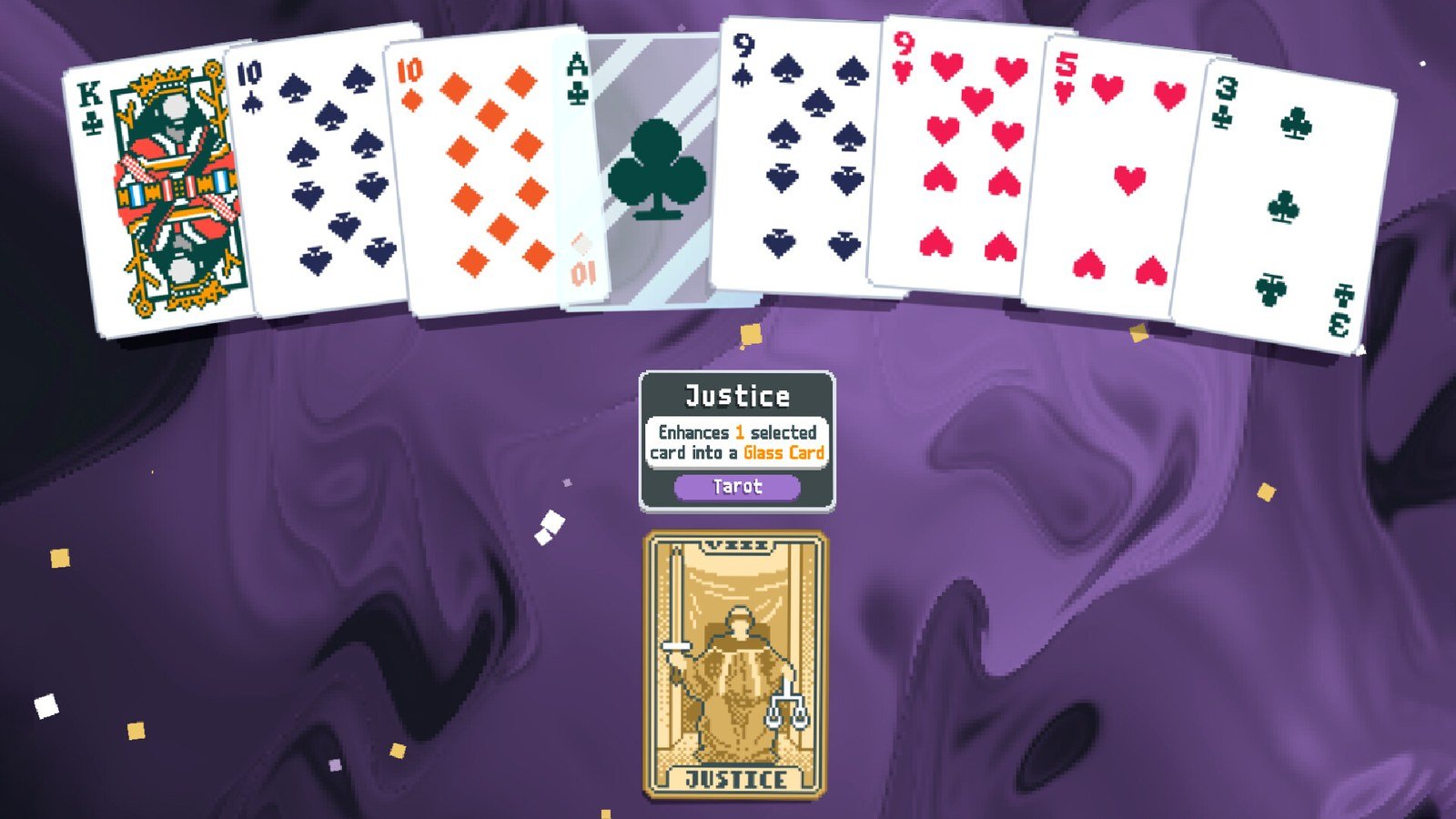
If Jokers are the engine, the deck is the fuel, and Balatro lets the player refine it. Tarot cards convert suits, enhance cards into bonus, steel, gold or glass versions, or destroy them outright. Spectral cards go further, copying cards and applying editions at a price. Planet cards level up a specific poker hand for the whole run, permanently raising its base Chips and Mult, which quietly rewards committing to one hand type and building the deck to draw it.
Destroy enough cards, copy enough kings, convert enough suits, and the deck stops being a standard 52. It becomes a machine for producing hands that do not exist in poker: Five of a Kind, a Flush House, a Flush Five. The scoreboard does not object. The scoreboard is the point.
The boss is a rule change
Boss Blinds are the design’s immune system. Each one disables part of the player’s machine: no repeat hand types, face cards debuffed, one hand only, discards cut, Jokers silenced. They exist to punish the single-strategy build, and they are why Balatro runs stay tense after the engine is strong: the question stops being “how big is my number” and becomes “does my number survive having its favorite rule banned”. Beating runs unlocks new decks and higher stakes that stack extra restrictions, and endless mode runs until ante 39, where the required score overflows the number format entirely and the game prints its famous surrender: naneinf.
Europe’s ratings board briefly re-rated the game 18+ for “evil playing cards”, in LocalThunk’s own mocking phrase, despite there being no gambling in it at all. The rating fight only underlined the design truth: this is a game about poker the way chess is a game about war.
Reception
Balatro scored 90 on Metacritic for PC and 92 on OpenCritic, where 100 percent of critics recommend it. It sold a million copies in its first month and passed five million by January 2025. At The Game Awards 2024 it was nominated for Game of the Year and won Best Independent, Best Debut Indie and Best Mobile; it then took Game of the Year at the Game Developers Choice Awards. A résumé piece, by an anonymous developer who does not play poker, beating the industry’s biggest productions at their own ceremony.
My take
The analytical point about Balatro is that its genius is legibility. Every number on screen is explainable: the hand, the Chips, the Mult, the Jokers firing one by one in sequence while the score ticks up like a slot machine that shows its work. The player always knows why the number is huge, because they assembled the machine that made it huge, one shop decision at a time.
Most roguelikes hide their systems behind theme. Balatro’s theme is the system: multiplication, performed live, by clowns. That is why a game with no story, no characters and no world outcompeted games with all three. The fantasy it sells is not poker. It is watching your own idea become too big for the screen to hold.
Sources
- Steam store page and Steam API, Balatro (LocalThunk / Playstack): price, app details
- Wikipedia, Balatro: development, gameplay systems, ratings history, reception and sales
- OpenCritic: Balatro average score of 92 across 64 reviews, 100 percent recommended
- Metacritic: per-platform scores cited in the panel and text
- The Game Awards 2024 and 25th Game Developers Choice Awards records
The Checkpoint Poll
Leave a Reply