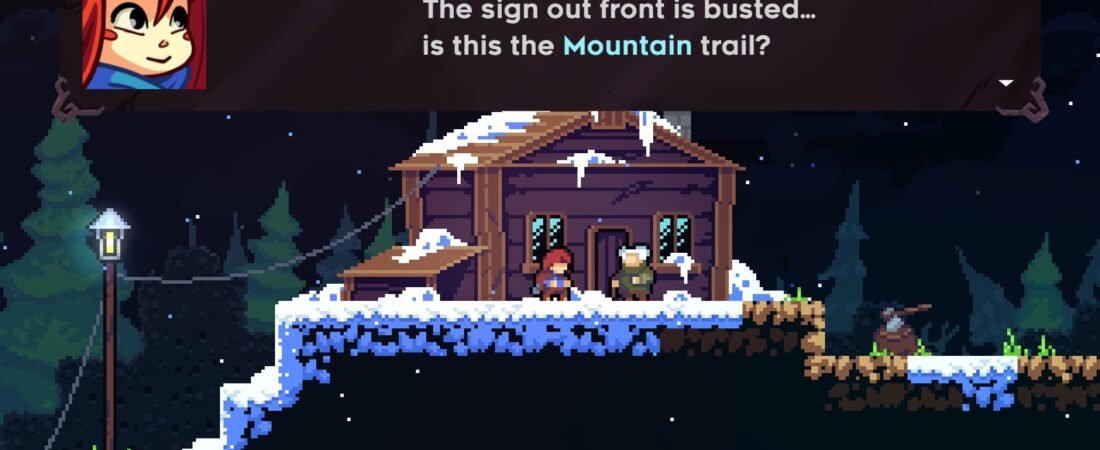
Precision platformers are usually built like exams: one mistake, back to the start of the question, and the game quietly keeping score of your failures. Celeste is built like a climbing partner. It is every bit as hard as the genre gets, and it is engineered, at the level of invisible frame windows and restart speeds, to make failure feel cheap and intent feel sacred. The sixth entry in my indie analysis series is the game that proved difficulty and kindness are not opposites.
What Celeste is
Celeste is a 2D precision platformer from Maddy Makes Games, directed and written by Maddy Thorson, programmed by Thorson and Noel Berry, with music by Lena Raine. It launched on January 25, 2018 for Windows, macOS, Linux, Nintendo Switch and PlayStation 4, with Xbox One a day later, at $19.99.
You are Madeline, a young woman carrying anxiety and depression up Celeste Mountain for reasons she cannot fully explain to anyone, including herself. The mountain is haunted and honest: partway up, it gives her self-doubt a body. Badeline, the “pragmatic part” of her, spends the game trying to stop the climb for her own protection. The cast around them is small: Granny, who laughs at the mountain and stays kind; Theo, a traveler from Seattle taking photos; and Oshiro, the ghost still running the hotel in his head.


Born in a weekend
Celeste began in August 2015 as a PICO-8 prototype, built by Thorson and Berry in about three days for a game jam and initially titled Everest. The constraints of the fantasy console forced the design minimal: a small character, a mountain, a climb. Thorson has said the team deliberately carried lessons from TowerFall, her 2013 arena game, into a single-player structure, and that Super Mario Bros. 3 was the strongest influence, particularly its approach of teaching through problem-solving rather than instruction.
The expanded game kept the prototype’s skeleton and its honesty. The original PICO-8 version, retitled Celeste Classic, is hidden inside the finished game as a playable minigame, a fossil of the weekend that started everything.
Four verbs and a stamina bar
Madeline’s kit fits on an index card: run, jump, climb, dash. The dash fires in any of eight directions, once, until she lands or touches a refill crystal. Climbing is governed by a stamina meter: grip long enough and her hands start to slip, which turns every wall into a resource decision. Wall jumps, dash refills, and that is essentially the whole vocabulary for eight chapters.
Complexity comes from the mountain, not the moveset. Each chapter introduces one idea and then spends its length interrogating it: dream blocks that carry Madeline through space when dashed into, moving blocks that hand her their momentum, bubbles, wind, feathers, traffic-light blocks. Because the verbs never change, every new room is a sentence in a language the player already speaks fluently. The difficulty is in the reading, not the alphabet.
Designed to forgive
Under the pixel art sits the game’s real technology: forgiveness, implemented in frames. Celeste grants coyote time, a few frames after leaving a ledge in which a jump still registers. It buffers jump inputs pressed slightly before landing. It rounds corners so a dash does not die on a stray pixel, and it lets Madeline wall-jump while slightly away from the wall. The design goal, stated plainly by the team, was to match the player’s intent rather than demand perfect execution.
Then there is the structure around failure. Challenges are single screens with checkpoints between them, and death restarts the screen almost instantly. The cost of a mistake is seconds, not progress. Celeste can therefore be brutally hard screen by screen while never being punishing in aggregate, because the game refuses to tax the attempt itself. Failure is data, delivered fast.
Difficulty you choose yourself
The same philosophy scales upward. Strawberries are optional collectibles placed on crueler lines through each room; they unlock nothing essential and exist purely as a wager the player makes with themselves. Cassette tapes hide B-side versions of each chapter, remixes at a much higher difficulty, and finishing all eight B-sides unlocks the short, savage C-sides. The game’s hardest content is literally tucked behind its own collectibles, opt-in at every level.
And it scales downward with equal care. Assist Mode, added late in development after the team watched the public argument over Cuphead’s difficulty, lets players slow the game speed, extend or infinite the dash, and grant invincibility. It was nearly shipped under the name Cheat Mode; Thorson renamed it because the word cheat was a judgment, and the mode was the opposite of one. Rock Paper Shotgun’s verdict at the time still stands as the design’s summary: it solved the difficulty argument so elegantly that everyone should have been paying attention.
The mountain is the metaphor
The story never lectures, because the mechanics already said it. Madeline’s arc is about a part of herself she tries first to outrun and then to abandon. Badeline throws her off the mountain for it. The resolution the game argues for, guided by Granny, is neither conquest nor surrender: reconcile, apologize, and climb together, which the moveset then literalizes when the two merge and the dash doubles. The famous gondola sequence stops the platforming entirely for a panic attack and a breathing exercise, and the game trusts that moment enough to let the genre wait.
The free Farewell expansion, released September 9, 2019, closes the book with the series’ hardest chapter and its most tender one: grief, this time, chased through space after Granny’s death, with jellyfish parachutes and exploding pufferfish folded into the farewell. It was the perfect capstone, per Kotaku, precisely because it treats mastery and mourning as the same climb.
Reception and the long tail
Critics scored Celeste 88 on Metacritic for PC (92 on Switch, 91 on PlayStation 4, 94 on Xbox One) and 92 on OpenCritic, where it sits in the 100th percentile. IGN gave it a 10 and called it a surprise masterpiece. At The Game Awards 2018 it won Best Independent and Games for Impact against a Game of the Year nomination; it took Best Audio at the Game Developers Choice Awards and two D.I.C.E. Awards. Sales passed 500,000 in its first year, a million by March 2020, and 1.7 million by January 2025, with the Switch version the reported best seller. Lena Raine’s soundtrack was streamed over 4 million times on Spotify in 2018 alone.
The tail is the community: speedrunners the designers actively accommodated, at times formally adopting techniques runners discovered, plus a modding scene still building mountains of its own. In October 2026, the studio delisted the game from Xbox storefronts in support of the BDS boycott, a reminder that this small game and its makers never really left the conversation.
My take
The analytical point about Celeste is that its kindness is not a mode. Assist Mode is the visible part, but the deeper design is the frame-level forgiveness, the instant restarts, the single-screen challenges, the optional cruelty of the strawberries: a difficulty architecture where the player, and only the player, sets the price of the climb. Most hard games demand respect. Celeste demands honesty, about what you attempted, what you intended, and what you are carrying up the mountain with you.
Plenty of platformers since 2018 are harder. Almost none are this careful. The mountain is the metaphor, yes, but the mercy is the mechanism.
Sources
- Steam store page and Steam API, Celeste (Maddy Makes Games): price, app details
- Wikipedia, Celeste: development, gameplay systems, reception, sales and accolades
- OpenCritic: Celeste average score of 92 across 74 reviews
- Metacritic: per-platform scores cited in the panel and text
- The Game Awards, Game Developers Choice Awards and D.I.C.E. Awards records
The Checkpoint Poll
Leave a Reply