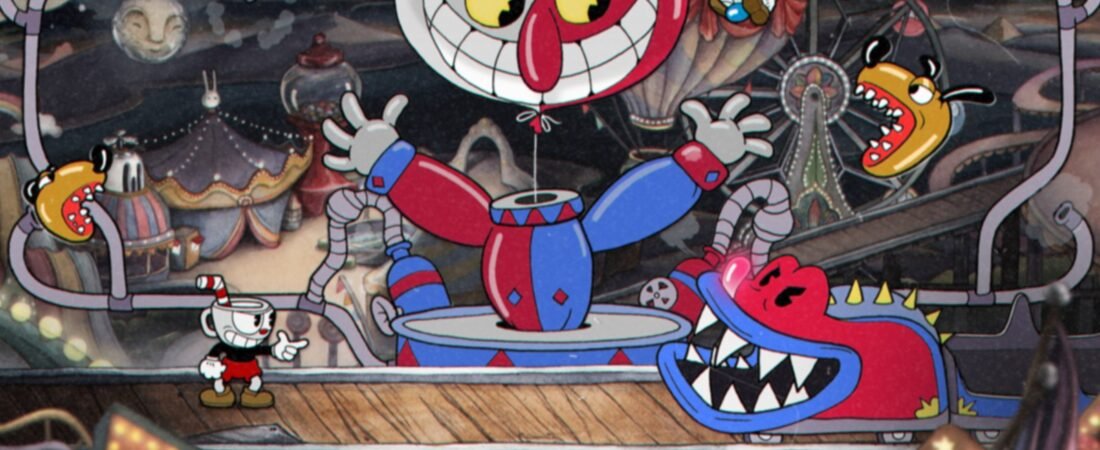
Most indie gambles are about time. Cuphead’s was about real estate: two Canadian brothers remortgaged their houses to finish a game drawn the way cartoons were drawn in 1934, frame by frame, on paper, with the mistakes left in. The ninth entry in my indie analysis series is the boss rush that treated authenticity as a production method, and difficulty as a teaching tool with a progress bar.
What Cuphead is
Cuphead is a run and gun game from Studio MDHR, the studio of brothers Chad and Jared Moldenhauer, released on September 29, 2017 for Windows and Xbox One at $19.99, then ported to macOS (2018), Nintendo Switch (2019) and PlayStation 4 (2020). On Inkwell Isle, brothers Cuphead and Mugman lose a craps game to the Devil and buy their souls back on credit: collect the soul contracts of his runaway debtors by midnight, or else. Elder Kettle hands them a potion that lets them fire energy from their fingers, and the debt collection begins.
The structure under the cartoon is a boss rush: more than 30 boss fights across four isles, broken up by a handful of side-scrolling run and gun levels, ending at King Dice’s casino gauntlet and the Devil himself.


The house bet
Development began in 2010, in the brothers’ homes in Oakville, Ontario and Regina, Saskatchewan. Chad Moldenhauer called Fleischer Studios, the Betty Boop and Popeye studio, “the magnetic north” of the art style, and the team refused every shortcut the style offered. Chad hand-drew the animation; backgrounds are watercolor paintings, digitized and colored in Photoshop. The animation runs at 24 frames per second, the standard of 1930s film, while the gameplay logic ticks at 60, which is why the game can look like a cartoon and still feel like a precision instrument. Human imperfections were kept deliberately, as a reaction against the perfectionism of modern pixel art.
Kristofer Maddigan’s score got the same treatment: 51 tracks of jazz, ragtime and big band, written for and recorded with live period-style ensembles. And when the money ran short before the art ran out, the brothers remortgaged their house to finish it. The character himself came from a strange place: a 1936 Japanese propaganda cartoon featuring a soldier with a teacup for a head, one of dozens of designs (a kappa in a top hat, plates, forks) the brothers tried before the cup stuck.
A boss rush wearing a cartoon
Strip the art away and Cuphead is an argument that the boss fight is the whole game. Each debtor is a multi-phase exam: a flower that becomes a gatling garden, a clown whose balloon head detaches, a dragon, a genie, a robot, a pirate whose ship is also a boss. Phases are transformations, announced like cartoon gags and functioning like new movesets. Land fights alternate with airplane fights that turn the game into a side-scrolling shoot ’em up, shrinking the hitbox to a plane and the margin for error to pixels.
Progression is gated honestly: a boss beaten on Simple mode pays no soul contract, so the story only advances on Regular, and finishing a boss on Regular unlocks Expert. There are no levels to grind and no stats to inflate. The only character build is the player’s own memory.
The parry economy
The one true mechanic, beyond shooting and dodging, is the parry. Certain objects in every fight glow pink, and slapping them mid-air (a jump, then a second press on contact) does different work everywhere: it bounces the player to safety, defuses attacks, opens bosses up, and charges the super meter. The meter is drawn as five playing cards. One card buys an EX move, a heavier version of the equipped weapon’s shot; a full meter buys a Super Art, earned by defending an urn from ghosts inside haunted mausoleums.
Around that core sits a tight loadout puzzle. Weapons (the spread of Spread, the homing of Chaser, the boomerang of Roundabout) and one passive Charm at a time are bought with coins from Porkrind’s Emporium, and only two weapons can be carried into a fight. Every loadout is a bet about the next boss’s phases, and every victory is graded, time, health, parries and meter use all scored, a letter rank dangling over the rematch.
Difficulty that teaches
Cuphead is famous for being hard, and the design reason it stays fair is feedback. Bosses telegraph in the grammar of cartoons: wind-ups are exaggerated, attacks arrive in readable patterns, and randomness is bounded inside phases rather than spread across whole fights. Death is instant and restart is instant, equipment kept, lives infinite, the retry loop measured in seconds.
The masterstroke is the death screen. When Cuphead falls, the game shows a progress bar marking exactly how far through the boss’s phases the player got, a little flag planted on the road to the knockout. Dying stops being a verdict and becomes a measurement: 40 percent, then 65, then the final phase. The game teaches pattern recognition by graphing it.
Co-op and the second cup
Two players share the couch: Mugman joins as a full second fighter, and death is not final while a partner survives, because a departing soul floats upward and can be parried back into the fight. The 2022 expansion, The Delicious Last Course, added a fourth isle and Ms. Chalice, playable via the Astral Cookie charm, with a genuinely different kit: a double jump, a parry dash, an invincible roll. She does not reskin the brothers; she re-teaches the game.
Reception and the long run
Cuphead scored 88 on both Metacritic (PC) and OpenCritic, won three awards at The Game Awards 2017 including Best Art Direction, and sold 2 million copies in its first two weeks and 6 million within two years, numbers that paid the mortgage back with interest. The Delicious Last Course arrived in June 2022 after delays the studio openly attributed to refusing crunch, and The Cuphead Show! ran on Netflix. In June 2026 the studio announced a sequel and a spin-off, Mighty Cuphead Adventure.
My take
The analytical point about Cuphead is that its art is not decoration on top of the design; it is the design’s communication channel. Rubber hose animation exaggerates anticipation for a living, which makes it the perfect visual language for a game about reading wind-ups. The 1930s style is usually described as the game’s charm. It is closer to its tutorial system.
And the difficulty discourse that surrounded it in 2017 missed what the game actually does: it grades you, graphs your deaths, lets a friend parry your soul back, and restarts in a blink. Cuphead is not hard because it hates the player. It is hard because mastery is the product, and it is engineered, kindly and precisely, to be mastered.
Sources
- Steam store page and Steam API, Cuphead (Studio MDHR): price, app details
- Wikipedia, Cuphead: development, animation process, gameplay systems, DLC, reception and sales
- OpenCritic: Cuphead average score of 88 across 215 reviews
- Metacritic: per-platform scores cited in the panel and text
- The Game Awards 2017 records: Best Art Direction and further wins
The Checkpoint Poll
Leave a Reply