By Ruan Martini, Daily Checkpoint
NVIDIA announced DLSS 5 at GTC 2026, on March 16, and the pitch was not what anybody expected. For years, DLSS meant one thing: your game renders at a lower resolution, AI cleans it up, you get free performance. DLSS 5 does none of that. It is not an upscaler. It is not frame generation. Confirmed by NVIDIA’s own newsroom post, DLSS 5 is what the company calls 3D-Guided Neural Rendering: the game finishes rendering a frame the normal way, and then a neural model takes that finished frame, plus its motion vectors, and re-lights it. New skin with subsurface scattering, so light sinks into a face instead of bouncing off plastic. Fabric that actually sheens. Hair that behaves like hair. Jensen Huang called it “the GPT moment for graphics,” which is exactly the kind of sentence that makes half the internet excited and the other half reach for the slop memes.
Both halves got fed. The demos looked astonishing and wrong at the same time, Resident Evil Requiem’s Grace Ashcroft came out of NVIDIA’s own showcase with a noticeably different face, and the phrase “AI slop filter” attached itself to the tech within days.
Then the official rollout began, and it was almost funny in how small it was. DLSS 5 officially shipped on September 3, 2026, in exactly one video game: NBA 2K27. One. A basketball game. PC only, RTX 50 series only, plus GeForce NOW. That is still the entire official footprint as I write this in early November. The most hyped graphics technology of the year launched inside a sports title most PC players never opened.
The modding community looked at that situation, looked at the calendar, and decided NVIDIA was moving too slow. They were right, and what they did next is the actual story.
What the thing actually does, minus the keynote fog
Before the chaos, thirty seconds of honesty about the mechanics, because half the arguments online come from people fighting a version of this tech that does not exist.
NVIDIA’s Jacob Freeman laid it out plainly in an exchange with YouTuber Daniel Owen, covered by Gizmodo and HotHardware: DLSS 5 takes a 2D frame plus motion vectors as input, works in screen space from a single frame, and infers the materials from the rendered image. It does not read your engine’s material data. It looks at the finished picture and guesses what things are made of, then re-lights them. The geometry underneath never changes. Freeman’s description is considerably more modest than his CEO’s “generative control” phrasing, and that gap matters, because a model that guesses materials from a flat image will sometimes guess wrong. Skin becomes wax. Stone becomes clay. A cartoon face becomes a crime scene. Keep that in your pocket, it explains everything in the second half of this article.
Developers who integrate it properly get controls precisely because the model has opinions: an intensity slider, color grading controls, and semantic masking, so artists can tell the model to keep its hands off specific faces or objects. Remember those controls. The official version has them. The leaked version, in the wild, mostly does not.
One Brazilian, one basketball game, one 158 MB file
On August 26, 2026, a Brazilian hardware enthusiast named Renan Maniero was poking through the early access PC build of NBA 2K27 and found a file that was not supposed to be interesting: nvngx_dlssnr.dll, 158 megabytes, Windows file description “NVIDIA DLSSNR,” version 310.8.0.0. Guru3D and a stack of other outlets carried the find. The game itself did not even have a DLSS 5 toggle in its menus yet. Neither NVIDIA nor 2K had confirmed NBA 2K27 as a DLSS 5 title. The runtime was just sitting there in the build, loaded, waiting for somebody curious.
Somebody curious is the most dangerous creature in PC gaming.
Within roughly 24 hours, the RenoDX Discord had the thing running inside Control, a game from 2019 that has never heard of DLSS 5. The first outside test the press could verify came from Dan Mateescu of Compusemble, a RenoDX community tester who contributes to Tom’s Hardware: Control at 4K on an RTX 5070 Ti went from 71 FPS to 35 FPS with neural rendering applied to the characters. Tom’s Hardware confirmed those figures independently, with the fair caveat that the internal settings were not disclosed. Half your frame rate, gone, in exchange for Jesse Faden’s face rebuilt by a neural net. The first build only touched characters, HDR was broken, and still, the door was open.
Then came the lock picking. The leaked runtime’s CUDA binaries targeted Blackwell cards only, meaning RTX 50. RTX Remix modder Uncle Burrito patched the binaries with Ada-compatible ones, and suddenly the thing ran on an RTX 4090. Community tests shared by Wccftech put that card at roughly 135 to 145 FPS dropping to about 83 with neural rendering on, a 39 percent hit instead of a 50 percent one. After that the flood: RTX 30 and RTX 20 cards via unlock tools like ShyVortex’s DLSS Unlocked, at speeds best described as interpretive. And in the story’s most cursed footnote, a modder named Daniel, handle danielblnc, got NVIDIA’s actual DLL running on AMD hardware through a HIP translation layer. Confirmed by GameGPU’s testing: an RX 9070 XT, AMD’s flagship, ran Cyberpunk 2077 with DLSS 5 at 12 FPS at 1080p when the port launched. Twelve. Later updates dragged it up near 30, against 80 plus native on the same card. A proof of concept, not a feature, but what a proof.
It is not a DLL swap, and that distinction runs the whole show
Anyone who has modded DLSS before knows the classic ritual: download a newer nvngx_dlss.dll, drop it in the game folder, done. That works for Super Resolution because every DLSS game already loads that file and already feeds it color and motion data. Neural rendering is a different runtime entirely. Most games never load nvngx_dlssnr.dll, never expose the inputs it wants, and have no idea it exists. You cannot swap a file the game never asks for.
So the scene built plumbing instead. Three routes, all confirmed real projects:
RenoDX plus ReShade, using the add-on build of ReShade to hook DX12 games, capture the buffers, and call the NR runtime late in the pipeline, after upscaling and tonemapping. This is the route that produced the Control demo, complete with a “Neural Uplift” toggle in the ReShade overlay and a row of style sliders.
OptiScaler forks with DLSSNR support, which intercept games that already ship with DLSS and feed the neural runtime from there. This is how a lot of the YouTube comparison footage you have seen was made.
And DLSS5-Feeder, from a GitHub developer named jlrouzies-fr, which is the piece that turns “some games” into “basically any game.” The Feeder fabricates the inputs DLSS 5 needs, synthesizing motion vectors from the frame and depth buffer of games that have no DLSS at all. DX9 through DX12. Even emulators: profiles exist for PCSX2, Dolphin, Xenia and RPCS3. When people say modders put DLSS 5 in everything, the Feeder is a large part of why “everything” is barely an exaggeration.
There is one more wrinkle, and it changes how you should read every benchmark from August and September. There are two leaked DLLs, not one. The August file, version 310.8.0.0, was an unfinished pre-release build, and it is the one behind almost every viral verdict from that period, good and bad. It roughly halved frame rates everywhere it landed. Reported power draw figures were absurd too, with community tests describing 500 to 580 watts on an RTX 5090 in some scenes, and one MSI 5090 Lightning Z reportedly pulling up to 802 watts in Control with the effect on. Your GPU, reimagined as a space heater with opinions about faces.
Then NVIDIA shipped its updated model inside NBA 2K27 on October 16, 2026: 2x faster than the September model, 10x faster than the March demo version, about 118 million parameters by NVIDIA’s own description, with lower VRAM use. Maniero extracted that build too, the same day, version 310.9.16.0. The new DLL carries both models inside it as presets, A for September, B for October, switchable in the tools, which turned every tester into a lab. Community tester Detro measured Cyberpunk 2077 on an RTX 4080 SUPER with the neural pass cost dropping from 8.8 milliseconds to 5.4, and frame rates with 4x frame generation climbing from 108 to 150. Tester GamingOptimized reported The Witcher 3 running up to 90 percent faster on the October preset than the September one. Whether the faster model also quietly sanded some quality off your favorite game is its own fight, and yes, we are getting to it. Skyrim fans, you appear in both the best and worst sections of this article, somehow. Dual citizenship.
The tool zoo, starring a manager with no hashes
Raw injection frameworks are for people who enjoy config files. Everyone else wanted a button. The scene obliged within days, and the button with the biggest name is the one the owner of this site asked me about specifically: DLSS 5 Manager, by a GitHub developer going by NODIX-TECH, self-described in its own repository as “THE FIRST DLSS 5 MANAGER.” It was first published on August 30, 2026, four days after Maniero found the DLL, and PC Guide was covering it by September 7 as a one-click installer whose first public beta had landed the week before.
What it does, per its own documentation and PC Guide’s coverage: it bundles DLSS 5 with ReShade and OptiScaler, scans your game library, offers per-game install modes with names like “Multipass” and, I swear this is real, “DEEP – FRIED Chicken,” supports emulators, and ships its own “Live Flow” mode that applies the effect without DLL injection. Version 1.1.7 added an AMD mode for RDNA 4 cards. Releases kept rolling through version 1.3.8. Its footprint is genuine, too: Nexus Mods preset pages for Cyberpunk 2077 and The Witcher 3, the popular KK PHOTOREALISM presets, tell users to install NODIX’s Manager as step one. For a huge slice of the audience, this tool is the front door to the whole scene.
Now the part where I stop being a fan and start being your friend. The Manager’s release downloads are executables of roughly 560 to 600 megabytes, they are unsigned, and the project has published no SHA-256 hashes so you can verify what you downloaded is what the developer uploaded. A user asked for hashes in a GitHub issue on September 24; the developer agreed to add them; the October 3 release notes for version 1.3.5 still had none. The code sits public on GitHub, but the repository carries no open source license. None of that proves anything malicious, and I am not accusing a hobbyist of anything. It does mean that if you run it, you are extending a lot of trust to a pseudonymous account, and you should know that going in rather than after.
The wider zoo sharpens the point, because the careful end of the scene exists and looks different. DLSS5oneclick, by faisalkindi, is a roughly 17 megabyte Rust executable under an MIT license that point-blank refuses to touch anti-cheat games, and its own README warns that other “DLSS 5 manager” style executables circulating online are not it, calling out one 500 megabyte binary with no source behind it. At least one YouTube video from September reports a viewer whose system was compromised by a lookalike DLSS 5 tool downloaded from the wrong place. rakanki911’s DLSS 5 Swapper takes the middle road: auto-detects your games, makes backups, gives you an F8 overlay with real sliders. Upshift, DLSS5-Autopilot, DLSS5-Reshade-AIO and a half dozen more fill the gaps. The pattern to teach your eyeballs: the real projects live on GitHub under a named developer with a history you can read. The fake ones live in a video description.
Two more warnings, and these are not fine print, they are load-bearing. First: everything in this ecosystem injects into games, and to kernel-level anti-cheat, an injector is an injector. Sportskeeda reported that Easy Anti-Cheat flags DLSS5-Feeder as an illegitimate file. Games guarded by EAC, BattlEye or Vanguard will refuse to launch or worse, and every serious guide in the scene repeats the same line: single-player, offline, or do not touch it. People “tested” this stuff in Counter-Strike. That is an exhibition, not a lifestyle choice, unless your hobby is collecting bans. Second: stability. The community’s own reports include crashes when the swapchain rebuilds, broken HDR in early builds, roughly a gigabyte of extra VRAM per activation in the RenoDX route, and at least one reported memory leak in Stellar Blade when toggling the effect repeatedly. This is a leaked, unfinished runtime being fed fabricated inputs by hobbyist plumbing. When it works, it feels like magic. Set your expectations at “brilliant science project,” not “driver feature.”
This article is coverage of that scene, not a manual for it. If you go exploring, you now know which names are real, which risks are documented, and which downloads deserve your suspicion.
The perfect tier: where the model earns its keep
Enough caution. You came for the games, sorted the way the community actually experienced them: the miracles, the solid wins, and the war crimes. We start with the miracles, because they explain why anyone bothered.
Quake. The original. From 1996. A community retro roundup covered by the Patreon creator gpuvendor ran the leaked runtime on id Software’s thirty-year-old shooter, on an RTX 5070 Ti, and the torchlight alone would sell you. Stone floors gain texture and wet-looking reflections, and the testers compared the result to modern ray-traced remasters. A game old enough to have a driver’s license became the leaked model’s most convincing demo. There is something poetic in that: a neural net trained on photorealism looking at 1996’s chunky brown castles and going, finally, something I understand.
Elden Ring collected some of the loudest community praise of the whole wave. Multiple YouTube testers, running the OptiScaler route on cards like the RTX 5080, kept landing on the same sentence in different words: stone looks like actual stone. The Lands Between’s weathered castles and cliffs respond to re-lighting like they were built for it, and the outdoor scenes drew even stronger reactions than the faces. The catch is written in the warnings section above: Elden Ring’s anti-cheat means every one of these tests ran offline with Easy Anti-Cheat disabled. Beautiful, absolutely. Something you can use on your co-op character, absolutely not.
Skyrim is the poster child, and its story has a twist I am saving for the joke section, so savor this half first. Modder PureDark, a name Skyrim players already trust, ran the original leaked DLL and produced footage that TweakTown, TechPowerUp and The FPS Review all carried: dated Bethesda faces turn realistic, shading smooths out, lips gain definition, the whole character screen looks like a remaster that never shipped. The price, per PureDark’s own numbers: 80 to 120 FPS down to around 60 in the character screen, and roughly 45 to 50 out in the world. Steep. For a game people have been visually rebuilding for fifteen years, a lot of players looked at those faces and paid it gladly.
The good tier: it works, with an asterisk the size of a frame time graph
NBA 2K27 goes first because it is the control group, the one official implementation, tuned by actual developers with the masking tools NVIDIA built. Digital Foundry’s testing at 4K ultra measured an RTX 5090 falling from 128.4 FPS to 62.7 with the effect on, a 51 percent cut, and The Verge reported NVIDIA itself acknowledging an average 50 to 60 percent performance hit across the RTX 50 lineup at launch. For that ransom, what do you get? Subtlety. Hair lighting, contact shadows, skin that reads as skin in close-ups, crowd detail. Hardware Unboxed found scenes where the difference is genuinely hard to spot, and noted the uncanny side effect of photoreal skin stretched over a basketball game’s dated animations. Their most important sentence for this entire article, paraphrased: the official implementation is nowhere near the over-processed mess of the leak mods. Official DLSS 5 is a scalpel. Everything else in this article is the same model holding a chainsaw, which is more fun to read about and less fun to be operated on by.
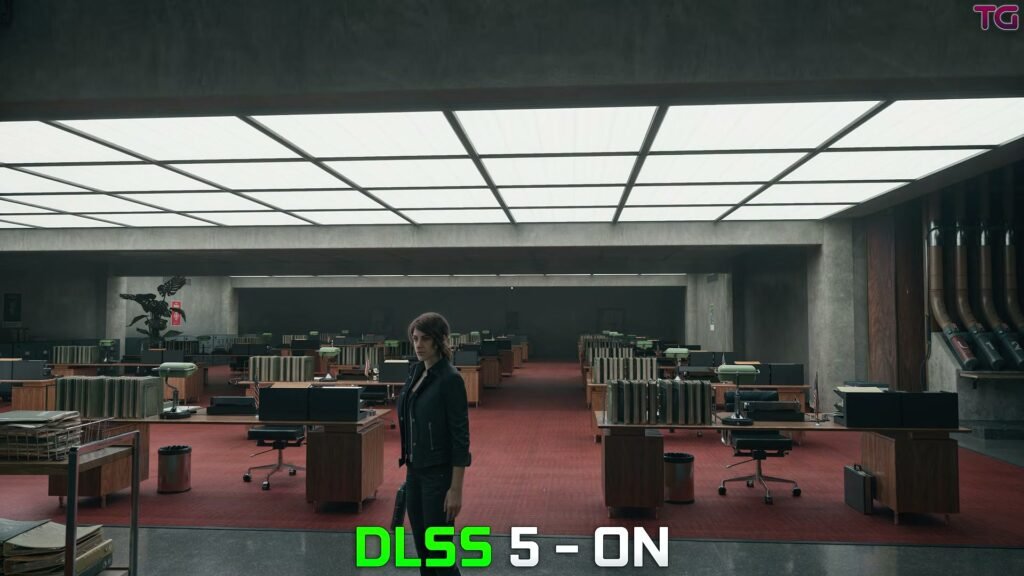
Control earns its spot on history alone, the first game the scene ever cracked, but the results held up beyond novelty. Wccftech described pre-rendered-quality facial detail on Jesse Faden, and the RenoDX build exposed seven style controls so you could dial the model’s taste up or down per scene. Characters only at first, HDR broken, frame rate halved on everything from a 5070 Ti to a 5090. As a proof that the leak was real, it did its job in a day. As a way to play Control, it remains a very expensive screensaver.
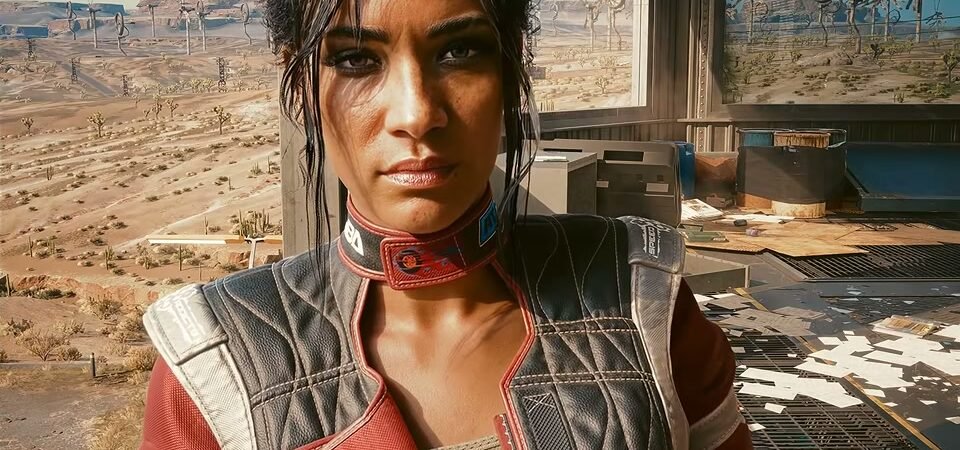
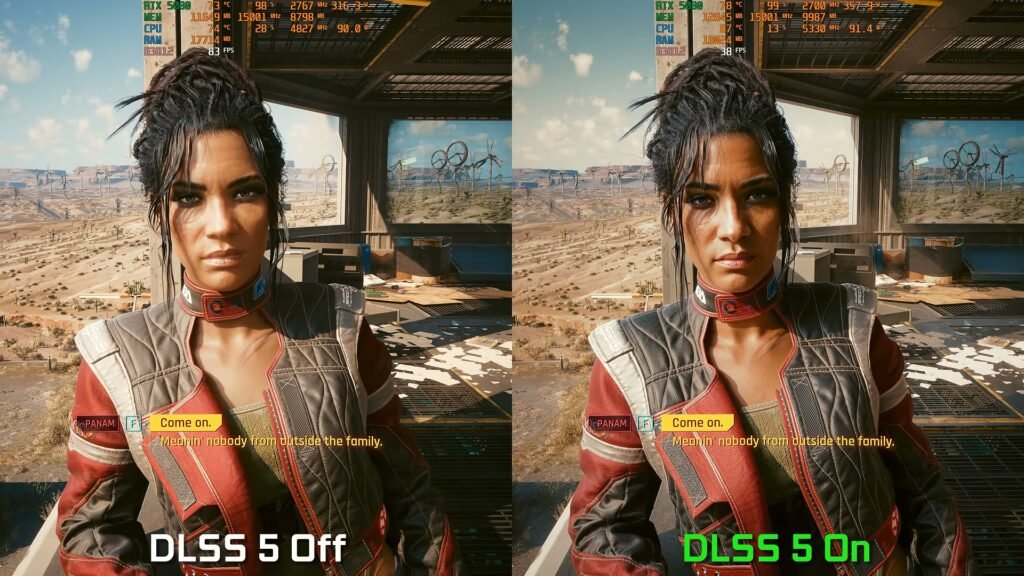
Cyberpunk 2077 became the scene’s laboratory rat, the most tested game of the wave by a mile, because Night City gives the model everything it loves: skin, chrome, wet asphalt, neon. Wccftech called the faces and materials remarkably photographic. The dedicated KK PHOTOREALISM preset exists because fans genuinely prefer the look. And yet the game’s most argued-over screenshot is a face: HotHardware’s own tester flatly dislikes what neural rendering does to Judy Alvarez, which tells you the whole DLSS 5 story in one image. The model does not enhance Judy. It recasts her. On performance, Cyberpunk is also where the October DLL proved itself, with Detro’s 39 percent improvement and GameGPU measuring about 20 percent from the new performance preset, alongside slightly weaker shadows and facial detail in stills. Faster, a touch softer, still Night City. Most players in the threads took that trade without blinking.
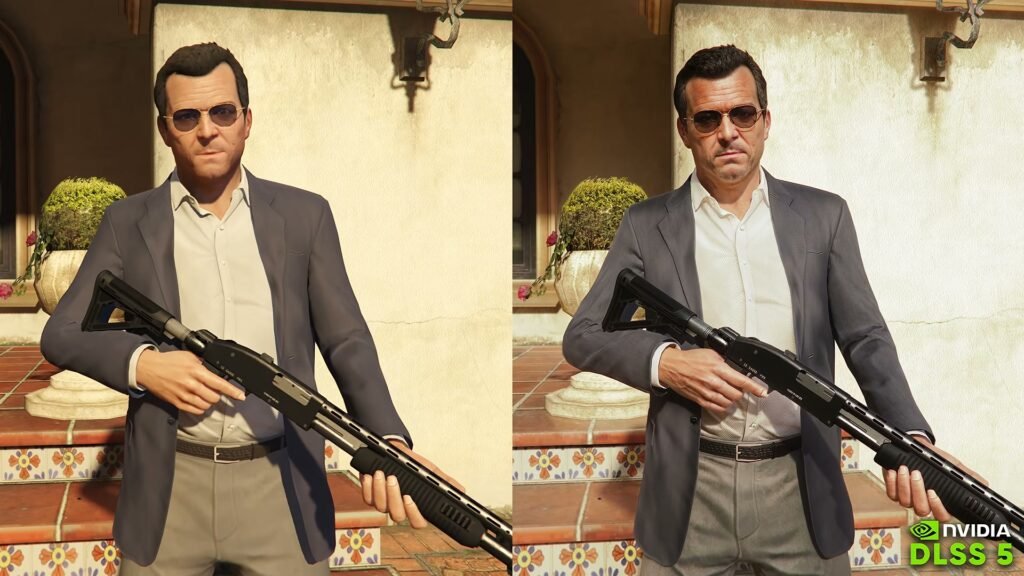
GTA V Enhanced produced the comparison footage that made group chats melt down, Lootward’s tests showing outdoor Los Santos scenes that flirt with photorealism, with hugely detailed skin. It also produced one of the leak’s signature tells: a faint halo outline tracing characters, the model’s segmentation showing its seams. And Rockstar’s own game carries the funniest asterisk in the good tier: in several shots, faces stop being enhancements and become reinterpretations, the AI drawing the person it thinks should be standing there. Franklin deserves better. Franklin deserves to remain Franklin.
S.T.A.L.K.E.R. 2 responded like it was designed in a lab for this: MxBenchmarkPC’s tests, carried by Wccftech, show materials, faces and lighting visibly rebuilt, the Zone’s grime upgraded to documentary footage. Sometimes the model gets over-aggressive with local contrast and facial structure, and the RTX 5080 in that test lost more than half its performance. The Zone was already a place that punished you for entering. Now the punishment is itemized in milliseconds.
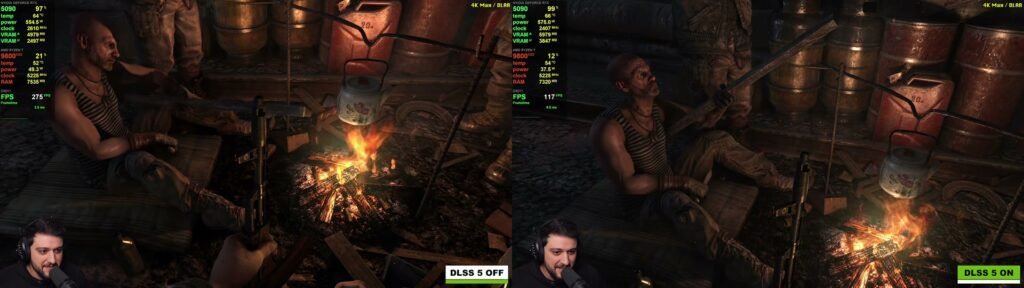
Metro Last Light Redux got the connoisseur treatment from zWORMz, a dedicated on-off comparison at 4K and even 8K on an RTX 5090, and atmospheric shooters turn out to be the model’s home turf: tunnels, gas masks, dust in flashlight beams. Re-lighting a game that is already about light and dark is less a transformation than an amplification. Heavy cost, as always. Atmosphere has never been free.
Sleeping Dogs: Definitive Edition matters for a different reason: it is the viral proof that the Manager route works on an older DX11 title. A tutorial reel from creator Joe Gucc, running DLSS 5 Manager version 1.2.7 in September, showed Hong Kong re-lit at around 105 FPS. A 2012 game, one click, no config file archaeology. Whatever you think of the tool’s paperwork, that reel is why half the scene downloaded it.
Stellar Blade split its testers down the middle, which in this article counts as a good result. Reddit user Qeeyana’s tests, carried by Wccftech, on an RTX 5090 with DLAA at max settings: clear added detail across faces, hair, skin, clothing and local lighting, with outdoor frame rates sliding from a range of 155 to 250 down to 118 to 125, and one indoor scene collapsing from 270 to 132. Stylized faces do not always sit comfortably under a photorealism model, which is the polite version of a sentence the joke section will say much louder.
Assassin’s Creed Shadows and The Last of Us Part II Remastered close the tier as the two cautionary tales. Both were tested by Reddit user Worried_Matter4443, both show striking extra skin and lighting structure, and both come with Wccftech’s warning attached, the single most honest line written about this technology: more detailed is not automatically better. Naughty Dog’s faces are already reference-grade. Naoe’s face is a specific person’s face as Ubisoft’s artists built her. A model that improves the pores while changing the person has not enhanced your game. It has remixed it.
Beyond the headliners, the roundups from Mezha and ThePCEnthusiast list the thing running in Black Myth: Wukong, Senua’s Saga: Hellblade II, Silent Hill 2, Metal Gear Solid Delta, Monster Hunter Wilds, Starfield, Hogwarts Legacy through mods weeks before its official patch, and a fan-made DX12 port of the original 1993 Doom, because of course Doom is here too. Doom runs on everything, and now, apparently, everything runs on Doom’s new colleague. Per-game verdicts in that second wave are thin, so I am not grading them. It runs. Sometimes that is the whole headline the scene needed.
The joke tier: faces were harmed in the making of this section
And now the part of the article that half of you scrolled straight to. Everything above ran the photorealism model on games that at least aspire to photorealism. The community, being the community, immediately asked a better question: what happens if we feed it games that are proudly, aggressively not?
An X user named jo ran the experiment, and Dexerto carried the results on September 1, 2026. Start with Danganronpa, a visual novel built on flat, sharp, unmistakably anime faces. The model looks at Makoto Naegi, the most ordinary protagonist in gaming, and renders him as Chucky. The killer doll. Same energy, same haunted plastic, a face that wants to discuss your mortality. Junko Enoshima comes out as what Dexerto’s coverage called the worst kind of paralysis demon, and Hope’s Peak Academy’s corridors, flattened and re-lit, turn into the Backrooms. A murder mystery visual novel became a horror game in a genre its developers never shipped.
Higurashi When They Cry fared no better in jo’s tests. Rena gains realistic hair growing out of a hand-drawn sprite like a cursed mod for a game that does not support mods, and Mion’s hands come out with sausage fingers, the classic AI tell, rendered faithfully at full resolution. Jo captioned the series with the most honest review the leak ever received: “someone needs to take my computer away.” The Trails games, per Metro’s write-up, produced results described as pure nightmare fuel, and Shin Megami Tensei V followed the same pattern into the wall.
The fair context, which somehow makes it funnier: NVIDIA knew. Edward Liu, from NVIDIA, had already said publicly that DLSS 5 is intended for photorealistic content, and GameSpot’s summary of NVIDIA’s own guidance listed the exclusions plainly: no Final Fantasy, no Kingdom Hearts, nothing stylized. The scene read that list as a menu.

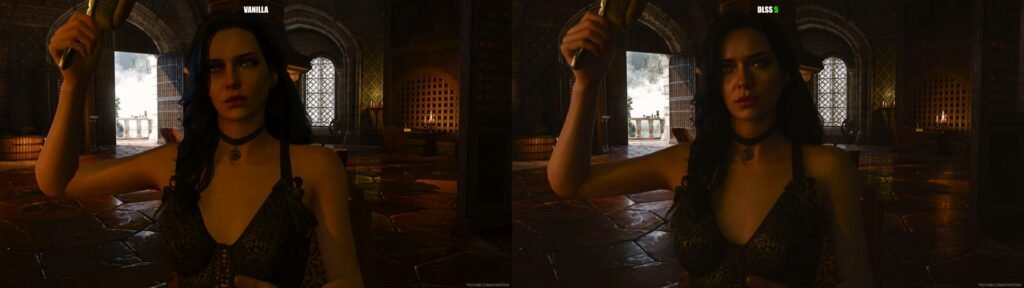
Back in photoreal territory, The Witcher 3 pulls off a rare double: a good-tier game in tuned single-pass mode, and a headline act here the moment you enable two-pass Multipass. Community reports gathered by GameGPU in late October describe Geralt’s and NPCs’ faces changing from scene to scene, the model re-deciding who these people are between cuts, hair turning excessively shiny, the full uncanny valley with a season pass. It needs an RTX 5080 or better to even run that mode stably, and the community’s own fix is to drop to 50 percent intensity or go back to a single pass. The Continent’s greatest monster hunter, defeated by a settings menu.
The Matrix Awakens, Epic’s Unreal Engine 5 showcase, got fed into DLSS 5 by creators PlayBreakers through a setup I want you to appreciate: a PS5 video stream, piped into a PC running the neural pass. The skin sharpened. Everything else paid. Particles, smoke, sparks and explosions blur out, and the asphalt and car textures go clay-like, microdetail erased. A demo built to flex the future of real-time graphics came out looking like a very expensive pottery class.
Oblivion Remastered, tested by Reddit user mightyjam7 in screenshots carried by Wccftech, gains impressive detail and loses the night: evening scenes come out too bright, the darkness lifted like somebody left a studio light on in Cyrodiil. Final Fantasy VII Rebirth, tested by Reddit user zhubaohi, ships its verdict inside the tool itself: the RenoDX style presets named Default and Cinematic produce an over-sharpened, haloed presentation, and only the one called Natural keeps the game looking like itself. When the preset named Cinematic is the problem, the naming department has failed you.
And then there is SpongeBob SquarePants: Titans of the Tide, benchmarked on an RTX 2060 SUPER through OptiScaler, falling from 126 FPS native to 27 with the model at 70 percent resolution. A cartoon platformer, quartered, so that Bikini Bottom can enjoy realistic subsurface scattering. Nobody needed this. Everybody needed to see it. That tension is the entire modding scene in one benchmark.
The last joke is the cruelest because it wears a lab coat. Remember the October DLL, the faster one, the fix? GameGPU’s game-by-game roundup found it making several beloved titles look worse. Skyrim loses ambient occlusion and microcontrast, the PureDark magic sanded down by the update that was supposed to help. Forza Horizon 6 goes flatter, volumetric light thinned out, even as performance tester GamingOptimized measured that same game gaining from 27 to 37 FPS on an RTX 4060: faster and uglier, both true at once, pick your fighter. Kingdom Come: Deliverance II loses background shading and indirect light. Red Dead Redemption 2 comes out flatter, its cinematic facial work stiffened, and GameGPU notes many users quietly reverted to the original heavy DLL for the looks. Progress, in this scene, is a slider with a sense of humor.
The fine print, because somebody has to be the adult
Time to defend and convict the technology in the same breath, because the loudest takes in both directions are running ahead of the evidence.
Hardware Unboxed’s full analysis of the official build made the distinction that matters: official implementations will not over-process like the mods, because developers get the intensity controls, the grading tools and the semantic masking, and they answer to their own art directors. NBA 2K27’s subtle result is what the technology looks like with adults supervising. The leak mods are the raw model, unsupervised, with sliders where the supervision used to be. Judging DLSS 5 by a Danganronpa screenshot is like judging a camera by a photo taken through a funhouse mirror that somebody stole from the factory.
The mockery overshot in the other direction too. YouTuber WhizzDumbPlayz went through the viral GTC footage frame by frame, in coverage carried by Wccftech, and showed that several of the most mocked anomalies, Starfield’s Heller with his nostril and hair oddities, Oblivion Remastered’s Heinrich Oaken-Hull and his double eyelids, the blurred ball in EA FC, exist in those games with DLSS 5 switched off. Some of the artifacts blamed on neural rendering were frame generation’s fault. The meme needed a villain and did not check the footage. The Grace Ashcroft face from NVIDIA’s own demo remains a legitimate argument, by the way. That one was theirs.
So where does the truth sit, after two months of leaks, patches, managers and memes? Officially implemented, DLSS 5 is a real, expensive, genuinely impressive re-lighting technology that currently lives in one basketball game and costs half your frame rate at its worst-tuned. In the wild, it is a leaked pre-release model, later joined by a leaked current model, doing unsupervised work of wildly varying quality: miraculous in Quake, transformative in Skyrim, debatable on Judy Alvarez, and criminal in any building where anime is taught. Both of those paragraphs are true. Any article that only gives you one of them is selling something.
My take, and where normal players should stand
If you own an RTX 50 card and a normal relationship with risk, the correct move is boring: wait. Official support is not a rumor. Hogwarts Legacy gets DLSS 5 on November 5, days from now. Where Winds Meet follows in the coming weeks. RTX Remix, NVIDIA’s own modding platform, received it on October 23, which is the company quietly admitting the modders had the right idea about where this tech gets fun. RTX 40 support is officially planned, with no date attached, and I would rather wait for NVIDIA’s version of that than trust a patched CUDA binary with my Friday night.
If you are the kind of person who read the joke section as a shopping list, I understand you, I am somewhat you, and the warnings section above is my whole blessing: real projects on GitHub, offline single-player games only, and suspicion as a default setting.
Meanwhile, in my house, the PS5 Pro sits under the TV running firmware exactly as Sony intended, waiting for November 19, when GTA 6 arrives and none of this touches it. No leaked DLLs, no managers, no Chucky faces. Lucia’s face will be exactly the face Rockstar’s artists built, at whatever frame rate the console gives me, and after two months of watching PC gaming’s most powerful AI argue with Geralt about who he is, that sounds less like a limitation and more like peace.
The modders will keep going, of course. The October model is faster, the tools are maturing, the Feeder already feeds emulators, and somewhere out there is a game nobody has tried yet whose faces are living on borrowed time. When they find it, I will be here, taking notes and laughing in the group chat like everybody else. Just do not ask me to install a 600 megabyte unsigned executable called a manager to watch it happen. A man has to draw the line somewhere, and mine is drawn exactly there, right next to Makoto Naegi’s new face.
Sources
NVIDIA Newsroom, GTC 2026 announcement and October 2026 model update post. Digital Foundry, DLSS 5 hands-on and NBA 2K27 testing. Hardware Unboxed, launch analysis and October model follow-up. Tom’s Hardware, leak verification and community benchmark coverage, via TechTimes and Igor’s Lab summaries. HotHardware, launch testing and October model testing. Wccftech, ten-game mod roundup and Reddit tester coverage. Dexerto, the anime game tests. GameGPU, new versus old DLL roundup and AMD port testing. Guru3D, Mezha and ThePCEnthusiast, DLL discovery and tested-game roundups. PC Guide, DLSS 5 Manager coverage. Sportskeeda, anti-cheat flag report. GitHub: NODIX-TECH/DLSS-5-MANAGER, rakanki911, faisalkindi/DLSS5oneclick, jlrouzies-fr/DLSS5-Feeder, danielblnc/DLSS-NR-on-AMD, ShyVortex/dlss-unlocked, plus the dlss5-swapper.com safety audit.
Leave a Reply