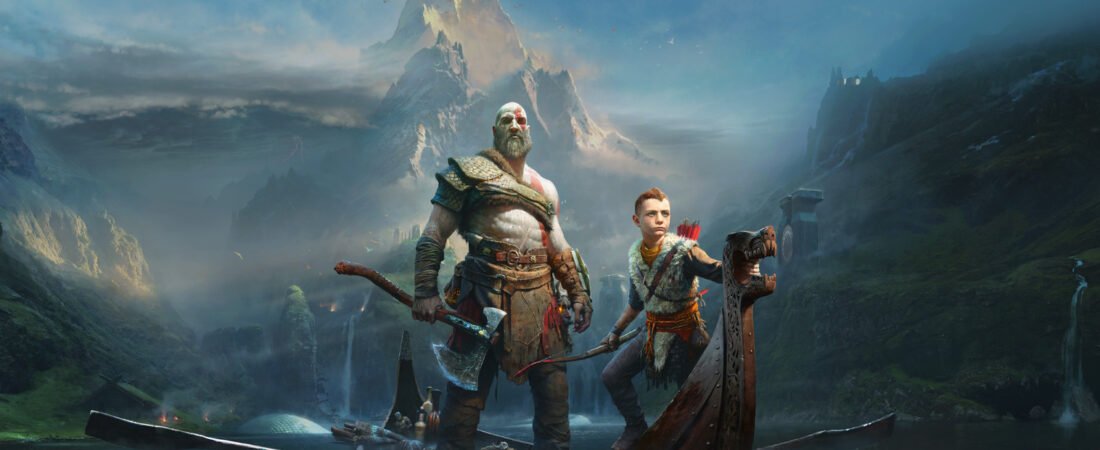
Some games age into museum pieces. You admire them, you respect them, and you never actually want to play them again. God of War (2018) aged into a favorite hoodie. Eight years later I still put it on, and it still fits like it was made yesterday.
By Ruan Martini, Daily Checkpoint
Here is my confession up front, so nobody accuses me of hiding it in paragraph nine. I have finished God of War (2018) more than once, on more than one difficulty, and I am about to do it again before February. That is not a reviewer being thorough. That is a man with a backlog the size of a phone book choosing, voluntarily, to go back to the snow. With God of War Laufey arriving on February 16, 2027 and putting Faye in the lead, this is the perfect moment to talk about why the 2018 game is not just a classic, but the friendliest epic ever made. Yes, friendliest. An epic about a god who once murdered an entire pantheon is the friendliest game in its weight class . Yes, there are light spoilers ahead, but the game is eight years old, so at some point the statute of limitations becomes my friend.
The Setup Is a Funeral, and That Is the Whole Point
The old Kratos, the Greek era Kratos, solved his problems by screaming at them and then removing their heads. The 2018 game opens with that same man quietly chopping firewood. His wife Faye has just died. He has a son, Atreus, who he barely knows how to talk to. Her last wish was for her ashes to be scattered from the highest peak in the nine realms, so father and son pick up the bag and start walking. That is the entire plot engine: a grieving man, a confused kid, and a very long walk.
Everything the game does grows out of that walk. Kratos is not trying to conquer anything. He is trying to be less of a monster in front of his child, and failing at it in ways that feel painfully true. Christopher Judge plays him like a man holding a live grenade of rage inside his chest at all times, and choosing, scene after scene, not to throw it. When Atreus gets sick and Kratos has to confront what he has been hiding from the boy, the game lands punches that no boss fight in the series ever touched. The most famous word in the game is “Boy.” It starts as a bark. By the end, the way he says it has changed, and you realize the accent of the whole story was hiding in one syllable.
One Camera Shot, From the First Tree to the Last Peak
Let us talk about the trick everybody knows and nobody has successfully copied. God of War (2018) is filmed in a single continuous shot. No cuts. No loading screens. The camera follows Kratos over the shoulder from the opening scene to the credits, through fights, puzzles, boat rides, realm travel and revelations, and it never blinks. Director Cory Barlog fought for that idea inside the studio, and people thought he was insane, and he was right and they were wrong, which is my favorite genre of office story.
Why does it matter? Because you never leave. When Kratos rows across the Lake of Nine and the World Serpent rises out of the water the size of a weather event, there is no cutaway to make it feel bigger and safer. You are standing in the boat. When the story slows down and father and son sit in silence, the camera sits there with them, and the silence gets heavy, and it is wonderful. Other games have spectacle. This one has presence. The camera trick also meant the game had to hide its loading inside elevators, doorways and slow squeezes through rock, and honestly, I would take a hundred dignified rock squeezes over one more spinning loading icon.
The Axe, the Head, and the Best Stranger in Games
The Leviathan Axe is the best feeling weapon of its generation, and I will die on this hill, preferably holding the axe. You throw it with a thud that lands in your teeth, it sticks in ice and flesh, and when you call it back it tears through everything on the way home and slaps into Kratos’s palm like it missed him. Brok and Sindri, the dwarf brothers who upgrade your gear and bicker like an old married couple across the realms, keep making it stronger and keep making every shopping trip a comedy sketch. Then there is Mimir, the smartest man alive, who spends the game as a severed head hanging from Kratos’s belt, telling stories, explaining lore, and being funnier than any character with a body has a right to be. A belt accessory became the best narrator in modern games. Nobody saw that coming.
And the fights. The Stranger who knocks on Kratos’s door in the first hour and picks a fight in the snow is still, for my money, the greatest opening boss in the business, two gods ruining a forest and a cabin and each other while the camera refuses to look away. The Valkyries wait out in the world as optional endgame nightmares for the players who want to be tested to the edge of their talent, including a queen who shall not be named in my house. Notice the word optional. Hold that thought, because it is the bridge to the most important thing in this whole article.
The Part Nobody Puts on the Poster: It Respects You
Here it is. The thing I actually sat down to say.
God of War (2018) launched with four difficulty settings. Give Me a Story. Give Me a Balanced Experience. Give Me a Challenge. Give Me God of War. Read those names again, because the names themselves are the philosophy. The lowest setting is not called Easy Mode for Babies. It is called Give Me a Story, because Santa Monica understood that millions of people buy a game like this for the father, the son, the world and the writing, and those people are not lesser customers. On the three lower settings you can change the difficulty mid game, up or down, no penalty, no shame popup, no achievement quietly deleted. Life got busy and the game got hard? Turn it down and keep walking with your kid. Feeling brave in month two? Turn it up. The game treats difficulty as a door you hold open for the player, not a wall you make them climb to prove they belong.
The highest setting plays by stricter rules, and here is the beautiful part: it tells you so, clearly, before you commit, including the fact that Give Me God of War cannot be lowered once you start. That is the whole contract. Total honesty, total choice. The punishment is there for the people who genuinely want it, labeled in plain language at the door, and it never ambushes anybody else. Meanwhile the optional Valkyrie fights sit out in the world like a gym for masters, completely separate from the story, so the hardcore crowd gets its mountain and the rest of us get to finish a masterpiece without our blood pressure filing a complaint.
I bring this up because the industry keeps having the same loud argument about hard games, and this eight year old game already solved it while everybody was busy arguing. An epic does not have to be a filter. A masterpiece does not need to humiliate a percentage of its audience to feel proud of itself. God of War (2018) is enormous, gorgeous, violent, emotional and hard exactly where you ask it to be, and it sold more than five million copies in its first month and over 23 million by November 2022, becoming the best selling game in the entire series. It won Game of the Year at The Game Awards in 2018, in the same year as a certain cowboy epic you may have heard of, and it holds a 94 on Metacritic. The crowd did not punish it for being welcoming. The crowd carried it on their shoulders. Respect is not a compromise. Respect is a feature, and the receipts are twenty three million copies tall.
The Walk Is the Game
People remember the fights, but the thing that lives in my chest is the walking. The Lake of Nine is the hub of the journey, and it is quietly one of the smartest levels ever built, because the water level drops as the story progresses, and every drop reveals beaches, ruins and secrets that were hiding underwater the whole time. The world literally opens up as the World Serpent moves, and Jörmungandr himself is so big that his body is geography. You do not fast travel past that. You row, and Mimir talks, and Atreus asks questions a kid would ask, and the game breathes.
The road takes you through Alfheim, where beautiful elves are having an ugly war and you learn that picking a side in somebody else’s fight has a cost. It takes you under a giant turtle to Freya’s house, because in this game a witch lives under a tortoise the size of a hill and nobody treats it as strange. And it takes you to Helheim, the frozen land of the dead, where the Leviathan Axe is useless because ice cannot freeze the coldest place in creation. Which brings us to the moment. You know the moment. Kratos goes home, alone, sits in the dark of his little house, and unwraps the Blades of Chaos from their cloth, the weapons of the life he swore he buried, while the ghost of Athena watches from the firelight to tell him he will always be a monster. He puts them on anyway, because his son is dying and the only way to save him is to become the thing he hates for a little while. It is the best scene in the series. It might be the best scene in any game about a parent. No orchestra of marketing ever manufactured a moment like that; it is eight games of history being picked up with shaking hands.
The Boy Is Not a Burden
Every escort mission in gaming history trained us to expect the kid to be a problem. Santa Monica built the opposite. Atreus is a weapon with a personality: he shoots what you aim at, chokes enemies, summons spectral animals, reads the runes you cannot, and translates the world for a father who never learned its language. In combat he is a genuine second fighter. In the story he is the reason for all of it, and the design never lets you forget either job.
The writing takes a real risk with him, too. Halfway through the journey, Atreus learns he is a god, and like any kid handed a crown, he becomes a little tyrant about it for a while, arrogant, cruel, drunk on the idea that the rules are for mortals. It is uncomfortable to watch, which is the point. Kratos has to teach the boy what the old games taught us Kratos never learned: power without control is just a tantrum with casualties. “Do not be sorry. Be better.” That is the whole education in six words, father to son, and the game makes you earn hearing it. Across from them stands Baldur, the Stranger from the cabin fight, a god cursed to feel nothing at all, no pain, no pleasure, no warmth, hunting for a fight that can make him feel something. He is Kratos’s dark mirror and Faye’s opposite in every way, a man destroyed by a parent who loved him the wrong way. This game thinks about parenting from every angle at once, the good, the bad and the godlike, and it never once turns into a lecture. It just keeps walking and lets you figure it out.
And then the ending. The highest peak, the ashes, the truth about who Faye really was and what she named her son when the giants called him Loki. Kratos looks at the boy she left him and finally understands that the walk was never about the mountain. The mountain was just the excuse. She was teaching them to be a family the only way left to her, one step at a time, from inside a story she wrote before she died. Which, if you have been paying attention, is exactly why giving this woman her own game in February feels less like a spin-off and more like a debt being paid.
Where It Stands Now
The game never really left. Sony patched it for PS5 so it runs at a smooth 60 frames per second, and a PC version arrived in January 2022 and introduced it to a whole second audience. Ragnarök followed in 2022 and finished the Norse story for Kratos and Atreus. And now the wheel turns again: Laufey takes the lead in February, fighting through the afterlife in a story that runs alongside this one, which means every scene in the 2018 game just gained a second camera angle we have not seen yet. Faye was planning things in the margins of this story the whole time. Playing this game again in 2026 is not nostalgia. It is research, and it also happens to be the most fun research assignment I have ever given myself.
If you have never played it, I envy you in a way I rarely envy anybody. It goes on sale constantly for less than a pizza night. Play it before February, on whatever difficulty makes you happy, and do not let a single person on the internet make you feel anything about that choice. Then come find me in the Coming Soon section and we will count down to Faye together.
Tell me your difficulty story: did you cruise on story mode, sweat through challenge, or did the Valkyrie queen legally change your personality? I read every confession, and I have a few of my own.
Sources
God of War (2018), Santa Monica Studio and Sony Interactive Entertainment, released April 20, 2018 for PlayStation 4, Windows version January 14, 2022. Sales figures: over five million copies in the first month and 23 million by November 2022, per Sony’s financial reporting as covered by GameSpot. Game of the Year at The Game Awards 2018; Metacritic score 94. Difficulty settings and their mid game adjustment rules as shipped in the original release. Sequel and series details via Santa Monica Studio and PlayStation’s official pages.
The Checkpoint Poll
Leave a Reply