Every roguelike asks you to accept death as tuition. Hades did something ruder and smarter: it made death the delivery truck for the plot. Supergiant’s 2020 action RPG is the third entry in my indie analysis series, and it is the game that proved a genre built on repetition could carry one of the best-written stories in the medium, 21,020 voiced lines of it.
What Hades is
Hades is an isometric roguelike action RPG from Supergiant Games, the San Francisco studio behind Bastion and Pyre, written and directed by Greg Kasavin, with art by Jen Zee and music by Darren Korb, who also voices the lead. It entered early access in December 2018 as an Epic Games Store exclusive, reached Steam a year later, and launched in full on September 17, 2020 for Windows, macOS and Nintendo Switch, with PlayStation and Xbox versions in August 2021 and an iOS release via Netflix in 2024. It costs $24.99.
You are Zagreus, immortal prince of the Underworld and son of Hades, and you are leaving home whether your father likes it or not. Each escape attempt fights up through four regions of the dead (Tartarus, Asphodel, Elysium and the Temple of Styx), each ending in a boss: a Fury, the Bone Hydra, the hero Theseus fighting alongside the minotaur Asterius, and finally Hades himself at the gates. The Olympian gods, delighted by the family drama, aid the run with gifts called Boons.


The loop: escape, die, talk, repeat
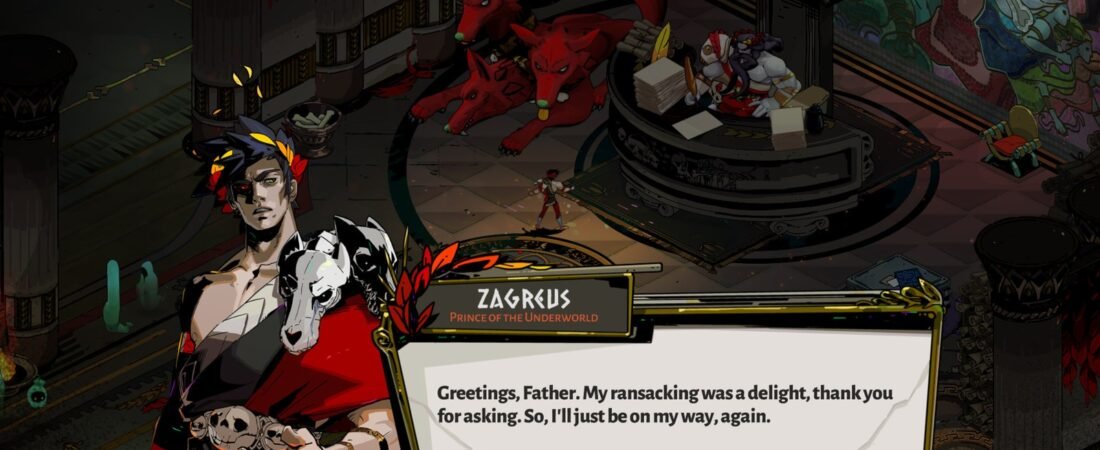
A run is a randomized climb through rooms drawn from pre-built layouts, and clearing a room means choosing a reward that shapes the build for that run only. Zagreus fights with a weapon attack, a Special, a ranged Cast, a dash that grants a moment of intangibility, and a Call that summons a god’s wrath. Death, when it comes, washes him up in the pool of blood at the House of Hades, in front of his father’s desk.
The loop’s genius is in what survives. Charon’s Obols and the run’s Boons are lost, but Darkness, Chthonic Keys, Gemstones, Nectar and Titan Blood persist, and the House is where they are spent and where everyone reacts to what just happened. So the failure state of a normal roguelike, back at the start with nothing, becomes the game’s living room: new dialogue, new subplots, new gifts to give, new permanent upgrades to buy. The run and the rest are not two modes. They are one breathing cycle.
Boons: builds made of gods
Six Infernal Arms anchor the combat: the Stygian Blade, the Heart-Seeking Bow, the Shield of Chaos, the Eternal Spear, the Twin Fists and the Adamant Rail, unlocked with Chthonic Keys. Each weapon carries four Aspects, alternate forms (including one hidden Aspect each) upgraded with Titan Blood, which quietly rewrite how the weapon wants to be played.
On top of the weapon sit the Boons. Eight Olympians offer the core gifts (Zeus brings chain lightning, Poseidon brings knockback waves, Athena brings deflection, and so on), with Hermes and Chaos in supporting roles. Each encounter offers a choice of three, themed to the god, competing for shared slots on the Attack, Special, Cast, Dash and Call. Rarities scale the numbers, Poms of Power level Boons mid-run, and Daedalus Hammers reshape the weapon itself for the rest of the run.
The system’s ceiling is the Duo Boon: 28 top-tier powers that fuse two gods at once, offered only when Zagreus already holds the prerequisite Boons from both. Builds in Hades are therefore not assembled from loot drops; they emerge from negotiations between gods, mid-run, with prerequisites acting like a tech tree made of personalities. In the House, the Mirror of Night converts Darkness into permanent talents, including Death Defiance (extra lives per run) and God’s Legacy, which raises the odds of the Legendary and Duo Boons appearing. Supergiant’s store copy advertises thousands of viable builds, and for once the arithmetic of combinations makes the marketing line look conservative.
Death is not a reset
The writing is the headline. Supergiant’s own count puts the script at 21,020 voiced lines and 305,433 words, with 8,500 lines for Zagreus alone. The dialogue is reactive to a degree the genre had never attempted: characters comment on the weapon you carried, the boss who killed you, the god whose Boon you took, the subplot you advanced three runs ago. The main plot, reaching Persephone, resolves only across repeated successful escapes, and an epilogue feast reconciles the family with Olympus at the end of it.
Kasavin has explained the structural reason. Supergiant’s previous game, Pyre, had a branching narrative that most players experienced exactly once, because they played the game once. A branching story in a single-playthrough structure is content most of the audience never sees. The roguelike loop inverts that math: repetition is guaranteed, so the branching story gets an audience by design. Failure is not the obstacle to the narrative in Hades. Failure is the mechanism that delivers it, one death at a time.
Relationships run on the same rails. Gifting Nectar earns each character’s Keepsake, a swappable trinket (and from a god, a way to steer which Boons appear); continued gifts, later with Ambrosia, deepen into subplots, quests, Companion summons and optional romances. The social game is not a break from the dungeon. It is funded by it and pays back into it.
A difficulty dial with two ends
Hades solves the roguelike’s oldest argument, who the difficulty is for, by handing both ends of the dial to the player. God Mode is a setting that grants growing damage resistance after each failed run, designed explicitly so that struggling players can still reach the full story. At the other extreme, clearing the game unlocks the Pact of Punishment: a menu of voluntary curses (stronger enemies, altered boss fights, an extra phase here, a machine-gun chariot there) measured in Heat, traded for continued access to the rarest rewards.
The same design therefore serves a first-time player who needs the story to be reachable and the specialists who eventually cleared the once-thought-impossible 64 Heat run in August 2023. Difficulty is treated as a player preference with rewards attached, not as the game’s identity.
Built in the open
Supergiant, a team of roughly twenty people, developed Hades in paid early access for nearly two years, tuning gameplay and narrative on live feedback before the 1.0 story was even complete. It sold 700,000 copies during early access and 300,000 more in the three days after the full launch, passing a million before the reviews had cooled.
The honors list is absurd for an indie: 93 on Metacritic and 94 on OpenCritic; Best Game at the BAFTAs, plus Artistic Achievement, Game Design and Narrative; Game of the Year at the D.I.C.E. Awards and the Game Developers Choice Awards; a Nebula Award for game writing; and, in 2021, the first Hugo Award ever given to a video game. The Game Awards gave it Best Indie and Best Action in 2020. Over fifty Game of the Year awards, all told, for a game about dying in your father’s house.
My take
The analytical point about Hades is that its innovations are all acts of alignment. The genre’s weakness (repetition) is pointed at the writing’s weakness (unseen branches). The hub is not downtime; it is where failure converts into story and currency. The difficulty argument is dissolved by giving the player both ends of the dial. Even the gods are load-bearing: Boons are loot, fiction and build-crafting in a single choice of three.
Plenty of roguelikes after 2020 copied the shape. Almost none copied the discipline underneath it, because the discipline is the expensive part: 300,000 words of reactive writing, recorded and coded to fire at the right death, on the right run, with the right weapon in hand. Hades did not make dying fun. It made dying mean something, and the genre has been chasing that trick ever since.
Sources
- Steam store page and Steam API, Hades (Supergiant Games): price, app details, build variety claims
- Wikipedia, Hades: release history, gameplay systems, development and reception
- Supergiant Games official infographic (December 2020): 21,020 voiced lines, 305,433 words
- Hades Wiki and Prima Games guides: Infernal Arms, Aspects, Duo Boons and Mirror of Night details
- Private Division press materials: OpenCritic 94 (PC), Game of the Year award counts
- Metacritic and OpenCritic: review scores cited in the panel above
The Checkpoint Poll
Leave a Reply