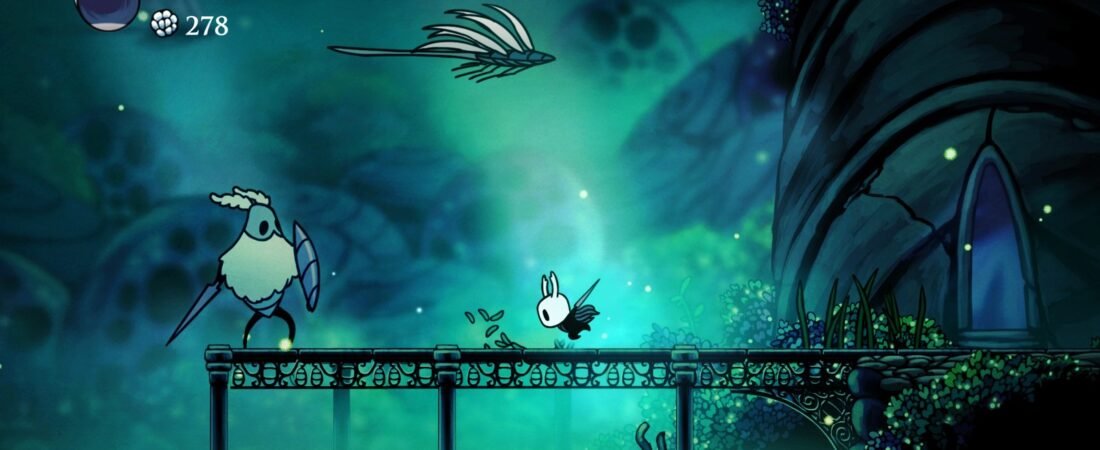
Some games hand you a map, a marker and a polite arrow. Hollow Knight hands you a blank page, a dead kingdom and one instruction it never says out loud: figure it out. Nearly a decade after launch, that refusal to help is still the most interesting design decision in the genre, and it is the reason a $15 game from a tiny Australian team has sold more than 15 million copies.
This is the first entry in a series where I take indie games apart properly: what the game is, how it plays, and why its systems work. Hollow Knight goes first because it set the modern standard.
What Hollow Knight is
Hollow Knight is a 2D action-adventure metroidvania from Team Cherry, a small studio based in Adelaide, Australia, directed and designed by Ari Gibson and William Pellen, with music by Christopher Larkin. It launched on PC on February 24, 2017, reached the Nintendo Switch in June 2018 (shadow-dropped during that year’s E3 Direct), then PlayStation 4 and Xbox One that September, and it is still priced at $14.99.
You control the Knight, a small, silent, insectoid warrior with a sword called a Nail, descending into Hallownest: a vast underground kingdom of bugs that fell to a supernatural plague called the Infection. The goal, which the game assembles slowly out of fragments, is to break the seals held by three beings called the Dreamers and confront the source of the Infection. The Steam store page advertises over 130 enemies and 30 epic bosses, and even those numbers undersell the place.
The project began as a Ludum Dare game jam entry called Hungry Knight, then raised A$57,138 on Kickstarter in 2014 against a A$35,000 goal. Everything about its scale since then has been a surprise, including to the people who made it.

A kingdom that refuses to explain itself
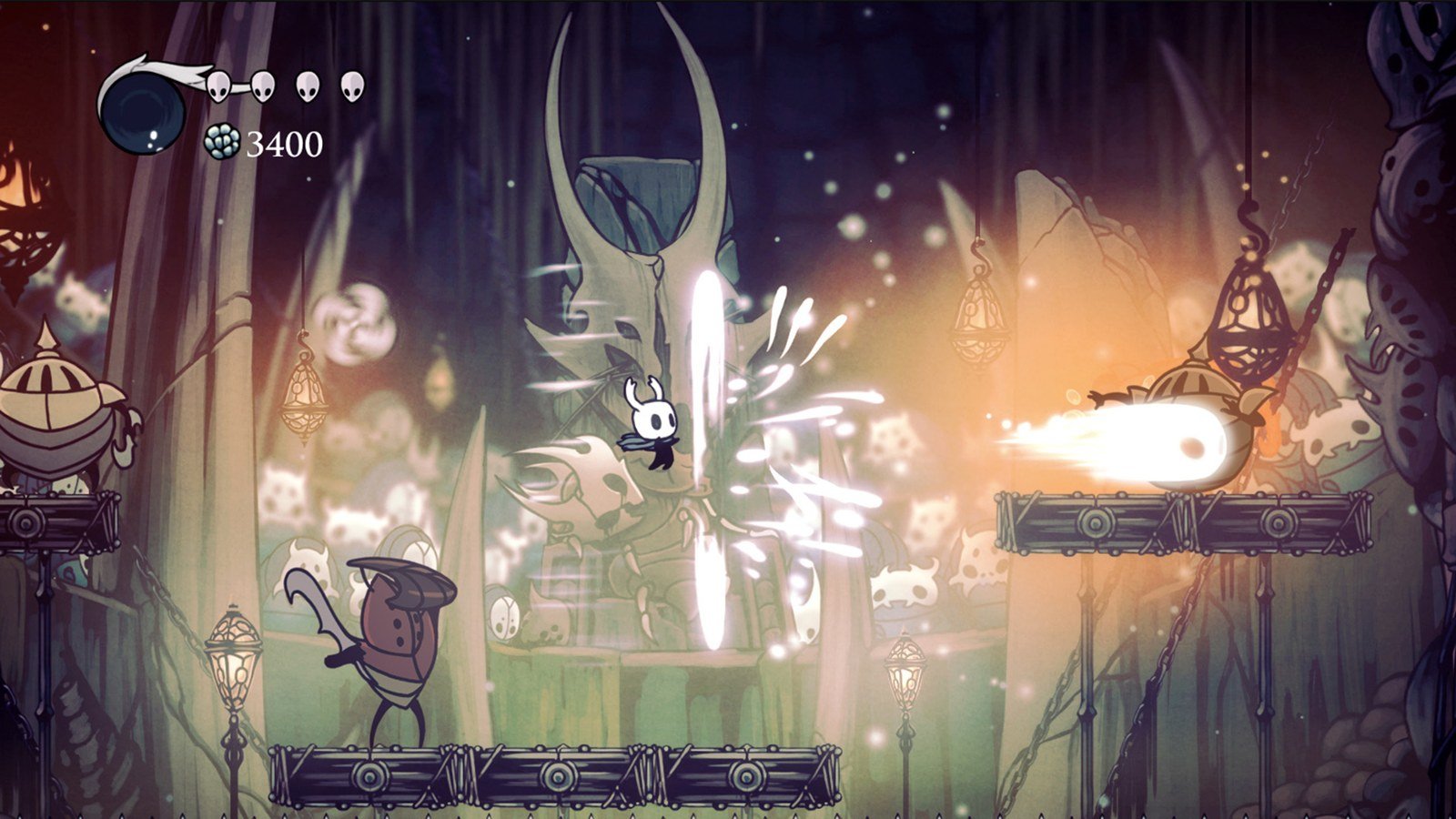
Most games treat story as something delivered. Hollow Knight treats it as something buried. There is no opening crawl, no companion character explaining the world, no quest log summarizing the plot. The history of Hallownest comes from NPC dialogue, half-finished monuments, item descriptions and rooms that imply what happened in them. Piecing together what the Pale King did, what the Radiance is and why the kingdom emptied out is an act of archaeology the player does voluntarily, or not at all.
That choice pairs with the world structure. Hallownest is one continuous, interconnected map, and the game is openly content to let a player finish it having missed entire regions and bosses. Team Cherry has been on record being fine with that, and the design backs them up: the critical path asks for a fraction of what the map contains. The rest exists to reward curiosity rather than completion, which is a very different incentive than a checklist.
The Soul economy: aggression pays for survival
Combat in Hollow Knight looks simple. The Knight has one melee weapon, a handful of offensive spells, and a health pool measured in masks. The engine underneath is the Soul system, and it is the cleverest thing in the game.
Landing hits on enemies fills the Soul Vessel. Soul is then spent in one of two ways: cast a spell, or hold Focus to heal one mask. Healing and damage draw from the same tank, and the tank only fills by attacking. So the safest-looking option, backing off to heal, is mechanically the worst one: the resource for survival is generated by the exact behavior that puts you in danger. Focus also takes time and leaves the Knight standing exposed, so healing mid-fight is a decision with a price, not a button that fixes mistakes.
Movement is tuned to support that economy. Team Cherry modeled the Knight’s handling on Mega Man X: no horizontal acceleration, generous control in the air, and a dash (earned from the rival character Hornet in Greenpath) that can interrupt a jump mid-flight. The stated goal was that every hit taken should feel avoidable right up to the last second. The game is hard, but it is hard in a way that keeps pointing back at the player’s choices rather than at the game.
The map is a mechanic, not a menu
Here is the decision that defines the whole experience. Hollow Knight’s map system withholds almost everything a modern game gives away for free.
Each region’s map must be found and bought from Cornifer, a cartographer you first have to locate by following his humming and his trail of paper. Buying the map does not complete it: rooms are only drawn in after you rest at a bench while carrying the Quill. Your position on the map is not shown at all unless you spend one of your limited charm notches on the Wayward Compass. Pins marking benches, vendors and stag stations are separate purchases from Iselda’s shop in Dirtmouth.
Team Cherry has described this mapping system as the game’s biggest design challenge, a balance between not divulging the world’s secrets and not becoming player-unfriendly. The result is that spatial knowledge is a resource the player builds, like health or currency. Getting lost is not a failure state the game failed to prevent. It is a designed condition, and it makes the moment a new shortcut opens, or a bench appears at the end of a long corridor, land completely differently than it does in games where the map fills itself in.
The supporting systems reinforce it. Benches are the only checkpoints: resting restores masks, saves, updates the map and is the only place charms can be swapped, and it also respawns every regular enemy. Fast travel runs through 11 Stag Stations unlocked with Geo tolls, riding the Last Stag through tunnels beneath the kingdom.
Death, Geo and your own ghost
Death in Hollow Knight has a price list. You lose all of your Geo, the game’s currency, and a Shade, your own ghost, is left floating where you died holding it. Until you return and defeat the Shade, your Soul Vessel stays cracked, with reduced capacity. Die a second time before recovering it and the Shade, and everything it carried, is gone for good.
Critics compared the system to Dark Souls at launch, and the resemblance is real, but the twist matters: the Shade fights back with your own moveset, so the retrieval run ends in a duel against yourself. It converts the walk of shame into one of the game’s signature encounters, and it makes every long trip away from a bench a genuine calculation about how much Geo you are willing to carry into the dark.
Charms: a build system with 45 pieces
Layered over the core kit are 45 charms, passive relics that cost one to four notches each. You start with three notches and can earn up to eleven, so the loadout is always a constrained choice rather than a full collection. Charms extend the Nail’s reach, discount spells, speed up Focus, generate Soul, summon companions, and yes, one of them exists purely to show you where you are on the map.
Because charms can only be changed at benches, the build is not a menu you tune mid-corridor. It is a commitment you make at a checkpoint for the territory ahead, which turns bench placement into build placement. The system is also where the game’s generosity hides: several of the strongest effects in the game sit inside charms a casual route can walk straight past.
Four free expansions and a 15 million tail
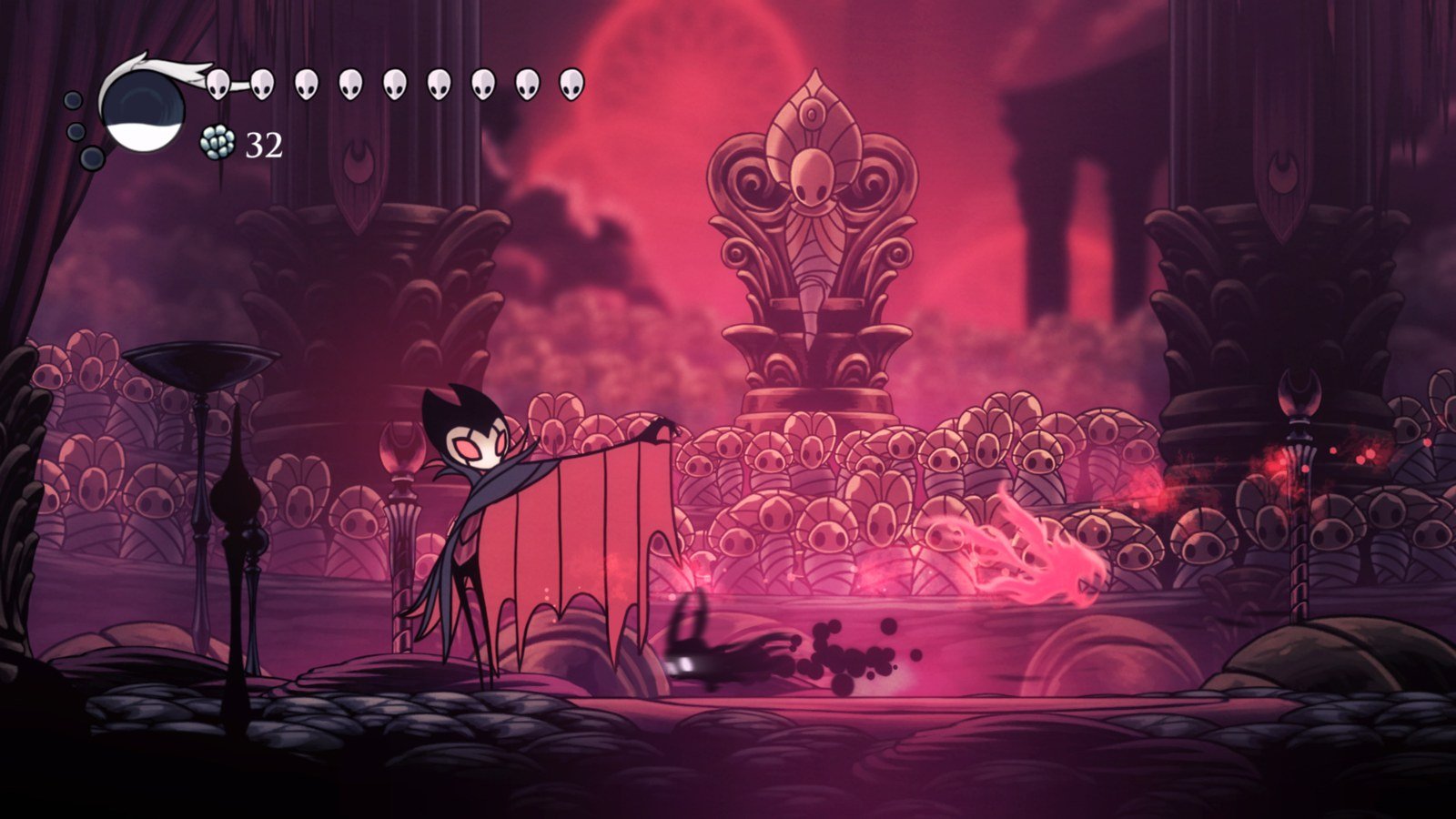
Team Cherry supported the game with four expansions, all of them free and all now bundled into every version: Hidden Dreams (August 2017, new bosses and a second fast-travel system), The Grimm Troupe (October 2017, a full questline with its own boss fights and charms), Lifeblood (April 2018, refinements and a new boss) and Godmaster (August 2018, the Godhome boss-rush structure and two additional endings). A permadeath Steel Soul mode and multiple endings round out the package.
The commercial arc is the part the industry still studies. Half a million copies by November 2017. A million on PC alone by June 2018. 2.8 million by February 2019. And in an August 2025 interview with Bloomberg, Team Cherry put the total at more than 15 million copies, for a game that costs $14.99, was made in Unity by a core team you could fit in a minivan, and spent years being sold mostly by word of mouth. Enhanced versions for Switch 2, PlayStation 5 and Xbox Series X/S arrived in February 2026, because apparently the tail on this game does not end.
The critical reception matched the sales, just quieter at first: 87 on Metacritic for PC and 89 on OpenCritic, with the Switch version later scoring 90. PC Gamer named it Best Platformer of 2017, and it took Independent Game of the Year at the Australian Games Awards. The decade since has mostly been other outlets upgrading it to all-time lists.
My take
The analytical point about Hollow Knight is that its famous difficulty is not the product. The product is trust. Team Cherry trusted players to navigate without a marker, to assemble a story out of ruins, to lose currency and walk back for it, to miss content and never be told. Almost every system in the game is that same bet placed again: withhold the convenience, and the player’s own effort becomes the reward.
That is why it sits at the top of this series. Plenty of indie games are excellent. Very few rewire what players expect an entire genre to do, and then sell 15 million copies doing it at half the price of a normal game. Hallownest is the reference point now. The rest of this list gets measured against it, fairly or not.
Sources
- Steam store page and Steam API, Hollow Knight (Team Cherry): price, app details, official enemy and boss counts
- Wikipedia, Hollow Knight: release dates, development, Kickstarter, mapping design challenge, sales timeline
- Team Cherry via Bloomberg (August 2025): 15 million copies
- Hollow Knight Wiki: benches, Stag Stations, charms and notch counts
- Metacritic and OpenCritic: review scores cited in the panel above
- Game Informer, the making of Hollow Knight: movement design goals
The Checkpoint Poll
Leave a Reply