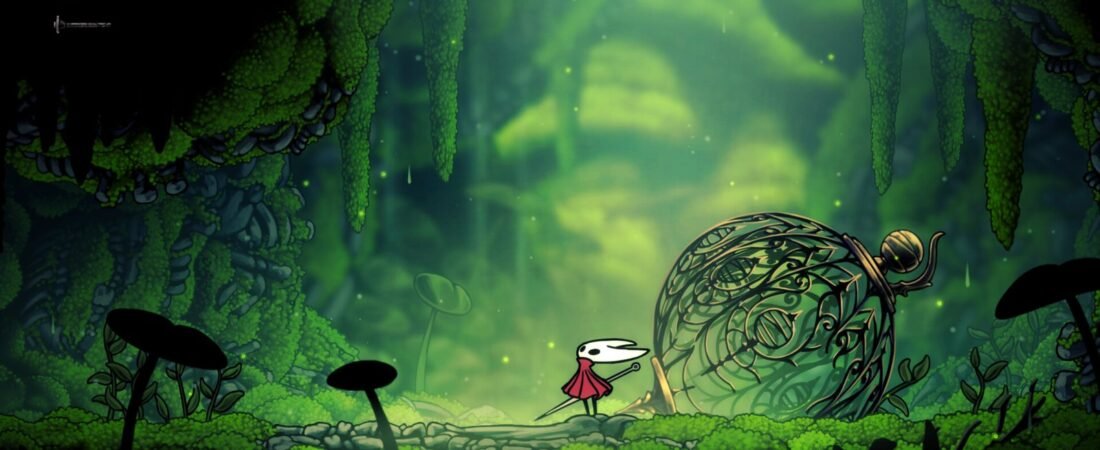
Sequels usually inherit the hero and change the world. Silksong did the harder thing: it kept the studio, kept the genre, and rebuilt the character so completely that the old game’s muscle memory becomes a liability. Team Cherry’s follow-up to Hollow Knight is the fourth entry in my indie analysis series, and it is a study in how much of a game lives inside its protagonist’s movement.
What Silksong is
Hollow Knight: Silksong is a 2D action-adventure metroidvania from Team Cherry, the Adelaide studio of co-directors Ari Gibson and William Pellen with technical director Jasmine (Jack) Vine and composer Christopher Larkin. It launched worldwide on September 4, 2025 at $19.99, day one on Xbox Game Pass, for Windows, macOS, Linux, both Nintendo Switch generations, PlayStation 4 and 5, and Xbox One and Series X/S.
The project began as planned downloadable content for Hollow Knight, a 2014 Kickstarter stretch goal, before outgrowing the role and being announced as a standalone sequel on February 14, 2019. You play Hornet, the princess-protector of Hallownest and the first game’s recurring duelist, captured and carried to Pharloom: a haunted kingdom of pilgrims ruled by silk and song, built around a religious Citadel at its peak. She escapes into the kingdom’s depths and ascends. The Steam page advertises over 200 enemy types and over 40 bosses.


Ascent, not descent
Hollow Knight was a descent into a tomb. Silksong inverts the axis: Pharloom is organized as a vertical pilgrimage, and the three acts climb it. Act 1 crosses the lower lands (Moss Grotto, Bone Bottom, the Marrow, Deep Docks, Greymoor, Bellhart) to the Citadel gates, guarded by the Last Judge at the Blasted Steps, with an alternate route through Sinner’s Road. Act 2 moves inside the Citadel itself (Choral Chambers, Cogwork Core, Whispering Vaults, High Halls, the Underworks below) and ends at the Cradle. Act 3 is hidden, unlocked by the Silk and Soul wish, and turns the story toward the Void and a final descent into the Abyss.
The traversal kit is built for the direction of travel: a Clawline grappling hook, the Drifter’s Cloak for gliding and riding updrafts, Cling Grip for wall climbing, Silk Soar for vertical launch, and the Faydown Cloak’s double jump waiting on Mount Fay. Where the first game’s abilities mostly opened doors sideways and down, these are elevators. Structure and moveset are the same decision.
Formal quests arrive with the climb. Wishes, collected from NPCs and Wishwalls in Bone Bottom, Bellhart and Songclave and tracked in a Tasks menu, come in seven categories (Wayfarer, Hunt, Gather, Grand Hunt, Donate, Learn, Sprint). They are not decoration: completing nearly all of them is the key that opens the hidden third act.
Hornet is not the Knight
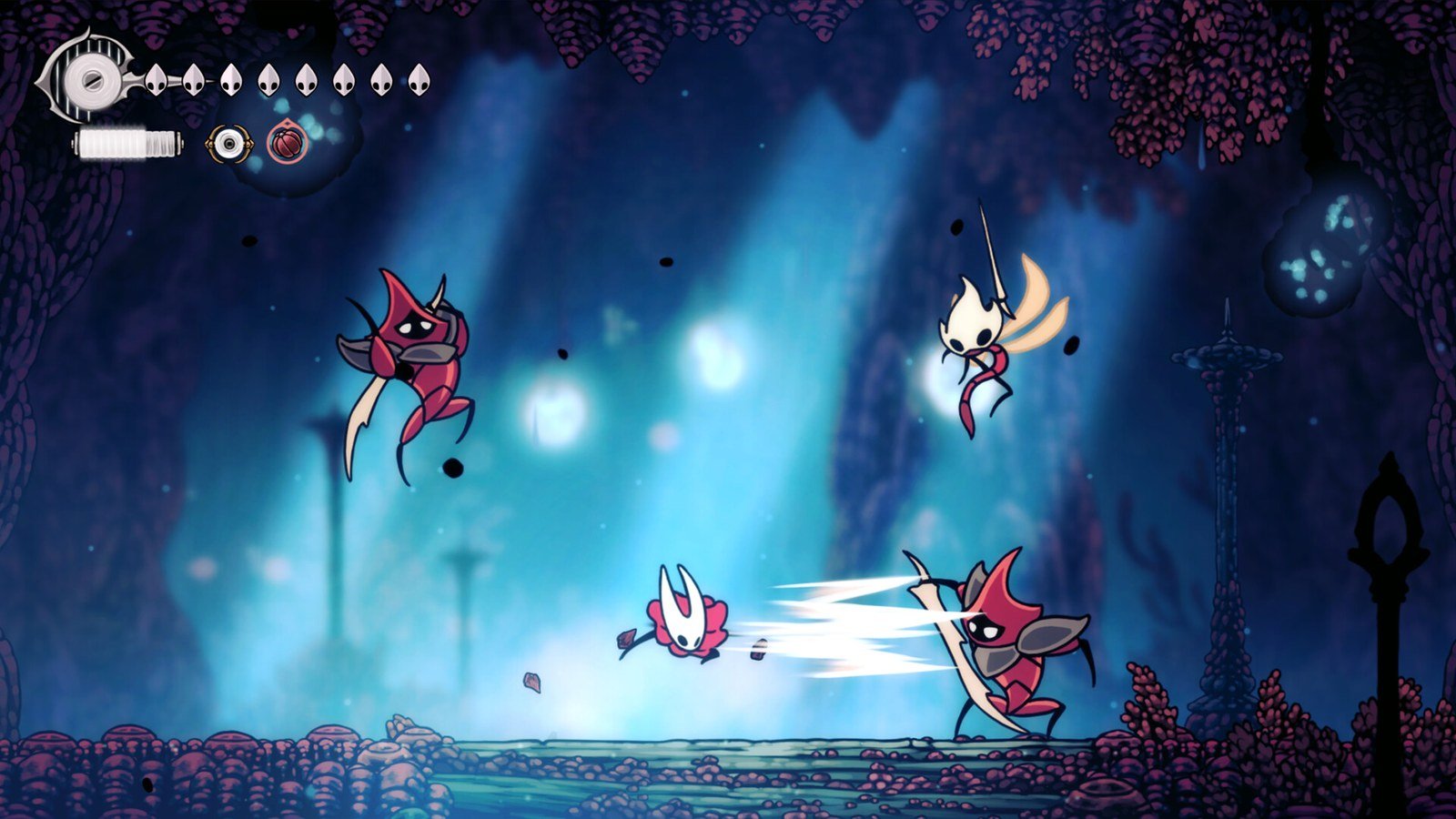
The Knight was a study in restraint: deliberate steps, a straight-down aerial pogo, a slow held heal. Hornet is quicker and more acrobatic in every dimension. She grabs and mantles ledges. Her downward aerial attack is a diagonal dive, which changes the geometry of every bounce: targets are approached on an angle, not from directly above. Swift Step, found in Deep Docks, unifies dash and sprint (tap to dash on ground or in air, hold to run), and she can heal in midair.
This is the sequel’s central design gamble. A returning audience arrives with thousands of hours of Knight-shaped instincts, and Silksong taxes those instincts immediately: enemies commonly deal two masks of damage, currency is scarcer, and boss runbacks run longer than the first game’s. Reviewers broadly judged it the harder game, and Team Cherry shipped no difficulty options at all. The difficulty is not a setting. It is a consequence of who Hornet is.
Silk: one spool, two masters
The Knight’s Soul split one resource between healing and spells, and Silk tightens the same screw. Striking enemies fills Hornet’s Silk spool. Bind spends a full spool to heal three masks at once, fast and usable midair, a completely different rhythm from the Knight’s one-mask-at-a-time Focus, which left him standing exposed. The same spool also powers Silk Skills, the special attacks recovered from Weaver remnants across Pharloom.
Because Bind is fast, the temptation is to heal constantly; because Silk Skills are powerful, the temptation is to spend. The spool arbitrates. And the death system feeds back into the same meter: on death, Hornet’s loose Rosaries are left in a silk cocoon where she fell, and breaking that cocoon on the retrieval run refills her Silk, so even the walk back is wired into the economy.
Crests rewrite the character
Charms are gone. In their place, seven Crests (Hunter, Reaper, Wanderer, Beast, Witch, Architect, Shaman) act as full character specifications. A Crest changes Hornet’s needle moveset, her attack speed and range, the geometry of her dive, how her Bind behaves, and how many color-coded Tool slots she carries. The Reaper’s heavy arcs harvest extra Silk. The Beast’s Bind becomes a life-stealing fury. The Architect spins the needle like a drill and can craft tools in the field by spending Silk. The Wanderer Crest restores a short, fast moveset close to the Knight’s, a deliberate nostalgia option buried in the system.
Tools fill the slots the Crest provides: red for offensive tools with limited charges, blue for support, yellow for utility, and white slots for Silk Skills. Red charges are refilled at benches with Shell Shards, which makes tool use a budgeting exercise between checkpoints. In a game with no difficulty settings, the Crest system is the difficulty and feel dial, disguised as loot: one collectible respecs not the build but the character.
Two currencies and a priced bank
Geo is gone too. Rosaries are the main money, paid to merchants, to Shakra for maps, and at toll stations for benches and Bellway fast travel. They are also losable: death drops every loose Rosary into the cocoon, and dying again before reclaiming it burns them permanently. Shell Shards, the second currency, are never dropped; they exist to refill and craft tools.
The elegant piece is the Rosary String. Vendors will string 80 loose Rosaries into an item worth 60 that can never be dropped. Banking your money costs you a quarter of it, every time, by design. Safety is a priced product rather than a menu toggle, so the decision to bank, and when, becomes a real economic judgment that changes with how dangerous the road ahead looks.
The launch that broke the stores
The demand story deserves its own paragraph in gaming history. Silksong had no pre-orders and no preload, so the entire audience hit the storefronts at the same minute on September 4, 2025, and Steam, the Nintendo eShop, the Microsoft Store and the PlayStation Store all buckled or went down under the load. On Steam the game passed 100,000 concurrent players within the first half hour and peaked at 535,213 on launch day (SteamDB), roughly eight times the original game’s peak and, at the time, the 18th-highest peak in Steam history.
By December 2025, Team Cherry put sales at over 7 million copies, with millions more playing through Game Pass. Critics landed at 90 on Metacritic for PC (92 on PlayStation 5, 94 on the original Switch) and 91 on OpenCritic. Team Cherry has since announced a first expansion, Sea of Sorrow, free for owners and planned for 2026, with new areas, bosses and tools.
My take
The analytical thread through Silksong is substitution with intent. Soul becomes Silk, and the heal gets faster but the meter gets hungrier. Charms become Crests, and the build stops being a loadout and becomes a body. Geo becomes two currencies, one of which can be lost and one of which cannot, with a taxed bank sitting between them. Even the map’s vertical axis flips.
Most sequels ask what else the world can contain. Silksong asked what else its hero can be, and rebuilt everything downstream of the answer: movement, healing, economy, difficulty, structure. That is why it belongs near the top of this series. It is the rare sequel that treats its own predecessor as a first draft.
Sources
- Steam store page, Hollow Knight: Silksong (Team Cherry): price, enemy and boss counts, app details
- Wikipedia, Hollow Knight: Silksong: release, development history, gameplay, reception and sales
- Hollow Knight Wiki: Crests, Tools, Rosaries and Rosary Strings, Wishes, Swift Step values
- SteamDB: launch-day concurrent player peak of 535,213
- Nintendo Life and PCGamesN guides: act structure and progression routes
- Team Cherry blog (December 15, 2025): Sea of Sorrow expansion announcement
- Metacritic and OpenCritic: review scores cited in the panel above
The Checkpoint Poll
Leave a Reply