Every RPG trains the same reflex: something jumps out of the dark, so you kill it, take its experience points, and move on richer. Undertale is the game that looked at that reflex and built an entire moral engine out of it, one where the experience points are an accusation, mercy is a combat verb, and the save file itself is a witness. The seventh entry in my indie analysis series is a $9.99 game made almost entirely by one person that temporarily sat on top of Metacritic’s all-time PC chart.
What Undertale is
Undertale is a role-playing game created by American developer Toby Fox, released on September 15, 2015 for Windows and macOS at $9.99, then ported to Linux (2016), PlayStation 4 and Vita (2017), Nintendo Switch (2018) and Xbox One (2021). A child falls from Mount Ebott into the Underground, a sealed kingdom of monsters exiled after a war with humanity, and has to cross it to get home: through the Ruins, Snowdin, Waterfall, Hotland and the Core, to King Asgore, who needs one more human soul, theirs, to break the barrier.
The premise is fairy-tale plain. Everything the game does with it is not.


One man, one Kickstarter
Fox developed Undertale over 32 months, financing it with a 2013 Kickstarter that asked for $5,000 and raised $51,124 from 2,398 backers. He built it in GameMaker Studio and made nearly everything himself: design, writing, code and the full soundtrack. Temmie Chang provided the main character art and sprites, with a few guest designers, and Fox has said he deliberately worked alone to avoid depending on anyone.
His influences are worn openly: the Mother series (he had made EarthBound ROM hacks as a teenager, including the notorious Halloween Hack), Mario & Luigi, the Touhou bullet hell games, Moon: Remix RPG Adventure, and Shin Megami Tensei, whose talk-to-monsters negotiation is the clear ancestor of Undertale’s central system. Fox said he found most traditional RPGs boring to play despite loving them, and set out to make one where story and gameplay were the same thing rather than two abstractions taking turns.
FIGHT, ACT, MERCY
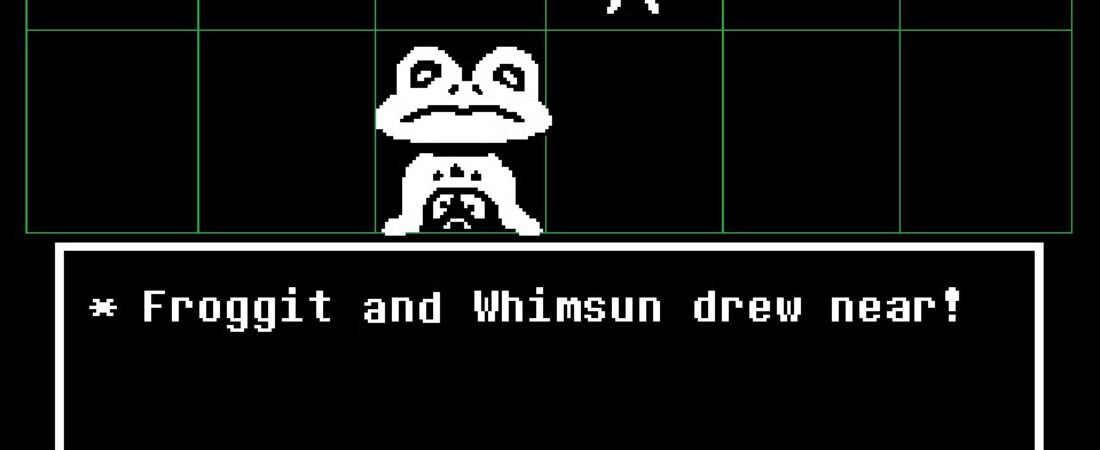
Combat is turn-based on the player’s side and a bullet hell on the enemy’s. You pick FIGHT, ACT, ITEM or MERCY from a menu; then the monster attacks and your soul, a small red heart in a box, has to dodge patterns of bullets, lasers, bones, spears and musical notes. Bosses keep redesigning the box itself: gravity, a moving arena, a soul that can shoot back.
The revolution is in the menu. Every enemy can be spared. ACT opens a list of interactions specific to that monster (check, compliment, flirt, joke, threaten, hug), and using the right ones changes the monster’s state until its name turns yellow and MERCY ends the fight with no kill. Some bosses cannot be fought to a peaceful end at all: the only pacifist solution is to survive their dialogue, enduring attacks until the person underneath the boss fight finishes saying what they needed to say. Negotiation is not a cutscene choice. It is the combat system, played under fire.
Killing still works exactly like an RPG. It pays EXP and gold and raises your LV. For most of a first run, that simply looks like the genre’s normal bookkeeping.
EXP means execution points
It is not. Late in a neutral run, Sans, the game’s laziest skeleton and its quiet judge, explains the acronyms the player has been collecting without reading: EXP stands for execution points, a way of quantifying the pain you inflicted on others, and LV is not level. It is LOVE, Level of Violence. The higher they grow, the easier it becomes to distance yourself, and the easier it becomes to hurt.
That reveal retroactively re-reads every fight in the game, and it powers the route structure. Spare everyone and the game bends toward the True Pacifist ending, which only fully unlocks after a neutral ending and a reload, as if the game wants the lesson learned in the right order. Kill some and the world lands somewhere in between, with a phone call reporting what your choices built. The routes are not morality meters with a good and a bad ending bolted on; they are three different arguments about what the player was doing all along.
The game remembers
Undertale’s boldest system is its memory. The game tracks actions across saves and playthroughs and writes them into the fiction: Flowey, the flower who teaches the tutorial and lies during it, remembers resets and taunts the player with what they did in timelines they abandoned. Characters’ dialogue shifts on repeat runs based on earlier behavior. Mercy and murder are both persistent.
The Genocide route is where the memory becomes a threat. It requires deliberately grinding each area’s random encounters to zero, emptying the Underground room by room while the music slows and the save points report how many are left. Towns evacuate. The Sans fight at the end of it is the game’s hardest, a boss who knows the genre’s rules and cheats against them. Completing it permanently alters the True Pacifist ending on that machine: the price of restoring the world is your soul, and the game does not let later kindness fully launder it. An RPG whose final boss fight is against the player’s own completionism is making a design argument almost nobody else has dared to ship.
No grinding, no fetch quests
Underneath the philosophy sits tight economy. Fox refused grinding as a requirement and refused fetch quests outright, because he dislikes backtracking. A neutral run is roughly six hours; encounters are mostly scripted, puzzles are short, and the difficulty of the bullet hell defense was tuned with playtesters who had never touched a shooter, so the game stays readable for people who came for the story. The challenge budget is spent where it matters: bosses, and the optional weight of choosing not to fight them.
Reception
Critics gave Undertale 92 on Metacritic for PC (93 on Switch), and 93 on OpenCritic. For a stretch after launch it was the highest-rated PC game of all time on Metacritic, and it remains in the site’s all-time top 50. It has sold at least five million copies. Fox followed it with Deltarune, a parallel story released episodically for free since 2018, which reuses the cast’s shapes to tell a different tale and has kept the Underground’s audience growing for a decade.
My take
The analytical point about Undertale is that it weaponizes fluency. It assumes the player arrives pre-trained by thirty years of RPGs, then quietly redefines the vocabulary (EXP, LV, MERCY, save, reset) until the player’s own habits become the subject of the game. The bullet hell is the attention tax that keeps every social interaction physical; the memory is the conscience that keeps every choice permanent.
A lot of games ask whether you will be good or evil. Undertale asks a ruder question: did you ever stop to check what the buttons meant? That is why a tiny pixel game from a $5,000 Kickstarter is still the reference point for choice design a decade later.
Sources
- Steam store page and Steam API, Undertale (Toby Fox): price, app details
- Wikipedia, Undertale: development, Kickstarter, gameplay systems, routes, reception and sales
- OpenCritic: Undertale average score of 93 across 76 reviews
- Metacritic: per-platform scores cited in the panel and text
The Checkpoint Poll
Leave a Reply